
Views: 0 Author: Site Editor Publish Time: 2026-09-30 Origin: Site


Global freight dynamics are shifting rapidly. Fleet managers face a daily operational tightrope where fuel costs fluctuate wildly, and state weigh stations enforce brutally strict axle regulations. Striking the perfect balance between maximizing payload capacity and maintaining rigorous highway compliance is the ultimate challenge of modern logistics.
Recent market analyses reveal a critical bottleneck forming at major global hubs. As maritime shipping lines roll out ultra-large mega-vessels exceeding 24,000 TEUs, inland transport networks are buckling under sudden, massive cargo surges. Port authorities are demanding faster turnaround times, pushing the industry away from outdated equipment. To prevent terminal gridlock and reduce emissions per ton-mile, progressive fleets are aggressively adopting multi-axle, high-capacity transport solutions. Upgrading your rolling stock is no longer just a fleet enhancement; it is a baseline requirement for operational survival.
A reliable container trailer serves as the structural backbone of intermodal freight. It is not just a steel frame on wheels; it is a highly engineered asset designed to absorb the massive dynamic loads of crane drops while keeping tare weight low for highway transit. By utilizing standardized ISO corner castings and heavy-duty twist locks, these vehicles eliminate archaic piece-by-piece cargo handling. Massive steel boxes transfer seamlessly from ship to shore, and ultimately to the highway, forming the foundation of supply chain velocity.
The massive influx of cargo from modern mega-vessels places immense pressure on port infrastructure. Automated seaports demand highly reliable ground transport to keep terminal yards fluid. The continuous flow of goods relies entirely on chassis that can withstand the high-cycle, abusive demands of rapid gantry crane loading. Without durable ground equipment, multi-million dollar port modernization efforts simply fail to translate into actual delivery speed.
Standard tandem-axle trailers frequently fall short for logistics companies handling high-volume contracts. There is a brutal economic imperative to move heavier loads in fewer dispatches. This strategy directly combats persistent driver shortages and volatile diesel prices. High-capacity solutions allow operators to maximize payload per trip, minimizing the environmental impact per ton of freight while drastically lowering the total cost of ownership over the equipment's lifespan.
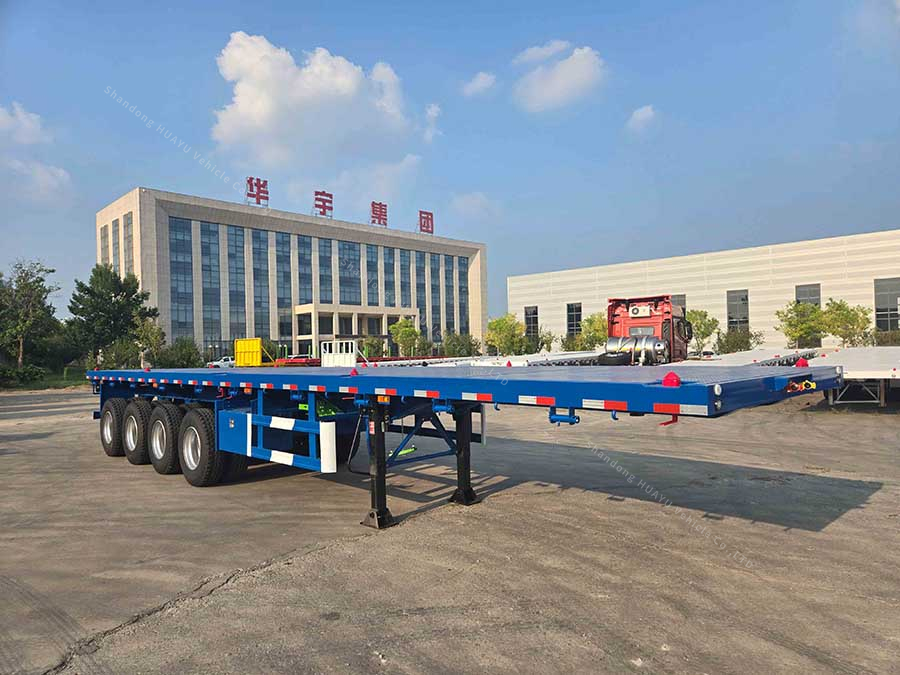
Skeletal chassis designs remain the undisputed industry standard for transporting standard 20ft, 40ft, and 45ft boxes over long distances. The defining feature is a bare-bones frame that completely omits a solid deck. This minimalist engineering drastically reduces the tare weight of the vehicle. For instance, a well-spec'd container chassis semi trailer featuring a 3-axle 40FT configuration offers unmatched agility. It translates directly into superior fuel efficiency and a higher legal payload capacity on public highways, making it the most cost-effective decision for interstate routes.
While skeletal models are highly specialized, flatbeds offer unparalleled versatility. A reinforced heavy duty container flatbed trailer features a solid steel floorboard. This unit carries standard shipping boxes via integrated twist locks but easily accommodates bulk cargo, steel coils, lumber, or industrial machinery. Dispatchers can secure lucrative backhaul loads that do not involve shipping containers, effectively eliminating unprofitable empty miles. The natural trade-off is a heavier tare weight, which necessitates a robust heavy-duty suspension system.
Specialized multi-axle trailers step into the spotlight for extreme payload scenarios. A 4-axle 80-ton trailer is explicitly designed for heavy industrial transport and specialized port operations. The strategic addition of a fourth axle serves a vital engineering purpose: optimal weight distribution. By spreading an 80-ton concentrated load across more contact points on the tarmac, these titans protect delicate road infrastructure from severe damage. They dominate regions with specific heavy-haul permits or private mining yards where standard highway restrictions are lifted.
| Trailer Type | Primary Application | Tare Weight Profile | Key Operational Advantage |
|---|---|---|---|
| 3-Axle Skeletal Chassis | Long-haul highway transit | Ultra-lightweight | Maximizes legal payload, superior fuel economy |
| Heavy Duty Flatbed | Mixed freight, backhauling | Medium to Heavy | Eliminates empty miles via multi-purpose hauling |
| 4-Axle 80-Ton Titan | Port zones, mining, heavy industrial | Heavy | Extreme weight distribution for massive payloads |
Time is the ultimate currency in a bustling seaport. Terminal tractors and their accompanying chassis must operate in perfect synchronization with towering gantry cranes. The efficiency of this high-stakes environment relies heavily on quick-locking mechanisms. Premium twist locks allow a crane operator to drop a 30-ton box onto the chassis, letting yard workers secure it with a satisfying metallic clunk in mere seconds. This rapid turnaround prevents crippling truck queues and keeps rigid shipping schedules intact.
Port-side equipment operates in aggressively corrosive environments. Constant exposure to saltwater, high humidity, and industrial chemicals rapidly degrades standard commercial steel. Structural durability is non-negotiable here. Top-tier manufacturers utilize high-yield strength steel treated with advanced marine-grade zinc-rich primers and polyurethane topcoats. These protective layers actively repel rust, significantly extending the lifecycle of the frame and drastically reducing maintenance overhead.
Transitioning a loaded container from a private port to a public highway introduces a labyrinth of regulatory challenges. Departments of transportation strictly enforce gross vehicle weight ratings and per-axle weight limits. A masterfully engineered chassis distributes the payload seamlessly across all axles. Fleet managers must intimately understand local bridge laws, which dictate the maximum allowable weight based on precise axle spacing. Selecting the correct 3-axle or 4-axle configuration is the only guaranteed way to avoid heavy fines at state weigh stations.
Aerodynamic drag becomes a primary adversary to fuel economy at cruising speeds. Skeletal chassis designs inherently slice through wind resistance far better than solid flatbeds. Air flows freely through the steel ribs when the trailer runs empty. Shipping containers naturally possess a high center of gravity, making high-speed stability a critical safety concern. Modern units are outfitted with Electronic Braking Systems to prevent catastrophic wheel lockup. Air ride suspensions dynamically adjust to the load's weight, swallowing road shock and reducing dangerous trailer sway.
The main beam acts as the unbreakable spine of any heavy-duty trailer. Industry-leading manufacturers forge these beams from high-tensile steel, typically graded as Q345 or Q460. These materials provide exceptional yield strength, allowing the frame to shoulder massive burdens without permanent deformation. Submerged arc welding is meticulously employed to create deep, flawless welds that fuse the web and flange of the I-beam, guaranteeing maximum structural integrity under immense torsional stress.
The suspension system dictates how the trailer performs across varying terrains. Procurement managers frequently spec industry-leading axle brands for their battle-tested reliability. Mechanical leaf spring suspensions offer rugged durability and low maintenance costs for rough terrain. Air ride suspensions, while slightly more complex to maintain, provide unparalleled cargo protection and high-speed stability for fragile goods on long highway hauls.
Public safety relies entirely on the integrity of the securing mechanisms. Trailers are typically equipped with 4, 8, or 12 heavy-duty twist locks. A 40ft configuration featuring 12 twist locks offers maximum operational flexibility. It can lock down a single 40ft container, a 45ft box, or two separate 20ft containers simultaneously. Forged from hardened steel, the rotating head engages directly into the container's corner castings, firmly preventing any lateral shift during transit.
Procuring a new fleet of trailers is a capital-intensive endeavor. Buyers must look far beyond the initial sticker price and evaluate the equipment based on operational alignment, manufacturing integrity, and long-term financial impact.
The procurement journey begins with a ruthless audit of your typical payload profiles. The specifications of your new container trailer must directly mirror its working environment. If your dispatch handles standard boxes over long interstate distances, minimizing tare weight is paramount. A lighter chassis allows for a higher legal payload capacity, optimizing fuel burn.
If your contracts involve moving overweight boxes within a localized port zone, structural rigidity easily trumps weight savings. You must determine whether your daily operations require the nimble agility of a standard chassis or the unyielding structure of a heavy-duty model. Regional bridge laws will ultimately dictate whether a 3-axle or 4-axle setup is legally permissible.
Total Cost of Ownership is a far more accurate measure of a trailer's true value than its upfront acquisition cost. This metric encompasses routine maintenance expenses, tire wear rates, fuel efficiency, and projected residual resale value. A bargain trailer fabricated with inferior steel will inevitably bleed profits through accelerated tire wear from poor axle alignment and excessive downtime due to structural fatigue. Investing in premium equipment yields significantly higher operational uptime.
Even the most robustly engineered transport equipment requires a disciplined maintenance program. An unexpected equipment failure on the highway results in exorbitant roadside repair bills and cascading supply chain delays.
The mechanisms securing the cargo endure immense mechanical stress during violent lifting phases by port cranes. Internal components of twist locks become stiff due to grit, rust, or metal fatigue. Technicians must regularly clean out debris and apply heavy-duty grease to ensure smooth engagement. Structural inspections are equally vital. Maintenance teams must routinely examine main beams and suspension hangers for microscopic hairline fractures originating near weld zones. Catching a micro-fracture early prevents a catastrophic structural collapse.
Advanced telematics are fundamentally transforming fleet maintenance. High-capacity trailers feature sophisticated sensor networks that monitor equipment health in real-time. GPS tracking provides accurate mileage data, empowering managers to transition from reactive repairs to predictive maintenance. Load sensors integrated into air suspension systems transmit real-time weight distribution data directly to the dispatcher's dashboard, ensuring the trailer is never overloaded.
Selecting the ideal hauling equipment hinges entirely on the unique demands of your daily operations. For those dominating long-haul highway routes, the lightweight efficiency of a skeletal chassis is unmatched. Demanding port operations and mixed-freight contracts heavily favor the rugged versatility of a heavy-duty flatbed. These high-capacity assets are strategic investments that drive supply chain velocity, ensure strict regulatory compliance, and fiercely protect your profit margins. Evaluate your fleet requirements carefully, prioritize manufacturing quality, and invest in equipment engineered for relentless reliability.
Ready to upgrade your fleet's capacity and compliance? Evaluate your specific route requirements and explore high-performance transport solutions directly at Huayu Vehicle to find the exact trailer configuration that matches your operational demands.
A container chassis features a bare-bones, open-frame design engineered specifically to lock in and transport standard ISO shipping containers. Lacking a solid floor makes it significantly lighter, translating to better fuel efficiency and higher legal highway payloads. A heavy duty container flatbed trailer features a solid steel or wood deck. While equipped with twist locks for containers, the flat deck allows it to transport bulk cargo, steel coils, or oversized machinery. This offers superior versatility but comes with a heavier tare weight.
A specialized 4-axle container trailer is engineered for extreme payload applications, typically handling capacities ranging from 60 to 80 tons depending on the steel grade used. The fourth axle distributes the massive cargo weight over a larger surface area. While structurally capable of carrying 80 tons, operators must strictly adhere to local highway weight regulations and bridge laws, which often restrict legal carrying capacity on public roads.
Twist locks are standardized, rotating mechanical connectors welded onto the corners of a trailer's frame. They interface directly with the corner castings of a standard shipping container. Once the container is lowered, the operator manually rotates the handle, locking the massive metal box securely to the chassis. They are the primary safety mechanism preventing the container from tipping or sliding during high-speed cornering and sudden braking.
Compliance requires understanding equipment standards and regional weight distribution laws. You must select a trailer with the correct axle configuration that aligns with your intended payload weight to satisfy local bridge formulas. Overloading a specific axle triggers severe regulatory fines. The equipment must also feature certified ABS or EBS for heavy braking control, compliant LED lighting, functional rear impact guards, and highly visible retroreflective tape.
Yes, this is a standard capability designed to maximize operational flexibility. Most 40FT container trailers are manufactured with 8 to 12 individual twist locks. This configuration allows the trailer to securely carry a single 40-foot container positioned across the entire length, or safely transport two standard 20-foot containers simultaneously using the middle and end twist locks. Some specialized designs even allow a single 20-foot container to be mounted in the center for optimal weight distribution.
With a rigorous preventative maintenance program, a premium heavy-duty flatbed constructed from Q345 or Q460 high-yield steel can easily remain operational for 10 to 15 years. Lifespan is heavily influenced by the operating environment; trailers dedicated to highly corrosive port zones require diligent anti-rust treatments and frequent inspections of weld zones to achieve maximum longevity.
Adding a third or fourth axle increases rolling resistance, which naturally leads to a slight increase in fuel consumption and tire wear compared to a standard tandem setup. However, from a cost-per-ton perspective, multi-axle configurations are highly profitable. They allow fleets to haul significantly heavier payloads legally in a single trip, drastically reducing the number of total dispatches required to fulfill high-volume contracts.


