
Views: 0 Author: Site Editor Publish Time: 2026-11-15 Origin: Site


Transporting liquid freight presents a unique physical challenge on the road. A partially empty tank is significantly more dangerous and prone to rollover than a fully loaded one, despite the lower gross vehicle weight. This counterintuitive reality stems from the dynamic movement of the fluid itself. Fleet operators and safety directors face severe financial, legal, and operational risks from these rollovers. Multi-stop delivery routes inherently create partially filled tanks. This exposes fleets to unpredictable dynamic forces, cargo loss, and catastrophic equipment damage. Understanding the physics of liquid slosh and center-of-gravity shifts is a prerequisite for evaluating equipment. Fluid dynamics change how a vehicle responds to steering, braking, and acceleration. This guide breaks down the mechanics of roll stability and how to specify the right engineering controls when procuring your next semi tanker trailer.
The core mechanism driving liquid instability is known as the free surface effect. This occurs when a liquid moves freely across the width of a partially filled vessel. Unlike solid freight, which remains stationary on a pallet and maintains a fixed center of gravity, liquid conforms to the shape of its container. It reacts instantly to external forces. When a tank is only partially full, the liquid has physical room to travel. This creates a moving mass that actively fights against the vehicle's intended direction of travel.
Maritime engineering relies heavily on understanding this exact concept. Ship stability and heeling are directly impacted by unrestricted liquid shifting sideways in the hull. This movement decreases overall stability and moves the center of gravity off-center. The same physics apply directly to highway transport. When a truck enters a curve, centrifugal force pushes the liquid up the outer wall of the tank. The fluid seeks the path of least resistance, climbing the curved interior surface and shifting thousands of pounds of weight in a fraction of a second.
This creates a severe dynamic center of gravity shift. The load's center of gravity in a liquid tank moves outward and upward during a turn. As the liquid climbs the outer wall, it pulls the vehicle's weight distribution away from the centerline. This drastically reduces the vehicle's rollover threshold. The mechanical reaction is immediate. The tires on the inside of the turn lose their contact patch and traction. Simultaneously, the suspension airbags on the outside compress heavily under the shifting weight. The fifth wheel twists, transferring that rolling moment directly into the tractor frame.
Fleet managers must differentiate between front-to-back movement and side-to-side movement. Forward and backward movement is called surge. This happens during acceleration and hard braking. Side-to-side movement is called slosh. This occurs during cornering, highway off-ramps, and lane changes. Both present severe operational hazards, but lateral slosh is the primary catalyst for catastrophic rollovers.
Lateral slosh creates a violent pendulum effect inside the shell. The liquid swings outward, generating a rolling moment that the trailer's suspension, axles, and tires must counteract. If the rolling moment exceeds the suspension's mechanical capacity to keep the tires planted on the asphalt, the trailer will flip. The force of the liquid hitting the side wall acts as a massive lever, pushing the top of the tank outward and pulling the bottom inward.
Rapid steering inputs amplify this danger significantly. Sudden lane changes or evasive maneuvers cause the liquid to violently roll up the side of the tank. This compounds the lateral force far beyond that of a steady, sweeping turn. The sequence of a slosh-induced rollover usually follows a specific pattern:
The critical danger zone exists when tanks are filled between 20% and 80% capacity. Below 20%, the mass of the liquid is generally too low to overcome the empty tare weight of the trailer. Above 80%, the liquid does not have enough physical empty space to build momentum before hitting the tank wall. Tanks operating in that middle range experience the most violent and unpredictable dynamic forces.
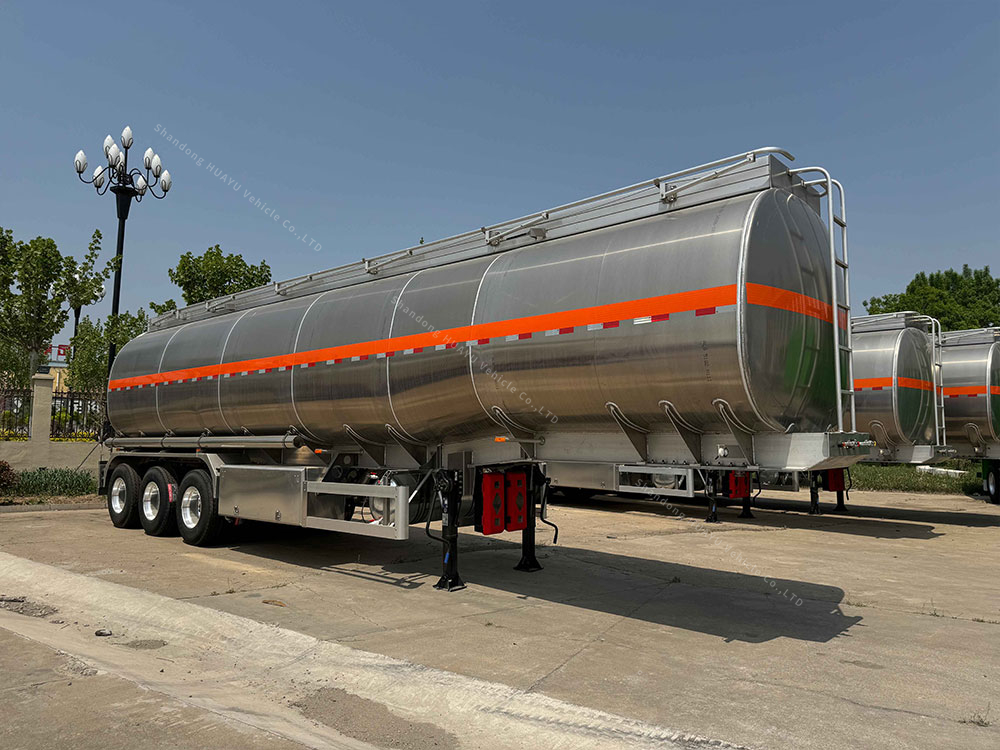
The physical shape of the tank shell dictates exactly how liquid behaves during transit. Cylindrical tanks feature a perfectly round cross-section. They are structurally superior for handling high internal pressure, which is why they are standard for transporting compressed gases. However, they possess a high resting center of gravity and a uniform radius. This uniform curve allows liquid to easily ride up the side walls during turns. Cylindrical designs are inherently less stable when partially filled because the fluid encounters no geometric resistance as it shifts laterally.
Elliptical tanks provide a vastly different dynamic profile. These tanks feature a wider, flatter bottom. This shape lowers the resting center of gravity by several inches compared to a cylinder of the same volume. The flattened profile restricts the vertical movement of liquid during lateral slosh. Because the side walls are steeper relative to the bottom, the fluid cannot climb as easily. This physical disruption of fluid momentum improves overall roll stability and keeps the weight closer to the axles.
Engineers evaluate these designs using a static roll plane model. This mathematical approach calculates the exact tipping point of a specific tank geometry based on track width and center of gravity height. The ratio of the long axis (width) to the short axis (height) in an elliptical tank is mathematically optimized. A wider track and a lower profile minimize sloshing force and rolling moment during steady turning. The flatter the ellipse, the more stable the platform becomes during partial-load operations.
Liquid density plays a massive role in dynamic stability and equipment selection. Transporting heavy industrial chemicals requires entirely different engineering than hauling light hydrocarbons. Water weighs roughly 8.34 pounds per gallon. Gasoline weighs about 6 pounds per gallon. Sulfuric acid can weigh over 15 pounds per gallon. The heavier the liquid, the more kinetic energy it generates when shifting inside the shell.
Heavier liquids amplify the rolling moment exponentially. A partial load of high-density fluid creates a massive lateral force during a turn, even at low speeds. Procuring an industrial tanker trailer requires highly optimized tank geometries. You need lower overall tank heights to maintain safe operation during partial-load transit. A tall cylindrical tank carrying high-density chemicals at 50% capacity is a severe rollover liability. The suspension simply cannot counteract the leverage generated by heavy fluids shifting high up in the tank shell.
Internal structures are critical for managing fluid dynamics, but their functions are frequently misunderstood. Baffles are internal bulkheads with precisely engineered holes or cutouts. These openings allow liquid to flow through slowly, rather than rushing all at once. They act as mechanical speed bumps for the fluid mass, breaking up the energy of the wave.
There is a common industry misconception regarding these structures. Many operators assume baffles prevent rollovers. They do not. Baffles are designed primarily to control longitudinal surge during acceleration and braking. They offer virtually no resistance to lateral slosh. The liquid still moves freely from side to side across the entire width of the tank.
A diesel tank trailer used for multi-stop deliveries relies heavily on baffles for stopping power. When approaching a red light, 40,000 pounds of liquid surging forward can physically push the truck into the intersection, even with the tractor and trailer brakes fully locked. Baffles break up this forward momentum. They keep the truck controllable during hard stopping, even if they provide zero protection against rollovers in highway curves.
Bulkheads offer a completely different mechanical solution. Bulkheads are solid, impenetrable dividers that split the trailer into completely separate, sealed compartments. They do not allow fluid to pass through under any circumstances. This fundamentally changes how the load behaves on the road.
Dividing a load into smaller, fully loaded compartments eliminates the free surface effect in those specific sections. If you have a four-compartment trailer, and three compartments are 100% full while one is completely empty, the trailer handles like it is carrying solid freight. There is no physical room for the liquid to move. This is the most effective mechanical strategy for preventing lateral slosh in multi-drop operations.
However, compartmentalization introduces several operational trade-offs that fleets must manage:
| Internal Structure | Primary Function | Surge Mitigation (Front-to-Back) | Slosh Mitigation (Side-to-Side) | Operational Impact |
|---|---|---|---|---|
| Baffles | Slows fluid movement via pass-through holes | High | Low | Easier to clean, lighter tare weight |
| Single Bulkheads | Creates isolated, sealed compartments | High (if compartments are full) | High (if compartments are full) | Heavier, complex plumbing, harder to clean |
| Double Bulkheads | Prevents cross-contamination between compartments | High | High | Maximum weight penalty, highest maintenance |
| Smooth Bore | No internal structures | None | None | Maximum payload, easiest to sanitize |
Evaluating trailer specifications requires a strict alignment with operational realities. Long-haul bulk transport differs wildly from local multi-drop routes. A truck driving straight across flat interstate highways faces different physics than a truck navigating urban delivery routes with constant stop-and-go traffic. You must define your capacity utilization. If your trucks always run 100% full out and 100% empty back, slosh is less of a concern, and you can prioritize payload over compartmentalization.
Route topography dictates the necessity for advanced roll-stability systems and specific tank profiles. Mountainous curves, steep highway off-ramps, and tight urban intersections constantly agitate the fluid load. Operations in these environments demand elliptical tanks and multiple compartments to keep the fluid in check. Flatland operations might prioritize payload capacity and opt for fewer bulkheads, relying instead on driver training and electronic stability systems.
When inspecting a gasoline trailer for sale, roll stability must be the primary focus of your mechanical audit. Start by examining the tank profile. Ensure the axis ratio favors a wide, low stance. Verify the integrity and placement of internal bulkheads if the trailer is intended for multi-stop fuel delivery. Look closely at the weld seams where the bulkheads meet the outer shell, as this is a common failure point under heavy slosh loads.
Electronic stability control (ESC) and roll stability support (RSS) systems are non-negotiable for modern fleets. These systems integrate directly into the trailer's ABS network. They monitor lateral acceleration, suspension load, and wheel speed in real-time. If the system detects an impending rollover, it automatically applies specific trailer brakes to pull the vehicle back into a straight line, reacting faster than humanly possible.
Evaluate the suspension systems carefully. Air ride suspensions equipped with rapid-response leveling valves manage lateral weight shifts far better than traditional spring suspensions. The air valves react to the shifting fluid, stiffening the outside air bags to keep the trailer level during a turn. Spring suspensions simply compress under the weight, exacerbating the lean angle and pushing the trailer closer to its tipping point. Wide-base single tires can also provide a slightly wider track width, further improving the roll threshold.
No tank design, baffle configuration, or electronic system can entirely override the laws of physics. If a driver enters a curve too fast with a partial load, the trailer will roll. Engineering controls provide a wider margin of error, but they do not eliminate the risk. Driver behavior remains the ultimate variable in liquid transport safety.
Rapid steering inputs and overcorrection are exceptionally dangerous. Swerving to miss debris can induce a resonant slosh. The fluid wave bounces off one wall and slams into the other, flipping the trailer even at lower speeds. Drivers must understand that the liquid acts as an independent, hostile force during sudden maneuvers. The load is not static; it actively works against the driver's steering inputs.
Training protocols must focus heavily on anticipation and smooth operation. Drivers must execute speed reduction prior to entering curves, not during the curve. Braking in a curve shifts weight forward and outward simultaneously, creating a worst-case scenario for stability. Steering inputs must be smooth and deliberate. Drivers need acute awareness of the "slosh delay." They must anticipate the fraction of a second it takes for the liquid to hit the tank wall after a steering maneuver and avoid compounding that force with further steering corrections.
Degraded internal components pose massive safety risks that are entirely invisible from the outside. Baffles endure thousands of pounds of force during every single braking event. Over time, the welds can fatigue, crack, and fail. Broken or detached baffles create unpredictable liquid behavior. A loose baffle essentially becomes a metal battering ram inside the tank shell, capable of puncturing the exterior wall from the inside out.
Inspection requirements for bulkheads and baffles must be rigorous. You cannot assess internal integrity by kicking the tires. Fleets must schedule regular internal inspections. Confined-space entry is hazardous, so camera-assisted checks are highly effective for ensuring structural integrity. High-definition drop cameras can inspect weld seams without requiring full confined-space entry protocols. Any signs of spider cracking around the baffle mounting rings or bulkhead joints require immediate out-of-service repairs.
A: A partially filled tank allows liquid to move freely side-to-side, known as the free surface effect. During a turn, this liquid shifts outward, drastically moving the center of gravity and increasing rollover risk. A full tank acts as a solid, stable mass with no room for fluid movement.
A: No. Baffles primarily stop front-to-back liquid surge during braking and acceleration. They feature holes that allow fluid to pass through. They offer very little resistance to the side-to-side slosh that causes rollovers during steady turning or rapid steering inputs.
A: Elliptical or modified-square tanks provide the best roll stability. They feature a lower center of gravity and a wider base. This optimized long-to-short axis ratio minimizes lateral sloshing forces and restricts fluid from climbing the walls compared to standard cylindrical tanks.
A: Surge is the violent forward or backward movement of liquid inside the tank. It occurs during acceleration or braking. Severe forward surge can physically push a truck forward into an intersection even after the driver has fully applied the brakes.
A: Heavier liquids, such as industrial chemicals, generate significantly more kinetic energy and a stronger rolling moment when they slosh. Transporting high-density fluids requires lower tank profiles and specialized geometries to maintain stability during partial-load operations.
A: A smooth bore tank has no internal baffles or bulkheads. It is typically used for food-grade products or highly viscous liquids that require frequent, thorough sanitization. Because they lack internal structures, smooth bore tanks are highly susceptible to violent slosh and surge.
A: RSS monitors wheel speed and lateral acceleration. If the system detects forces that indicate an impending rollover, it automatically applies specific trailer brakes. This reduces vehicle speed and counteracts the rolling momentum much faster than a human driver can react.


