
Views: 0 Author: Site Editor Publish Time: 2026-09-27 Origin: Site


Fleet managers and owner-operators consistently face a brutal mechanical reality. Hauling 40 to 60 tons of bulk cargo without the chassis sagging, bowing, or cracking is no small feat. When a rig hits its absolute maximum capacity, the structural integrity of the equipment reaches its breaking point.
Under these grueling conditions, trailers endure a relentless combination of forces. They face immense downward pressure from the sheer weight of the cargo. Severe torsional twisting from rutted roads and violent lateral shifts during cornering add to the strain. If the chassis lacks adequate rigidity, these forces act as a catalyst for rapid metal fatigue. The inevitable results are catastrophic structural failures, severe highway safety hazards, and crippling operational downtime.
To combat these harsh realities, the modern heavy duty side wall trailer relies on precise engineering. Maintaining a rigid frame under a massive payload requires more than just welding heavy chunks of iron together. It demands a sophisticated blend of high-grade metallurgical materials, calculated weight dispersion, and robotic manufacturing. This guide explores the core engineering principles that keep bulk transport equipment intact, empowering buyers to make data-driven decisions that maximize both safety and long-term profitability.
Key Takeaways for Fleet Engineers
Material Matters: Utilizing high-yield carbon steel, specifically grades like Q345 or T700, is a non-negotiable prerequisite for preventing permanent chassis deformation under extreme weights.
I-Beam Engineering: The structural geometry of the main beam, particularly the 500mm web plate thickness and the quality of submerged arc welding, dictates the primary vertical load-bearing limits.
Torsion Resistance: A tightly woven matrix of cross members effectively stops the frame from twisting on punishing off-road terrain.
Axle Distribution: Upgrading to a multi-axle setup drastically reduces localized stress by spreading the downward force over a broader surface area.
Smart Purchasing: Evaluating a manufacturer's robotic welding consistency and anti-corrosion treatments guarantees a superior return on investment.
In the realm of commercial transport engineering, frame rigidity stands as the ultimate metric of durability. It refers to the inherent ability of the chassis to resist two distinct forms of deformation when fully burdened. The first is deflection, or vertical sagging. The second is torsion, known as longitudinal twisting. A truly rigid frame will hold its geometric shape under immense stress and seamlessly snap back to its baseline state once the cargo is unloaded.
To truly grasp why this matters, picture a rig fully loaded with 60 tons of dense coal or steel coils. A complex matrix of physical forces immediately attacks the chassis. The static load exerts an unyielding downward pull of gravity acting on the dead weight of the cargo. The moment the truck accelerates, this static weight is violently amplified into a dynamic load. Hitting a pothole at highway speeds introduces kinetic shockwaves, creating sudden high-impact stress fractures along the frame.
When navigating a construction site or an unpaved mining route, one set of wheels might drop into a deep rut while the other remains elevated. This applies a brutal torsional stress that tries to wring the longitudinal beams like a wet towel. From a bottom-line perspective, overcoming these forces directly dictates fleet profitability. A stable chassis ensures perfect axle alignment, which drastically reduces uneven tire wear and keeps the asset generating revenue rather than sitting in a repair shop.
Standard commercial mild steel falls completely short for high-capacity bulk transport. When standard metal is subjected to the crushing force of 60 tons, it easily exceeds its elastic limit. The result is plastic deformation, leaving a permanent unfixable sag in the middle of the trailer bed. Overcoming this requires specialized metallurgy.
Premium manufacturers construct the modern reinforced bulk cargo trailer using high-strength low-alloy steels. The industry standards for these heavy-duty applications are Q345 and T700 grades. The primary differentiator here is yield strength, which measures the absolute maximum stress a material can absorb before it permanently bends.
To illustrate the engineering difference, consider the following material comparison:
Steel Grade | Yield Strength | Primary Application | Impact on Tare Weight |
|---|---|---|---|
Standard Mild Steel | 235 MPa | Light-duty urban transport | Extremely heavy to achieve basic strength |
Q345 Steel | 345 MPa | Standard 40-ton highway hauling | Moderate weight reduction |
T700 High-Tensile | 700 MPa | 60 to 80-ton heavy-duty off-road | Significant reduction in empty weight |
Beyond pure strength, T700 steel fundamentally alters the weight-to-strength ratio. Engineers can design a frame that is physically thinner and lighter, yet exponentially stronger than a bulky frame made of cheap steel. Shedding this excess empty tare weight translates directly into higher legal payload capacities for the operator. Intelligent design pinpoints high-stress concentration zones near the kingpin and suspension mounts, reinforcing them heavily to prevent catastrophic shearing.
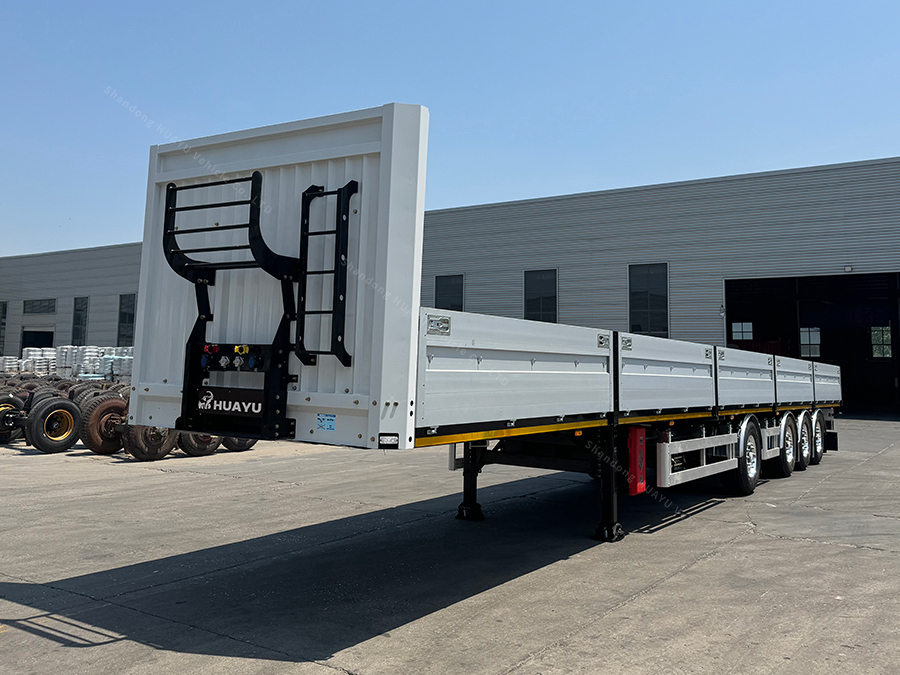
The undisputed backbone of any bulk transport unit consists of two massive longitudinal beams running from the tractor connection to the rear bumper. These are fabricated in an I-shape geometry. In mechanical engineering, the I-beam is mathematically proven to be the most efficient structure for bearing crushing vertical loads while actively minimizing material weight.
An I-beam is forged from three distinct steel plates. The horizontal top and bottom plates are known as flanges. When a trailer is maxed out with cargo, the bottom flange experiences extreme stretching tension, while the top flange endures severe crushing compression. Connecting them is the vertical web plate. For loads exceeding 60 tons, it is standard engineering practice to utilize web plates towering at 500mm in height to completely eliminate mid-chassis sag.
The structural integrity of this beam relies entirely on how these plates are fused. Top-tier manufacturers employ Submerged Arc Welding. This highly automated process creates a deep, flawless, and continuous weld entirely under a protective blanket of granular flux. By shielding the molten metal from atmospheric oxygen, this technique eliminates porous weak spots and microscopic air pockets.
While the towering longitudinal beams masterfully handle vertical gravity, they remain highly vulnerable to lateral twisting if left unsupported. To counter this torsional stress, the main beams are bound together laterally by a dense array of horizontal cross members. Typically fabricated from heavy-duty channel steel, this forms a rigid ladder-like grid directly beneath the cargo floor.
The spacing between these cross members is a critical metric for frame rigidity. Tighter spacing, such as placing a support every 400mm instead of every 600mm, provides a solid foundation. This prevents the steel cargo floor from caving in under concentrated point loads. More importantly, this dense grid locks the beams in perfect parallel alignment, stopping them from bowing outward during sharp turns.
Specifically, the side panels serve a purpose far beyond merely acting as a fence for loose cargo. When properly integrated, they function as a vertical structural truss system. The heavy vertical pillars of the side walls are deeply anchored and welded into the outer side beams of the chassis grid. Once locked into place, they create a highly rigid box-like structure that violently resists twisting forces.
Achieving total frame rigidity is equally about mastering the physics of weight distribution. The core principle is simple: pressure equals force divided by area. By adding more axles to the ground, the total pounds-per-square-inch of pressure exerted on any single point of the trailer frame plummets.
For fleet managers handling extreme weights, upgrading to a multi axle side wall semi trailer becomes an operational necessity. While a standard 3-axle setup is perfectly adequate for 40-ton runs, pushing payloads to 60 or 80 tons requires a 4-axle or 5-axle configuration. This expanded footprint spreads the downward force evenly across a massive surface area.
Strategic axle placement also cures the dreaded tail sag. By positioning the rear axles optimally, the overhang at the back of the trailer is fully supported. Acting as the critical intermediary between the steel frame and the harsh road is the suspension system. Robust mechanical multi-leaf springs, often utilizing 13mm to 16mm thick steel leaves, are engineered to absorb violent kinetic shocks before they travel up into the rigid chassis.
The journey from a blueprint to an indestructible trailer relies heavily on cutting-edge manufacturing technology. Before a single sheet of steel is plasma-cut, engineers deploy Computer-Aided Design and Finite Element Analysis. These digital simulators subject virtual trailer models to extreme 60-ton loads, allowing engineers to mathematically identify and reinforce microscopic weak points.
Once on the factory floor, the shift to robotic welding revolutionizes frame rigidity. Robotic arms guarantee absolute consistency. They deliver uniform heat penetration at the exact required speed, eliminating human error and preventing micro-cracks in critical junctions like the suspension hangers.
Finally, the ultimate enemy of steel is oxidation. Rust silently eats away at web plate thickness, devastating load-bearing capacity. Premium chassis undergo rigorous shot-blasting where high-velocity metallic abrasives strip away impurities. Immediately following this purification, the steel is sealed via electrophoretic painting or high-grade polyurethane, creating an impermeable barrier against road salt.
Looking at current trends across the global logistics sector, the engineering of frame rigidity is increasingly intersecting with strict highway weight regulations. Fleet operators are caught in a tug-of-war. They must maximize their legal payload per trip to remain profitable, but they cannot sacrifice the structural integrity needed for safe transport.
Consequently, the industry is rapidly shifting away from the old-school method of simply adding thicker steel. The modern trend heavily favors smart lightweighting. Buyers are demanding advanced metallurgical solutions combined with aerospace-inspired topological optimization. Manufacturers are responding by using AI-driven stress simulations to hollow out non-load-bearing sections of the frame while aggressively reinforcing the high-stress nodes. This evolution ensures that today's trailers can legally carry more revenue-generating cargo while still surviving the brutal torsional stresses of unpaved environments.
Even the most advanced heavy-duty equipment requires disciplined operational habits to prevent premature metal fatigue. The way a trailer is handled on the job site dictates its ultimate lifespan.
Proper loading technique is paramount. Dropping 50 tons of dense aggregate directly into the dead center of the cargo bed creates a massive point-load, forcing the beams to endure unnatural stress. Operators must distribute bulk material evenly across the entire length of the floor, perfectly balancing the pressure between the tractor connection and the rear axle group.
Preventative visual inspections serve as a fleet manager's best defense. Before major hauls, mechanics should actively hunt for hairline fractures along the welds, check for warped cross members, and ensure that side wall hinges remain tightly secured. Furthermore, strict suspension maintenance ensures that road shocks do not bypass the dampeners and violently assault the rigid frame.
Procuring the ideal trailer requires aligning mechanical specifications directly with your daily cargo realities. If your routes involve hauling incredibly dense materials like steel coils or wet sand, prioritize a chassis built entirely of T700 steel. Look for a towering 500mm web plate and tightly grouped 400mm cross members. Conversely, if you haul lighter agricultural goods, a slightly lighter chassis will offer better fuel economy.
When negotiating with manufacturers, demand hard empirical data. Ask specific questions regarding the exact grade of steel forming the main longitudinal beams. Verify the millimeter thickness of the web plate. Ensure the critical stress points are welded by automated robotics rather than by hand.
Purchasing decisions must be driven by Total Cost of Ownership rather than the lowest upfront price tag. Investing capital into a heavily reinforced, properly engineered trailer yields a massive return. A truly rigid frame eliminates chronic welding repairs and ensures the asset remains in active, profitable service for decades.
Maintaining frame rigidity under a crushing full load operates as a complex symphony of mechanical engineering. It demands the unyielding strength of high-grade steel, the mathematical perfection of I-beam geometry, and the torsional resistance provided by a tightly woven cross-member grid. When paired with a multi-axle configuration to disperse weight and advanced robotic manufacturing to ensure flawless welds, the modern bulk transport trailer becomes an unstoppable asset.
A dependable chassis is the literal backbone of a profitable logistics operation. If you are ready to upgrade your fleet with equipment engineered to conquer the harshest loads without bending or breaking, explore the robust lineup at Huayu Vehicle. Contact our sales engineering team today to spec a trailer tailored precisely to your heaviest hauling needs.
While exact limits vary based on material and structural design, a standard 3-axle configuration typically handles 40 to 50 tons safely. However, a reinforced 4-axle or custom multi-axle trailer engineered with high-yield steel can comfortably and legally transport 60 to 80 tons without compromising the chassis.
Mid-chassis sagging is caused by severe overloading, poor weight distribution, or the use of cheap, low-yield steel. It is entirely prevented by utilizing high-tensile T700 steel, increasing the vertical height and thickness of the main beam's web plate, and enforcing strict, even loading protocols on the job site.
Yes. While locked side panels do provide excellent lateral stability and act as a truss against torsion, a properly engineered heavy-duty trailer relies primarily on its massive longitudinal beams and sub-floor cross members for core rigidity. Removing the drop sides effectively turns the unit into a flatbed without endangering the main chassis strength under standard loads.
Adding more axles increases the physical footprint of the trailer on the road. This means the sheer physical weight of the cargo is distributed over a much larger surface area of the chassis. By drastically reducing the concentrated stress on any single point of the frame, multi-axle setups actively prevent metal fatigue and weld cracking over the long term.
For a 60-ton payload, engineers typically specify a main I-beam with a web plate height of at least 500mm and a thickness of 8mm to 10mm, depending on the steel grade. The top and bottom flange plates are usually thicker, ranging from 14mm to 16mm, to handle the extreme stretching and compression forces.
Off-road driving introduces severe torsional twisting and high-impact kinetic shocks that highway driving does not. If a trailer is not built with tightly spaced cross members and heavy-duty leaf springs, this constant twisting will cause micro-fractures in the welds, significantly shortening the lifespan of the equipment.
A basic visual walk-around, checking for obvious rust streaks or weld cracks, should be conducted by the driver before every major long-haul dispatch. A thorough structural inspection by a certified mechanic should occur every 3 to 6 months, depending on the harshness of the terrain and the frequency of maximum-capacity loads.


