
Views: 0 Author: Site Editor Publish Time: 2026-11-16 Origin: Site


Dimensional accuracy dictates the safety, performance, and operational lifespan of heavy-duty transport equipment. In heavy haul logistics, even a quarter-inch of deck warping severely compromises load distribution and structural integrity. Unmanaged heat input and localized thermal expansion during the fabrication or repair of trailer decks lead to severe distortion. This thermal warping causes premature metal fatigue, persistent misalignment of twist locks, and immediate failures during rigorous safety inspections. Fabricators and fleet mechanics must implement strategic weld sequencing to control thermal dynamics and maintain strict chassis geometry. Techniques such as skip welding, back-stepping, and soft corner management serve as the non-negotiable fabrication standards for preventing distortion. Mastering these heat management strategies ensures the long-term reliability of heavy haul assets under maximum payload conditions. You will learn the exact physics behind thermal shrinkage, the proven sequencing methods that guarantee a perfectly flat deck, and the critical inspection points for evaluating structural welds.
A successful trailer deck demands absolute flatness, precise twist-lock alignment, and zero compromised structural welds. Achieving these strict success criteria requires a deep understanding of thermal dynamics on the shop floor. When an electric arc melts high-tensile steel, it introduces massive, localized thermal energy into the chassis assembly. Fabricators working with high-yield materials like Q345 or Domex steel must respect how these alloys react to sudden temperature spikes.
High-tensile steel expands rapidly when exposed to the extreme heat of a welding arc. The molten weld pool reaches temperatures exceeding 3,000 degrees Fahrenheit, while the surrounding base metal remains at ambient shop temperature. This extreme temperature differential causes rapid, localized thermal expansion. As the welder moves along the joint, the weld pool solidifies and cools, naturally shrinking in volume. This shrinkage exerts massive pulling forces on the surrounding base metal. Because the cooler, rigid base metal resists this contraction, residual stress becomes permanently locked into the steel structure.
When these residual stresses exceed the yield strength of the base metal, the trailer deck physically warps. The resulting distortion manifests in three primary forms: longitudinal bowing (where the beam arches up or down), transverse shrinkage (where the deck pulls inward), and angular distortion (where flanges fold toward the weld). Different structural profiles react uniquely to this intense heat input. Heavy-duty square tubing traps heat internally, making it highly susceptible to twisting if welded continuously. Open-flange I-beams dissipate thermal energy faster but remain highly vulnerable to flange bowing and web buckling when subjected to unbalanced, heavy welding passes.
A warped trailer deck creates severe operational and financial consequences for industrial container transport operations. Uneven deck surfaces disrupt proper weight distribution across the axles. This imbalance forces the trailer to dog-track down the highway, leading to rapid, irregular tire wear and compromised overall axle alignment. Operators will watch their tires scrub off tread in a fraction of their normal lifespan, drastically reducing fuel efficiency and increasing operating costs.
More critically, a distorted chassis prevents operators from safely securing standardized shipping containers. When the deck bows or twists, the chassis twist locks will not align perfectly with the container's corner castings. Operators facing misaligned twist locks often resort to excessive force, using sledgehammers or pry bars to force the connection. This damages the locking mechanisms and compromises the load's security during transit. Purchasing poorly fabricated equipment guarantees increased routine maintenance, frequent suspension repairs, and a severely reduced operational lifespan. The long-term financial impact of operating warped trailers far outweighs the initial savings of buying improperly welded equipment.
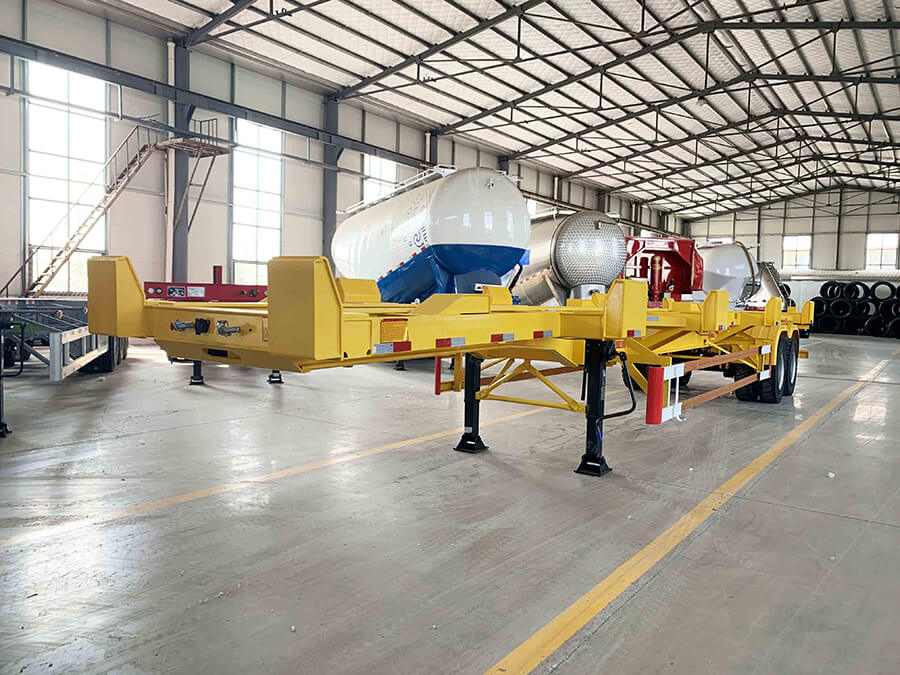
Top-tier fabricators deploy specific, highly controlled welding sequences to manage heat input and maintain dimensional stability across massive steel structures. These techniques prevent the compounding of thermal stress, ensuring the final product rolls off the line perfectly straight.
The skip sequence, also known as wandering, involves placing short, intermittent welds spaced far apart along the joint. Instead of welding in a continuous straight line from one end of a 40-foot beam to the other, the operator lays down a short bead, skips a predetermined distance, and lays another short bead. For example, a welder might lay a 4-inch bead, skip 12 inches, and lay the next 4-inch bead. Once the initial passes cool sufficiently, the welder returns to fill the remaining gaps.
This method completely prevents localized heat buildup. By spreading the thermal input evenly across the entire length of the chassis, the skip technique stops the steel from reaching critical distortion temperatures. The expansion and contraction forces remain isolated in small zones rather than compounding along the entire length of the main beam. This technique requires discipline from the welder but guarantees a flat flange.
The back-step method provides exceptional distortion control for long, continuous joints. This technique requires the operator to weld in short increments, moving in the exact opposite direction of the general joint progression. If the overall joint progresses from left to right, the welder starts at the right end of the first segment and welds back to the left. They then move further right to start the second segment, welding back to tie into the start of the first segment.
The shrinkage of each new segment physically counteracts the pulling force of the previous one. This opposing tension minimizes longitudinal bowing, which is absolutely critical when fabricating the massive main beams of a 40 ft shipping container trailer. Back-stepping breaks a massive thermal vector into smaller, self-canceling stress points, keeping the main structural members perfectly aligned.
Fabricators must alternate welds from side to side to maintain perfect squareness across the entire assembly. Welding the left main beam completely before touching the right main beam guarantees a warped chassis. The shrinkage forces will pull the entire frame out of square, resulting in a trailer that tracks sideways down the road.
Staggered welding requires the operator to weld a specific section on the driver's side, then immediately switch to the exact mirrored section on the passenger's side. Many high-end shops use a buddy system, where two welders work simultaneously on opposite sides of the chassis. This staggered approach balances the transverse shrinkage forces. The tension applied to the left side is immediately countered by equal tension on the right side, locking the chassis into a perfectly square geometry.
Welding continuously around sharp corners creates massive structural vulnerabilities. A continuous wrap-around weld generates concentrated stress risers and triggers severe localized warping. The thermal expansion forces collide at the 90-degree intersection, creating a tri-axial stress state where the metal cannot yield naturally. When the trailer hits a pothole fully loaded, these rigid corners are the first places to crack.
The "soft corner" technique eliminates this dangerous stress concentration. The welder stops the bead just short of the corner, typically leaving a quarter-inch gap. They then start a completely new bead on the adjacent side. This intentional gap allows thermal stress to dissipate naturally without distorting the structural tubing or inducing micro-cracks in the heat-affected zone. It allows the joint to flex slightly under dynamic road loads, drastically extending the life of the cross-members.
Equipment buyers need a reliable framework to assess the technical competence and quality control of potential suppliers. Evaluating a skeleton trailer manufacturer requires looking far beyond the marketing brochures and examining their actual shop floor fabrication protocols.
Robust jigs, heavy-duty platen tables, and hydraulic clamps lock the assembly in place before structural welding begins. However, rigid clamping alone cannot prevent distortion; it simply hides the residual stress until the clamps are released. Once the clamps come off, a poorly sequenced frame will immediately spring out of shape. Strategic tack welding holds the geometry true while allowing controlled movement during the final welding phase.
Expert fabricators utilize a strict "center-outward" tacking sequence. They place the initial tacks at the absolute center of the chassis and systematically move outward toward the ends. This sequence pushes thermal expansion toward the unconstrained ends of the beams. Tacking the ends first traps the expansion in the middle, causing the deck to buckle upward in a phenomenon known as oil-canning. Buyers should ask manufacturers to explain their tacking procedures during facility tours.
Monitoring interpass temperatures prevents the metallurgical degradation of the steel. Excessive heat destroys the mechanical properties of high-tensile alloys, causing grain growth and severe loss of yield strength. Welders must allow the joint to cool below a specific threshold—often 300 degrees Fahrenheit for high-yield steel—before applying the next pass. Professional shops use temperature-indicating crayons (Tempilstiks) or infrared thermometers to verify these limits.
Automated or robotic welding systems manage heat input much more consistently than manual processes. Robots maintain strict travel speeds, precise voltage control, and optimal wire feed rates. This consistency minimizes the size of the heat-affected zone and guarantees uniform thermal input across every millimeter of the chassis. When evaluating a manufacturer, the presence of robotic welding cells strongly indicates superior heat management.
Advanced fabricators do not rely on welding sequences alone; they intentionally pre-bend the main structural beams. By applying a specific, calculated counter-camber before welding, they anticipate the exact amount of thermal shrinkage. They use massive hydraulic presses to bow the raw I-beams upward by a precise fraction of an inch.
When the massive structural welds cool and contract, the shrinkage forces pull the pre-bent beams down into a perfectly flat profile. This highly engineered approach guarantees a straight chassis that will not sag under maximum payload. Counter-cambering requires extensive engineering data, precise hydraulic equipment, and years of fabrication experience to execute correctly.
Technical welding concepts translate directly into actionable, physical inspection points. Equipment buyers and fleet managers must know exactly what to look for when evaluating a flatbed trailer for sale to avoid purchasing compromised assets.
A thorough visual inspection reveals the true quality of the fabrication. Inspect the weld bead profiles for strict uniformity. Look for the complete absence of undercut, which occurs when the arc gouges away the base metal at the toes of the weld without filling it back in. Undercut creates a mechanical notch that will inevitably initiate a fatigue crack. Check the discoloration of the Heat-Affected Zone (HAZ) running parallel to the weld. A narrow, consistent blue or purple band indicates tightly controlled heat input.
Buyers must actively search for structural red flags. Continuous, uninterrupted long welds on thin decking materials guarantee hidden residual stress. Heavy, thick wrap-around welds on sharp corners indicate a lack of basic fabrication knowledge. A wide, erratic, and deeply discolored HAZ means the welder lingered too long, pumping excess, damaging heat into the trailer frame.
Industry-standard tolerances demand strict deck flatness over a 40-foot span. A high-quality trailer should not deviate more than a quarter-inch from perfectly flat across its entire length. You can verify this on the lot by pulling a tight string line from the front bolster to the rear sill. Any deviation exceeding acceptable engineering limits indicates poor fabrication and unmanaged thermal stress.
A warped chassis will inevitably fail under maximum payload. The residual stress locked into the steel reduces the frame's overall load-bearing capacity. When dynamic road forces combine with this internal stress, the welds crack, and the main beams buckle. Evaluating these quality indicators protects fleets from catastrophic downtime and expensive roadside recoveries.
| Inspection Feature | High-Quality Fabrication Indicators | Poor Fabrication Red Flags |
|---|---|---|
| Weld Bead Profile | Uniform width, smooth transitions, zero undercut, consistent tie-ins. | Erratic width, deep undercut at the toes, excessive spatter, convex bridging. |
| Heat-Affected Zone (HAZ) | Narrow, consistent, uniform discoloration parallel to the joint. | Wide, irregular, deeply burned discoloration extending far into the base metal. |
| Corner Joints | Use of "soft corners" with intentional gaps to relieve tri-axial stress. | Heavy, continuous wrap-around welds creating massive stress risers. |
| Longitudinal Seams | Visible evidence of skip welding or back-stepping sequences. | Single, continuous weld passes running the entire length of the beam. |
| Chassis Camber | Slight, intentional upward arch when empty; perfectly flat when loaded. | Visible sagging, twisting, or lateral bowing before any load is applied. |
| Cross-Member Alignment | Perfectly perpendicular to main beams, flush contact with the deck. | Gaps between cross-members and decking, indicating twisting during welding. |
Repairing or modifying existing trailers in the field introduces significant operational risks. Fleet mechanics must understand thermal dynamics to avoid destroying the structural integrity of the chassis during routine maintenance. A simple crack repair can easily warp a straight trailer if the mechanic ignores heat management.
Many field technicians operate under the dangerous misconception that "more weld is stronger." This fallacy destroys trailers. Over-welding introduces massive, unnecessary heat into the chassis. The math is unforgiving: laying down a half-inch fillet weld when a quarter-inch fillet is specified requires four times the weld volume. That means four times the heat input pumped directly into the steel.
This excessive thermal input drastically increases the risk of severe warping without adding any actual structural strength. The joint becomes brittle, and the surrounding base metal distorts. Metal tubing cross-members are especially vulnerable to over-welding distortion. The thin walls of the tubing buckle inward, destroying the deck's planar surface and compromising the trailer's cross-sectional strength.
Repairing high-tensile steel frames requires strict post-weld procedures. High-strength alloys are susceptible to hydrogen embrittlement and rapid cooling fractures. Controlled cooling and stress-relief techniques are mandatory to maintain the frame's elasticity. Fleet mechanics performing deck repairs must follow a strict mitigation checklist to prevent inducing new warps into a previously straight trailer.
Deck warping is never an unavoidable side effect of heavy fabrication. It remains a direct, preventable symptom of poor heat management, improper welding sequences, and ignored corner stresses. Maintaining dimensional accuracy requires strict adherence to thermal control protocols on the shop floor. Fleet managers and procurement officers must prioritize manufacturers who transparently document their welding procedures, prove their fixturing methods, and guarantee their quality assurance tolerances.
To ensure you acquire and maintain structurally sound transport equipment, execute the following steps:
A: The most effective sequences are skip (wandering) welding and back-stepping. Skip welding places short beads spaced apart to prevent localized heat buildup. Back-stepping involves welding short segments in the opposite direction of the joint progression. Both methods, combined with alternating sides, evenly distribute heat and balance shrinkage forces.
A: Warping occurs due to localized thermal expansion and contraction. The intense heat of the welding arc expands the steel. As the molten weld pool cools, it shrinks. This cumulative shrinkage pulls the high-tensile steel out of alignment, causing the deck to bow or twist if heat input is unmanaged.
A: Fixing a warped deck requires mechanical straightening using heavy hydraulic presses or precise flame shrinking (heat straightening). Both methods are highly complex. Removing residual stress without compromising the structural integrity or yield strength of the high-tensile steel requires specialized metallurgical knowledge and extreme caution.
A: Inspect for uniform bead appearance, zero undercut, and a narrow, consistent heat-affected zone. Look for evidence of staggered or skip welding on long longitudinal joints. Ensure the fabricator utilized soft corners (leaving small gaps at sharp intersections) rather than heavy, continuous wrap-around welds.
A: Yes, over-welding is a primary driver of severe distortion. Applying more weld metal than structurally necessary introduces massive, excessive heat input into the chassis. This unnecessary thermal energy drastically increases shrinkage forces, warping the frame without providing any additional structural strength.
A: Manufacturers maintain squareness by using heavy-duty fixturing jigs and executing a center-outward tacking sequence. They stagger final welds from side to side to balance transverse pulling forces. Additionally, advanced fabricators apply a specific counter-camber to the main beams prior to the final welding sequence to anticipate shrinkage.


