
Views: 0 Author: Site Editor Publish Time: 2026-08-14 Origin: Site


Fleet managers face operational friction daily. You need rapid, unobstructed loading access to keep docks moving efficiently. At the same time, strict lateral cargo containment during transit remains a non-negotiable safety requirement. Standard flatbeds leave irregular cargo completely exposed to shifting and harsh weather. Conversely, fully enclosed trailers restrict side-loading via forklifts. This limitation leads to severe dock bottlenecks and significantly increased material handling times.
The Fence Cargo Trailer serves as the engineered middle ground. Evaluating this asset requires analyzing modular frame designs, weight distribution capabilities, tow-vehicle interfacing, and suspension technologies to ensure both efficiency and compliance.
Strategic Modularity: Fence cargo trailers utilize removable or drop-down side panels, allowing 360-degree forklift access while maintaining rigid lateral support once secured.
Dynamic Load Stability: Proper utilization requires strict adherence to the 60/40 front-to-rear weight distribution rule, supported by integrated, high-tensile tie-down points and load bars along the fence structure.
Suspension Matters: Specifying an air suspension fence cargo trailer drastically reduces road-to-cargo shock transfer, minimizing the risk of lateral shifts against the side fencing.
Scalability vs. Tare Weight: High capacity fence semi trailer configurations offer superior payload limits but require careful evaluation of tare weight trade-offs to maximize ROI.
Success in freight transport relies on strict operational metrics. You must reduce loading and unloading times to improve overall turnaround efficiency. Every minute a truck sits in the yard waiting for a specialized loading bay cuts directly into route profitability. When a facility lacks open dock doors, enclosed trailers sit idle. A trailer with side access allows yard operators to unload freight directly on the tarmac using standard forklifts, bypassing the dock entirely.
Achieving zero cargo damage incidents is a baseline expectation. Freight that shifts, leans, or falls during transit results in insurance claims, rejected deliveries, and damaged client relationships. You must also adhere to lateral load securement regulations. Highway enforcement agencies heavily penalize operators who fail to properly contain their loads. Inadequate side protection leads to severe trailer sway. When a load shifts laterally, it alters the trailer's center of gravity. This dynamic shift forces the tow vehicle to fight the trailer's momentum, increasing fuel consumption, accelerating tire wear, and raising the risk of a rollover event.
Turnaround Time Reduction: Measuring the exact minutes from yard entry to yard exit.
Zero Cargo Damage: Tracking the condition of palletized or irregular freight upon delivery.
Regulatory Compliance: Passing weigh station and DOT inspections without securement violations.
Standard flatbeds offer exceptional accessibility. Forklifts and overhead cranes can approach a flatbed from any angle, making it easy to load wide, oversized, or irregularly shaped machinery. However, this accessibility comes with a severe penalty in containment. Flatbeds rely entirely on complex, time-consuming strapping, chaining, and tarping procedures. A driver might spend an hour securing and tarping a load before leaving the yard. If a single strap fails, the risk of lateral cargo loss is immediate.
Dry vans sit on the opposite end of the spectrum. They provide excellent protection from the elements and complete lateral containment. The rigid walls prevent any cargo from falling onto the highway. Yet, dry vans are restricted strictly to rear-loading operations. You must use a loading dock, and you cannot easily load oversized or oddly shaped freight. Palletized goods must be pushed down the entire length of the trailer, which is highly inefficient for multi-stop routes where side access would allow for quick, targeted unloading.
Trailer Type | Loading Accessibility | Lateral Containment Security | Primary Operational Bottleneck |
|---|---|---|---|
Standard Flatbed | 360-degree open access | Low (relies entirely on straps) | Excessive time spent tarping and securing |
Dry Van / Enclosed | Rear-door access only | High (rigid structural walls) | Requires loading docks; slow unloading |
Fence Cargo Trailer | Modular side and rear access | Moderate to High (steel gating) | Requires active maintenance of moving joints |
The defining feature of this trailer type is its engineered perimeter. Rather than a fixed wall, the trailer utilizes a system of removable stakes, interlocking gates, and drop-down fencing sections. When a forklift approaches with a heavy pallet or a piece of industrial machinery, the operator unlatches and removes the specific fence sections needed. This creates a temporary flatbed environment, providing unobstructed side access for rapid loading.
The mechanical process is straightforward but requires robust hardware. The vertical stakes drop into reinforced steel pockets welded directly to the trailer's outer rub rail. The horizontal gates then latch between these stakes. Once the freight is positioned, the panels lock back into place. Manufacturers use heavy-duty cam locks, drop-forged latches, and reinforced steel pins to secure the gates. These components withstand immense lateral pressure. If a load shifts slightly during a hard turn, the interlocking gates distribute that kinetic energy across the entire side of the trailer, preventing the localized failure of a single panel.
Pull the locking pins securing the horizontal gate latches.
Swing the gate open or lift it entirely off its hinges, depending on the design.
Lift the vertical steel stake out of the deck pocket to create a wide, unobstructed loading zone.
Reverse the process once the pallet is placed, ensuring all cam locks are fully engaged.
While the fencing provides a robust physical barrier, it is not the sole method of securing freight. A well-designed trailer integrates multiple anchor points directly into the main structural frame. You will find heavy-duty D-rings welded to the deck, continuous winch tracks along the rub rails, and reinforced stake pockets. These anchor points allow operators to apply downward and lateral tension directly to the cargo.
The fence structure acts primarily as a secondary containment barrier. It catches freight if the primary securement fails, but it must always be paired with active tie-downs to prevent dynamic shifting. Allowing heavy cargo to slide freely against the gates will eventually cause metal fatigue, bent stakes, and hinge failure. Operators must use equipment-rated straps, transport chains, and mechanical binders rather than standard utility tie-downs. Utilizing load bars for internal bracing between the fence panels adds a layer of rigidity, locking palletized goods tightly in place.
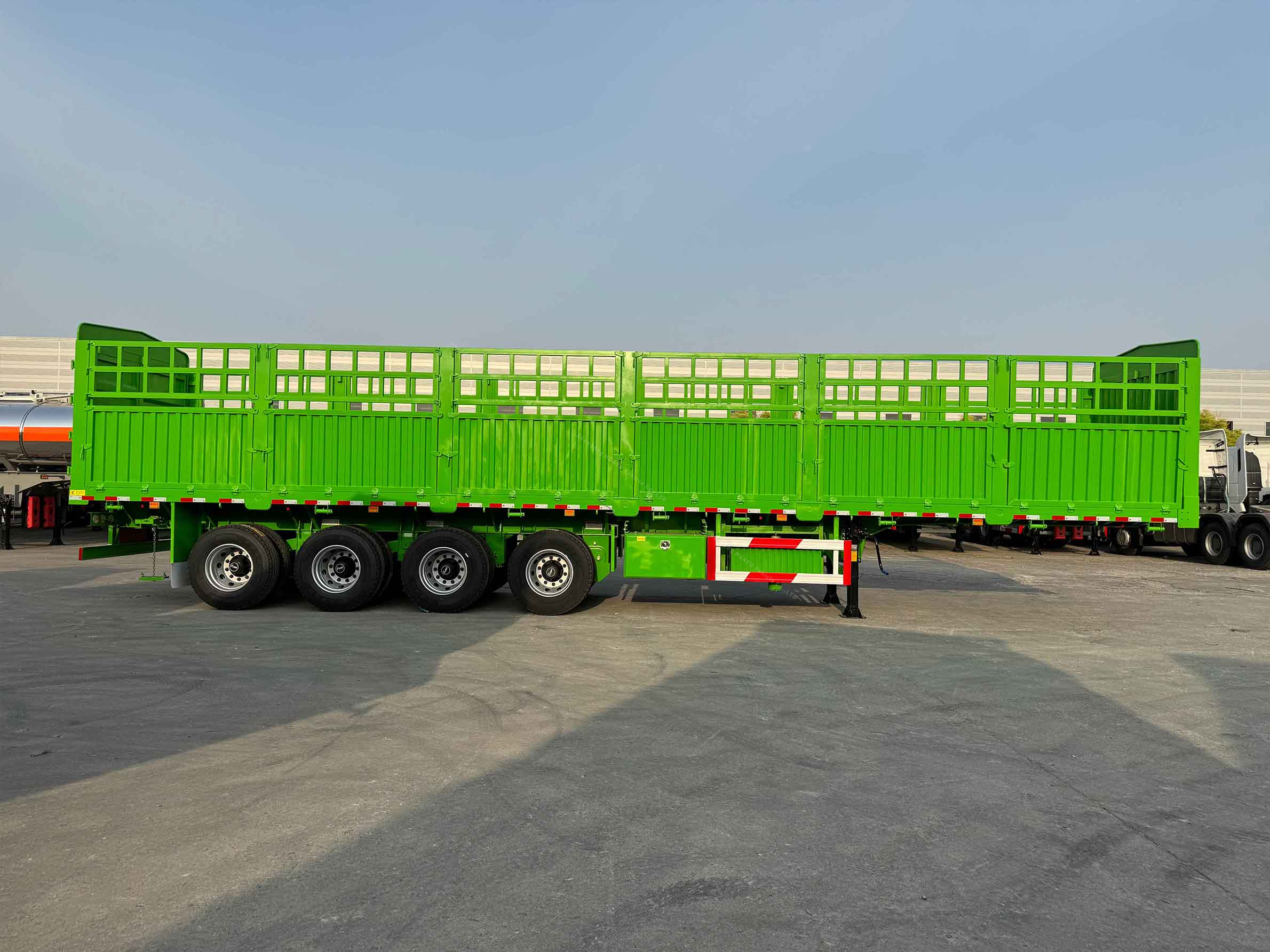
Loading any trailer requires a strict understanding of physics, specifically the 60/40 weight distribution rule. To maintain proper handling, you must place 60% of the total cargo weight forward of the trailer axles, with the remaining 40% positioned behind them. This ratio ensures adequate downward pressure on the tow vehicle's hitch or fifth wheel. If too much weight sits in the rear, the trailer acts as a lever, lifting the tow vehicle's rear wheels and inducing violent, uncontrollable sway.
A fence cargo trailer simplifies this balancing act. Because loaders can open the side panels, they have visual confirmation of the deck space and can place pallets precisely where needed. They do not have to blindly push freight from the rear doors. Micro-adjustments dictate the towing dynamics. Shifting a dense pallet of steel parts or heavy equipment even a few inches forward or backward drastically alters the trailer's balance. Side access allows forklift operators to make these micro-adjustments in seconds.
Weight Placement | Tongue Weight Effect | Towing Dynamics |
|---|---|---|
60% Forward / 40% Rear | Optimal downward pressure | Stable tracking, responsive steering |
50% Forward / 50% Rear | Insufficient downward pressure | Prone to minor sway at highway speeds |
40% Forward / 60% Rear | Negative pressure (lifting) | Violent sway, high risk of jackknife |
Transporting top-heavy cargo presents unique engineering challenges. Agricultural products in tall bins, stacked steel pipes, or crated machinery inherently possess a high center of gravity. When a trailer corners, the centrifugal force acts on this high balance point, threatening to tip the trailer or snap the securement straps.
To secure these loads, operators must anchor the freight as low to the deck as possible, routing chains over the lowest structural points of the cargo. The height of the fence panels plays a major role here. The fencing must correlate with the center of gravity of the load. Taller fence configurations provide a higher physical boundary, preventing top-heavy items from leaning outward during transit. This reduces structural fatigue on the deck and prevents the load from breaching the trailer's legal width limits.
Even perfectly distributed cargo will cause handling issues if the trailer deck is not level. The interface between the tow vehicle and the trailer must be adjusted to ensure a parallel deck alignment during transit. If the fifth wheel or pintle hitch is set too high, the weight shifts rearward, overloading the trailer's rear axles and reducing tongue weight. If set too low, the front axles bear excessive stress, and the tow vehicle's steering becomes compromised.
Integrating load-leveling hitches or automated leveling valves maintains stability. These systems compensate for heavy payloads, keeping the deck flat. A level deck ensures aerodynamic efficiency, reduces uneven tire wear, and guarantees that the weight remains evenly distributed across all available axles, keeping the rig compliant with highway weight regulations.
When operations scale up to handle massive bulk materials, standard trailers fall short. A high capacity fence semi trailer is engineered specifically for extreme payloads. These units feature multi-axle setups, such as tri-axle or quad-axle configurations. The main beams are heavily reinforced with high-yield structural steel, and the cross-members are spaced closer together to prevent deck sagging under concentrated loads.
Axle spread and placement directly impact legal weight limits. Highway bridge formulas dictate how much weight a trailer can carry based on the distance between its axles. Wider axle spreads allow for higher legal gross weights. However, this scalability comes with a maneuverability trade-off. Wide-spread axles scrub the tires aggressively during tight turns, making it difficult to navigate confined loading yards. Fleet managers must balance the need for maximum payload against the physical constraints of their delivery locations.
Every pound of steel added to a trailer to make it stronger is a pound subtracted from its maximum legal payload. This is the fundamental trade-off of tare weight. Specifying thicker, taller fencing and reinforced drop-gates drastically increases cargo protection and lateral containment. However, it makes the empty trailer significantly heavier.
Evaluating material choices optimizes the strength-to-weight ratio. High-strength steel offers incredible durability and impact resistance, making it ideal for hauling scrap metal or heavy machinery, but it is heavy. Aluminum fencing components reduce the tare weight, allowing for more revenue-generating freight per trip. While aluminum resists corrosion, it is more susceptible to bending from forklift impacts and requires specialized welding for repairs. You must align the material choice with the specific harshness of your daily freight operations.
Calculate the average weight of your daily freight loads.
Determine the maximum gross vehicle weight rating (GVWR) allowed in your operating region.
Subtract the weight of the tow vehicle and the estimated freight from the GVWR to find your maximum allowable tare weight.
Select steel or aluminum fencing based on the remaining weight allowance and the impact risk of your cargo.
The suspension system acts as the primary buffer between the harsh highway surface and your fragile cargo. Traditional mechanical suspensions rely on stacked steel leaf springs. These systems are highly durable, relatively inexpensive, and require minimal maintenance. However, leaf springs provide a very harsh ride. They react aggressively to potholes, transferring high-frequency kinetic energy directly through the trailer frame and into the cargo.
Upgrading to an air suspension fence cargo trailer fundamentally changes load protection. Air ride systems utilize heavy-duty pneumatic bags that compress and expand to absorb road shock. This drastically reduces the kinetic energy transferred to the deck. For operations hauling sensitive electronics, fragile agricultural goods, or precisely calibrated machinery, air suspension prevents product degradation during transit.
Suspension Type | Shock Absorption | Maintenance Requirements | Ideal Cargo Profile |
|---|---|---|---|
Mechanical Leaf Spring | Low (transfers vibration) | Low (periodic visual inspection) | Scrap metal, raw lumber, heavy machinery |
Pneumatic Air Ride | High (absorbs kinetic energy) | Moderate (checking airlines and bags) | Electronics, fragile agriculture, glass |
Suspension dampening has a direct relationship with lateral load forces. When a trailer hits a bump mid-corner, a stiff mechanical suspension can cause the tires to momentarily lose contact with the road, inducing a sudden lateral jolt. This jolt forces the cargo violently against the side fencing, testing the limits of the gate latches and tie-down straps.
Air suspension mitigates this risk by keeping the tires firmly planted and absorbing the spike in kinetic energy. Air systems feature ride height control valves. These valves automatically add or exhaust air from the bags to maintain a perfectly level deck height, regardless of how the load is distributed. A level deck prevents cargo from leaning against the side gates during cornering, preserving the structural integrity of the modular fence panels over years of heavy use.
The modularity that makes these trailers efficient also introduces specific maintenance vulnerabilities. Moving parts fail if neglected. The primary failure points include rusted hinges, bent stake pockets, and damaged locking pins. Forklift operators frequently bump the side panels during rapid loading sequences. Over time, these minor impacts deform the steel, making it difficult or impossible to remove and reinstall the gates.
Mitigating this overhead requires a strict, proactive framework. Implement routine inspection schedules where drivers check all latches and pins before every departure. Establish lubrication protocols to keep hinges moving freely in harsh weather conditions. Invest in driver and loader training. Teaching forklift operators the proper angles for panel removal and installation drastically reduces accidental impact damage, extending the lifespan of the trailer's perimeter.
Regulatory bodies strictly enforce lateral securement rules. A dangerous misconception in the industry is that the steel fencing replaces the need for active securement. Legally and practically, fencing is considered a containment method. It does not replace the requirement for equipment-rated straps, chains, and binders to lock the freight to the deck.
Complex tie-down systems create operational friction. Ratchet straps, chain binders, and edge protectors often confuse first-time operators or drivers transitioning from dry van routes. Improper tensioning leads to straps vibrating loose on the highway, resulting in internal load shifting. You must provide standardized, hands-on training for all operators. Teach them how to calculate Working Load Limits (WLL), how to inspect webbing for abrasion, and how to properly tension binders to prevent user-error and ensure total compliance.
Audit your current fleet's securement equipment to guarantee all chains, straps, and load bars are compatible with the new anchor point layouts.
Consult with trailer manufacturers to review specific tare weights and bridge law compliance for your operating region.
Request physical demonstrations of the gate-locking mechanisms to ensure they can be operated smoothly by a single driver in harsh weather.
Implement a standardized training module for your loading dock staff focusing strictly on the 60/40 weight distribution rule.
A: The 60/40 rule requires placing 60% of the cargo weight ahead of the trailer axles and 40% behind them. This maintains proper downward tongue weight on the tow vehicle, preventing dangerous trailer sway. Side access allows loaders to place pallets precisely. Moving heavy items even a few inches can significantly impact the trailer's dynamic balance.
A: Yes, these trailers are engineered with reinforced decking, high-yield steel main beams, and multi-axle configurations to support massive payloads. However, the machinery must be secured using proper equipment-rated D-rings and transport chains. The side fencing provides a perimeter but cannot support the dynamic weight of heavy machinery on its own.
A: Air suspension utilizes pneumatic bags to absorb high-frequency road vibrations, providing a much smoother ride than rigid leaf springs. This protects fragile cargo from shock damage, features automated valves to keep the deck level, and decreases the kinetic energy transferred to the modular fence joints, reducing long-term metal fatigue.
A: No. Side fencing is legally classified as a lateral containment method, not an active securement device. You are still legally required to use equipment-rated ratchet straps, chains, or load bars to anchor the freight directly to the deck. This prevents internal load shifting and protects the gates from impact damage.
A: Preventing sway requires strict side-to-side weight balance and adherence to the 60/40 front-to-back loading rule. You must also adjust the tow vehicle and trailer interface height to ensure the deck remains perfectly level. Finally, anchor all heavy cargo as low to the deck as possible to lower the center of gravity.
A: Yes, the side structure is highly modular. The vertical stakes, interlocking gates, and side panels can be completely removed or dropped down. This allows the trailer to function temporarily as an open flatbed, enabling unobstructed 360-degree access for forklifts and overhead cranes during the loading process.


