
Views: 0 Author: Site Editor Publish Time: 2025-08-24 Origin: Site


A fuel tanker trailer plays a critical role in global fuel logistics by ensuring the safe and efficient transport of gasoline, diesel, kerosene, and jet fuel over long distances. These trailers are indispensable for oil companies, gas stations, and aviation industries, supporting the continuous flow of energy that keeps economies running.
When selecting a fuel tanker trailer, two of the most important factors to consider are its dimensions and capacity. The size of the trailer directly affects road safety, maneuverability, and compliance with regional transport laws, while its capacity determines efficiency, cost-effectiveness, and the ability to meet delivery demands. Understanding these specifications is essential for businesses to achieve both safety and operational reliability.
When choosing a fuel tanker trailer, understanding standard dimensions is essential for safety, efficiency, and compliance with regional transport regulations. The trailer’s size not only influences the amount of fuel it can carry but also its road stability and maneuverability.
Most fuel tanker trailers are designed within specific size ranges to balance capacity and road safety:
Length: commonly between 10.5 to 13 meters, depending on tank capacity.
Width: generally standardized at 2.5 to 2.6 meters to comply with international road regulations.
Height: usually around 3.5 to 4 meters, allowing safe clearance under bridges and road infrastructure.
These dimensions may vary based on customer needs and country-specific requirements, but they remain within regulated limits for safe operation.
The axle configuration directly affects the trailer’s stability, weight distribution, and fuel-carrying capacity.
Single-axle trailers are compact and suitable for short-distance or urban transport.
Double-axle trailers provide a balance of capacity and maneuverability, commonly used for medium-distance fuel distribution.
Tri-axle trailers are designed for long-haul and heavy loads, offering better stability and higher capacity while meeting road safety standards.
Choosing the right axle setup is crucial for ensuring both efficiency and reduced wear on tires and suspension.
Every region imposes legal restrictions on the maximum dimensions of fuel tanker trailers. For example:
In Europe, the maximum trailer length is usually 13.6 meters.
In the U.S., regulations may vary by state but typically limit width to 102 inches (2.6 meters).
In Asia and Africa, road conditions and infrastructure often influence maximum size limits.
Compliance with these rules is vital to avoid penalties, improve road safety, and ensure smooth cross-border transport.
When selecting a fuel tanker trailer, one of the most critical factors to consider is its capacity. The right choice ensures operational efficiency, cost-effectiveness, and compliance with transport regulations.
Fuel tanker trailers are available in a wide range of capacities, typically from 20,000 liters to 60,000 liters.
Smaller trailers (20,000–30,000 liters) are often used for local fuel distribution, such as delivering to gas stations within cities.
Medium-sized trailers (30,000–45,000 liters) are suitable for regional transport, balancing efficiency and maneuverability.
Large trailers (45,000–60,000 liters) are designed for long-haul operations, carrying maximum loads across highways or international routes.
These ranges allow businesses to match their operations with the most efficient trailer size.
Another important aspect of fuel tanker trailer capacity is whether the tank has one large compartment or multiple smaller compartments:
Single-compartment trailers are ideal when transporting one type of fuel in bulk, such as diesel or jet fuel.
Multi-compartment trailers are designed with 2–8 separate compartments, allowing different types or grades of fuel to be carried in one trip. This not only improves efficiency but also helps reduce operating costs for fuel distributors serving multiple clients.
The ideal fuel tanker trailer capacity depends on several business and operational needs:
Transport Distance: Long-distance transport usually requires larger capacity to minimize trips, while local deliveries may use smaller trailers for easier maneuvering.
Fuel Demand: Companies with high-volume requirements, such as airports or oil depots, often rely on higher-capacity trailers.
Operational Costs: Larger trailers reduce the number of trips but may increase fuel consumption, while smaller trailers offer flexibility and lower operating expenses.
By carefully evaluating these factors, businesses can select the fuel tanker trailer capacity that best aligns with their goals for safety, efficiency, and profitability.
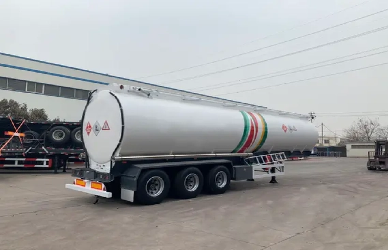
Choosing the right fuel tanker trailer is not only about selecting standard dimensions and capacity but also about understanding the key factors that influence these choices. The following considerations play a crucial role in determining the most suitable trailer for your operation.
The kind of liquid fuel being transported directly impacts trailer design and capacity.
Gasoline and diesel are the most common, requiring trailers with strong safety systems and anti-corrosion linings.
Jet fuel and kerosene demand even stricter standards for cleanliness and material compatibility to avoid contamination.
In some cases, trailers may need multi-compartment designs to carry different fuel grades simultaneously.
Thus, the fuel type determines both the internal layout and the materials used in a fuel tanker trailer.
The intended routes and distances are also major factors in dimension and capacity decisions.
Short-haul distribution (e.g., urban gas station supply) often requires smaller trailers for better maneuverability in tight city roads.
Long-haul operations benefit from larger-capacity trailers that reduce the number of trips and improve overall efficiency.
Additionally, road conditions such as slopes, rough terrain, or sharp turns may limit the trailer’s length or axle configuration.
Government regulations and infrastructure limitations set clear boundaries for fuel tanker trailer dimensions and capacity.
Axle load limits define how much weight each axle can carry to protect roads and bridges.
Bridge restrictions and tunnel height limits may require shorter trailers or reduced tank capacity.
Regional compliance standards, such as ADR in Europe or DOT in the U.S., must be met before a trailer can legally operate.
Failure to comply with these regulations can lead to fines, downtime, or even accidents.
Finally, efficiency and cost-effectiveness are central to trailer selection.
Fuel consumption increases with larger, heavier trailers, so operators must balance capacity with fuel efficiency.
Loading and unloading time also affects operations; multi-compartment trailers may take longer but allow more flexible distribution.
Maintenance requirements vary depending on the trailer’s size, material, and frequency of use, impacting long-term costs.
By carefully analyzing these factors, businesses can select the fuel tanker trailer that provides the best balance of safety, compliance, and profitability.
Choosing the right fuel tanker trailer is about balancing safety, efficiency, and cost. Here are three key considerations:
Match trailer size to your business model.
Short-distance or city deliveries → smaller trailers for easy maneuvering.
Long-haul or bulk transport → larger capacity trailers to reduce trips.
A proper balance avoids underutilization or excess fuel costs.
Multi-compartment trailers: best for delivering different fuel grades in one trip.
Single-compartment trailers: ideal for bulk transport of a single fuel type.
Choose based on delivery patterns and efficiency needs.
Work with a trusted fuel tanker trailer manufacturer that offers:
Customization (OEM/ODM) for your exact requirements.
Regulatory compliance with ADR, DOT, or regional standards.
After-sales support with spare parts and technical guidance.
Selecting the right fuel tanker trailer with proper dimensions and capacity is not just about meeting regulations—it directly impacts safety, operational efficiency, and long-term cost savings. A trailer that is too small may lead to frequent trips and higher expenses, while one that is oversized can cause maneuverability issues and unnecessary wear.
To make the best choice, it’s essential to work with experienced professionals. Manufacturers like Shandong HUAYU Vehicle Co., Ltd. provide customized fuel tanker trailer solutions that align with your fuel type, transport routes, and regional standards. With expert guidance and reliable after-sales support, you can maximize the value of your investment while ensuring safe and efficient fuel transport.
Looking for a high-quality fuel tanker trailer tailored to your needs? Visit Shandong HUAYU Vehicle Co., Ltd. and get professional advice today.


