
Views: 0 Author: Site Editor Publish Time: 2026-08-27 Origin: Site


High-frequency port terminal operations expose equipment inefficiencies immediately. Minor delays in container handling compound into significant demurrage and detention penalties. Selecting the wrong chassis configuration leads to payload weight violations, increased chassis splits, accelerated equipment wear from high-cycle loading, and compromised safety during drayage operations. Terminal environments subject equipment to extreme stress, from uneven loading surfaces to aggressive crane hard-landings. You need a technical evaluation of chassis specifications to survive these conditions.
Fleet operators must match frame design, axle configurations, and component durability to the specific operational realities of the target port terminal. You must also account for rail ramp transitions and over-the-road freight corridors. A well-specified chassis prevents out-gate delays, keeps drivers moving, and maximizes legal payload capacity across diverse freight networks. Ignoring these technical specifications guarantees elevated maintenance downtime and rejected gate entries.
Configuration Matching: Aligning chassis length and structural type (fixed vs. extendable) directly with the historical container mix (20', 40', 45', high-cube, or heavy 20s) reduces empty miles and operational bottlenecks.
Weight Distribution Compliance: Utilizing specific multi-axle setups is mandatory for maximizing payload capacity while adhering to strict federal and local bridge laws during port-to-warehouse transit.
Component Durability & Modularity: High-cycle port environments demand specific upgrades in landing gear, twist locks, and suspension systems, prioritizing modular parts to minimize maintenance downtime and pass stringent roadability inspections.
Establishing operational baselines dictates your entire chassis procurement strategy. You must define the required daily turnaround cycles and average queue times at the terminal. Port drayage involves intense, repetitive physical stress. Yard hostlers frequently drop and hook trailers in congested yards using hydraulic fifth wheels, slamming the equipment onto the pavement. Rubber-Tired Gantry (RTG) and Ship-to-Shore (STS) cranes often land containers hard onto the chassis bolsters. Equipment must withstand these daily impacts without structural deformation. Understanding these physical demands helps you specify the correct steel yield strength, bolster thickness, and suspension type.
Regulatory and safety compliance requires strict adherence to federal and local mandates. Fleets must comply with FMCSA regulations and specific Roadability rules under 49 CFR Part 396. Under these rules, chassis providers and motor carriers share responsibility for equipment safety, but drivers face the immediate consequences of violations at weigh stations. Terminals also enforce unique operating procedures. Automated terminals utilize automated straddle carriers (Auto-Strads) or Automated Guided Vehicles (AGVs). Your chassis designs must align perfectly with the automated positioning sensors and lifting profiles of these machines. Failing to meet these terminal-specific requirements results in immediate gate rejections.
Intermodal compatibility adds another layer of mandatory technical requirements. Seamless transitions between port terminals and rail yards demand specific structural reinforcements. Rail transport subjects the chassis to severe longitudinal forces during train marshaling and humping operations. Equipment moving onto rail networks requires AAR (Association of American Railroads) M-931 certification. This certification mandates reinforced kingpin assemblies, specialized front and rear lift pads for overhead rail cranes, and heavy-duty twist locks designed to survive the violent slack action of freight trains.
Payload optimization remains a constant mathematical balancing act. You must weigh the tare weight of the chassis against maximum allowable gross vehicle weights. A standard Class 8 tractor weighs approximately 17,000 lbs. If the federal gross limit is 80,000 lbs, every pound saved on the chassis translates directly to legal cargo capacity. Lighter equipment allows you to haul heavier freight legally. However, removing too much structural mass compromises durability. Finding the exact balance maximizes freight per trip without incurring overweight fines or causing premature frame failure under crane loads.
Operational Environment | Primary Stress Factor | Required Chassis Feature |
|---|---|---|
Manual RTG Crane Yards | Hard landings, uneven container drops | Reinforced steel bolsters, heavy-duty twist locks |
Automated Straddle Terminals | Sensor alignment, precise positioning | Standardized dimensions, high-visibility decals |
Intermodal Rail Ramps | Longitudinal train forces, overhead lifting | AAR M-931 certification, reinforced lift pads |
High-Volume Drop Yards | Aggressive coupling by yard hostlers | 160,000 lb static landing gear, K-bracing |
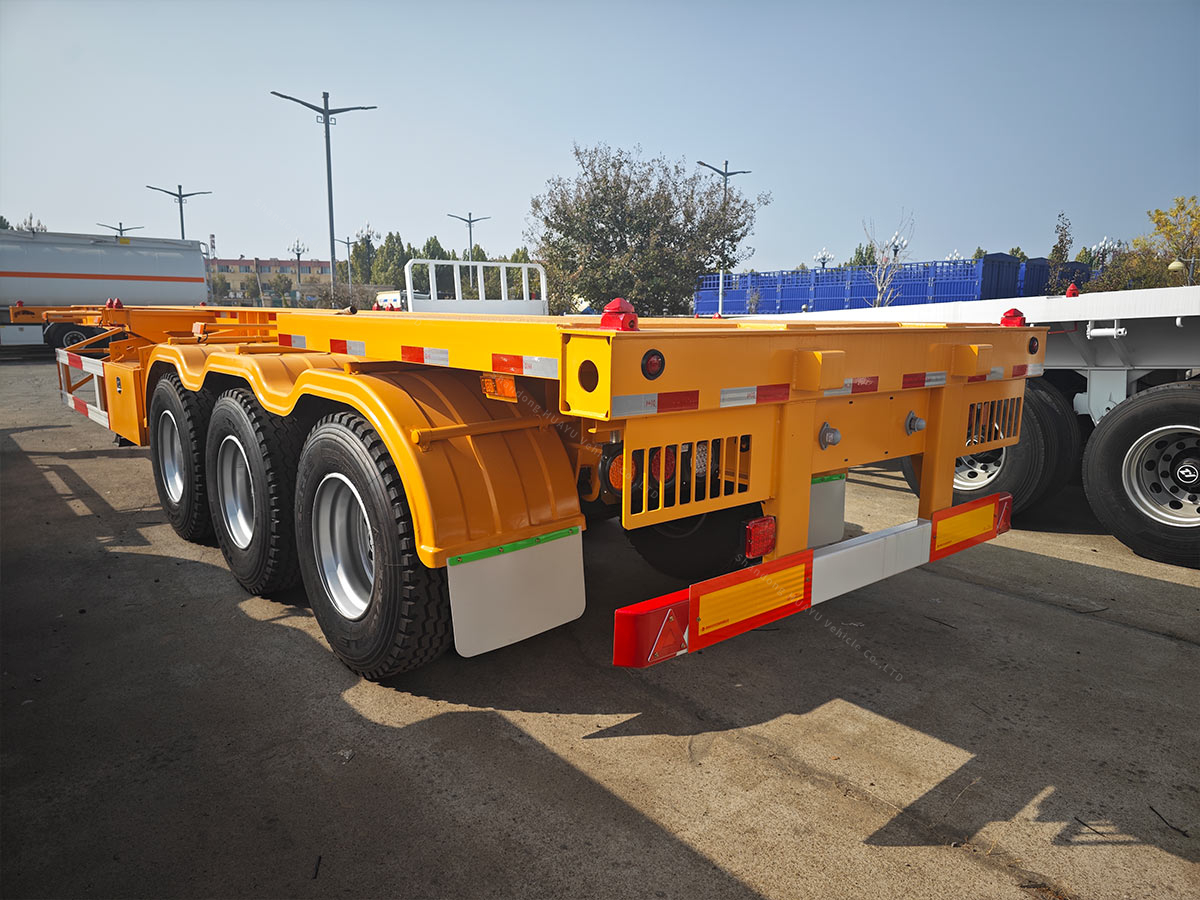
Fixed straight-frame designs typically come in 20-foot, 40-foot, and 45-foot lengths. These units offer maximum structural rigidity because they lack moving frame components. A standard Container Chassis Trailer with a fixed length provides the most reliable performance for predictable freight. Gooseneck configurations are mandatory for transporting 40-foot and 45-foot high-cube containers. The gooseneck drops the deck height behind the tractor fifth wheel, accommodating the deeper tunnel of a high-cube container. This design maintains legal bridge height clearances (typically 13 feet 6 inches) while lowering the cargo center of gravity for better rollover stability.
These trailers excel in dedicated lanes with highly predictable, uniform container traffic. If your fleet exclusively hauls 40-foot imports from the port to a local distribution center, fixed chassis eliminate unnecessary mechanical complexity. The primary trade-offs are lower tare weight and reduced maintenance complexity versus operational inflexibility. You cannot haul a 20-foot container on a standard 40-foot fixed chassis without specialized mid-frame bolster configurations. Attempting to mix freight types on fixed equipment leads to empty return miles and wasted driver hours.
Extendable chassis utilize telescoping frames and sliding tandem axles to accommodate multiple container sizes on a single unit. Mechanisms of action include pneumatic locking pins, internal roller systems, and heavy-duty slide pads. Drivers can extend the frame to carry a 40-foot container or retract it to haul a heavy 20-foot box. Sliding the tandem axles backward or forward helps distribute the load legally across the tractor drive axles and the trailer axles, ensuring compliance with state weight regulations.
These units serve fleets managing a volatile mix of container sizes. Dispatchers gain massive operational flexibility, assigning any available driver to any waiting container regardless of its length. However, this versatility introduces significant mechanical trade-offs. Extendable units carry increased tare weight due to the overlapping steel frame sections required for the telescoping action. They require higher initial capital expenditure. Maintenance requirements increase dramatically for locking pins, slider rails, coiled air lines, and pneumatic locking mechanisms. Saltwater port environments quickly corrode these moving parts if mechanics do not rigorously grease and inspect them.
Transporting exceptionally heavy cargo requires specialized axle configurations to remain street legal. A multi axle container skeleton trailer typically features tri-axle, quad-axle, or spread-axle setups. These designs distribute massive payload weights across a wider footprint on the pavement. This distribution is mandatory for transporting heavy 20-foot containers, ISO tank containers carrying dense liquids, and raw materials like scrap metal, resin, or agricultural exports.
Operating heavy equipment requires strict adherence to the Federal Bridge Gross Weight Formula. Multi-axle setups keep individual axle weights within legal limits. A standard tandem axle group legally carries 34,000 lbs, whereas a properly spaced tridem group can carry up to 42,000 lbs or more depending on local variances. When evaluating these trailers, prioritize lift-axle capabilities. A pneumatic lift axle allows the driver to raise one set of tires off the ground during empty returns. This feature drastically reduces tire wear, minimizes toll costs on multi-axle turnpikes, and improves fuel economy when the trailer is unladen.
The foundation of any reliable port container chassis trailer is its metallurgical integrity. Standard carbon steel bends and fatigues under the repetitive stress of terminal operations. High-tensile steel, such as Grade 80 or Grade 100, provides superior yield strength while allowing for thinner, lighter frame components. Grade 80 steel yields at 80,000 pounds per square inch, offering excellent resistance to permanent deformation when subjected to heavy container drops.
Examine the I-beam web thickness and flange design closely. The vertical web must resist torsional twisting when a container is loaded unevenly or when the chassis navigates uneven drop yard terrain. The top and bottom flanges handle the extreme tension and compression loads. Reinforced transition zones near the gooseneck drop and suspension hangers prevent stress fractures. Proper weld penetration and robotic welding processes ensure the frame acts as a cohesive, durable unit under extreme dynamic loads.
Steel Grade | Yield Strength (PSI) | Weight Impact | Best Application |
|---|---|---|---|
Grade 50 | 50,000 | Heaviest | Low-cycle, lightweight freight |
Grade 80 | 80,000 | Medium | Standard port drayage, heavy 20s |
Grade 100 | 100,000 | Lightest | Maximum payload optimization lanes |
Choosing between spring ride and air ride suspensions involves a strict operational analysis. Spring suspensions offer rugged mechanical simplicity. They resist terminal damage and require minimal maintenance. However, they transfer significant road shock directly into the container, causing the trailer to bounce aggressively when pulled empty. Air ride suspensions utilize pneumatic bags and leveling valves to protect fragile cargo and offer a smoother empty ride. The trade-off includes higher maintenance demands, vulnerable air bags that easily puncture, and increased susceptibility to damage from debris in unpaved drop yards.
Axle weight ratings must align with anticipated gross weights. Standard port chassis utilize axles rated between 22,500 lbs and 25,000 lbs each. Specifying 25,000-lb axles provides a critical safety margin against localized overloading. Heavy-duty wheel bearings and thicker axle tube walls prevent deflection when cornering heavily loaded ISO tanks or unevenly packed 40-foot containers. Deflection leads to uneven tire wear and premature wheel seal failures.
Landing gear endures brutal punishment in drop-and-hook operations. Evaluate both static load capacity and lifting capacity. A robust set should offer at least 160,000 lbs of static capacity to survive aggressive drops from yard hostlers. Lifting capacity should exceed 50,000 lbs to allow drivers to adjust trailer height when coupling to different tractors on uneven ground. Specify high/low gear ratios for ease of use. Reinforced K-bracing between the legs prevents the gear from collapsing if a hostler truck pulls the chassis before the fifth wheel jaws fully lock.
Twist lock mechanisms secure the container to the frame bolsters. Retractable twist locks allow the chassis to carry flat cargo or accommodate different container footprints without interference. Non-retractable locks are mechanically simpler but limit versatility. Assess all locks for ISO compliance. Prioritize modular twist lock assemblies that bolt on rather than weld on. Modular designs allow terminal workers to replace damaged locks in minutes using hand tools, rather than grounding the chassis for hot-work welding.
Braking systems must meet stringent FMCSA stopping distance requirements. Evaluate ABS configurations carefully. A 2S/1M (two sensors, one modulator) system is standard, but a 4S/2M system offers superior wheel slip control and safer braking on wet, slick port roads. Automatic slack adjusters and premium brake linings extend service intervals and prevent out-of-adjustment violations at weigh stations.
Coastal port environments destroy inferior electrical systems rapidly. Saltwater corrosion causes immediate roadability failures. Specify 100% LED lighting systems and fully sealed, molded wiring harnesses. Junction boxes must be watertight and packed with dielectric grease to repel moisture. Exposed copper wire turns green and fails within months in a marine environment.
Smart chassis technology transforms fleet management. Integration of GPS tracking provides real-time location data across sprawling terminals and off-site drop yards. ABS fault reporting alerts maintenance teams to issues before the driver hits the out-gate. Tire Pressure Monitoring Systems (TPMS) prevent blowouts, expedite terminal gate checks, and drastically improve overall fleet visibility by ensuring tires remain at optimal inflation for heavy loads.
Procurement requires balancing standardization against flexibility. Maintaining a homogenous fleet of fixed chassis simplifies parts inventory and mechanic training. Every trailer uses the same brake shoes, air valves, and twist locks. However, this standardization often requires frequent chassis splits. A driver may drop a 40-foot chassis at one yard just to bobtail across town to pick up a 20-foot chassis for their next dispatch. This wastes hours of driving time. Conversely, a fully extendable fleet eliminates chassis splits but doubles the maintenance burden due to moving parts and pneumatic systems.
Operators face an inverse relationship between tare weight and structural durability. Lightweighting a chassis improves fuel efficiency and increases legal payload capacity. Manufacturers achieve this by using aluminum components, super-single tires, or thinner steel profiles. However, port environments are unforgiving. The structural mass required to survive harsh terminal handling, straddle carrier impacts, and crane drops often necessitates heavier, robust construction. Sacrificing durability for payload often leads to catastrophic frame failures and cracked bolsters.
Deciding between port-exclusive and intermodal versatility impacts capital expenditure. Investing in heavier, AAR-certified chassis ensures rail compatibility. These units feature reinforced kingpins and specialized lift pads. If your freight never touches a rail car, this extra weight and cost provide zero operational benefit. Optimizing strictly for local port-to-warehouse drayage allows for lighter, less expensive equipment tailored specifically to highway transport.
Choosing between private fleet ownership and chassis pool leasing dictates your operational control. Direct procurement gives you absolute control over maintenance schedules, telematics integration, and equipment availability. You never wait for a roadworthy chassis. Utilizing terminal-managed pools converts fixed capital expenses into variable operating costs. However, pool chassis suffer from inconsistent maintenance, leading to unexpected out-gate delays, blown tires, and severe driver frustration.
Failed roadability inspections pose a massive risk to drayage margins. Delays at the terminal out-gate due to defective brakes, inoperable lights, or bald tires destroy driver productivity. Even newly acquired chassis can fail if poorly maintained. Mechanics must travel to the terminal trouble lane to perform repairs before the terminal releases the equipment.
Implement strict pre-trip inspection protocols focusing on gladhand seals, tire tread depth, and twist lock engagement.
Utilize TPMS and telematics to monitor equipment health remotely and schedule preventative maintenance.
Specify premium, corrosion-resistant OEM components during procurement to withstand the saltwater environment.
Establish a dedicated trouble-lane response plan with local mobile repair vendors to expedite out-gate releases.
Driver adoption and operational safety require active management. Improper operation of slider mechanisms or landing gear leads to severe equipment damage. Drivers can cause tip-overs during uncoupled loading if landing gear is unsupported or placed on soft asphalt. Manual handling of heavy slider pins risks driver shoulder and back injuries.
Develop standardized operating procedures (SOPs) for all equipment types in the fleet.
Mandate technical training for coupling/uncoupling procedures, specifically addressing fifth-wheel jaw verification.
Teach safe landing gear crank operation, emphasizing the use of low gear under heavy loads.
Demonstrate proper axle weight distribution adjustments on slider chassis using certified platform scales.
Supply chain lead times often disrupt fleet expansion. Extended delivery timelines for custom-configured chassis impact operational scaling. Waiting 12 months for specialized equipment leaves freight sitting on the dock and forces reliance on substandard rental pools.
Execute phased procurement planning, ordering equipment quarters in advance of projected volume spikes.
Utilize standardized, readily available configurations for baseline volume while awaiting specialized multi-axle or custom extendable units.
Build relationships with multiple manufacturers to diversify supply chain risks and leverage competitive build slots.
Audit historical freight data, including container sizes, average weights, frequency of drop-and-hook operations, and intermodal transitions to determine the dominant equipment requirement.
Initiate a pilot program with a shortlisted chassis configuration to test real-world durability and driver adoption in your specific port environment.
Request detailed engineering drawings and component specifications from manufacturers to verify steel grades, flange thickness, and robotic weld penetration.
Establish standardized driver training protocols for coupling procedures, landing gear operation, and axle weight distribution adjustments on new equipment.
A: A port container chassis features heavy-duty reinforcements designed for high-frequency terminal cycles. It includes upgraded twist-lock configurations, reinforced bolsters to survive crane hard-landings, and specialized coatings or sealed harnesses for saltwater corrosion resistance. Standard chassis are built for lighter highway use and lack the structural mass needed for aggressive drop-and-hook port environments.
A: Multi-axle configurations are required when transporting heavy 20-foot containers, ISO liquid tanks, or dense raw materials. Federal bridge laws and local weight limits dictate how much weight can rest on a single axle. Tri-axle or quad-axle setups distribute heavy payloads over a wider footprint, keeping the truck legal and preventing infrastructure damage.
A: Lower chassis tare weight directly increases the legal payload capacity you can haul. Every pound removed from the chassis is a pound of revenue-generating freight you can add. Additionally, lighter equipment improves fuel efficiency during empty return miles, directly reducing daily operating expenses and wear on the tractor.
A: Extendable chassis require rigorous maintenance of their moving parts. Technicians must regularly lubricate the slider rails and inspect the pneumatic locking pins for wear. Air lines that stretch and retract must be checked for chafing. Failure to maintain these mechanisms results in jammed frames and severe operational delays.
A: A chassis split occurs when a driver must travel to a separate location just to pick up a specific chassis type before retrieving a container. This creates logistical inefficiency and wasted miles. Investing in versatile equipment, like extendable slider chassis, allows one trailer to handle multiple container sizes, effectively eliminating the need for chassis splits.
A: Evaluate landing gear based on static load capacity and lifting capacity. Port operations require at least 160,000 lbs of static capacity to survive aggressive drops. Look for high/low gear ratios for easier cranking under load. Ensure the gear features reinforced K-bracing to prevent collapse during uncoupled loading in busy drop yards.
A: Not all port chassis can be used on rail. Rail transport requires AAR (Association of American Railroads) certification. The chassis must feature specific structural reinforcements, including heavy-duty kingpin assemblies, specialized lift pads, and reinforced twist locks to withstand the severe longitudinal forces experienced during train marshaling.


