
Views: 0 Author: Site Editor Publish Time: 2026-09-21 Origin: Site


Busy shipping ports demand absolute precision. Every inch matters when you navigate tight corners, thread between massive gantry cranes, and inch past towering stacks of freight. Poor handling slows turnaround times. Worse, it drastically increases accident risks. From a practical standpoint, your trailer's wheelbase directly solves this issue. How exactly does this structural dimension alter your daily operations? In this engineering breakdown, we explore the mechanics of wheelbase maneuvering. You will learn how to optimize your fleet for the high-pressure environment of modern shipping hubs.
Shorter wheelbases offer a tighter turning radius. They are ideal for highly congested port terminals where space is severely limited.
Longer wheelbases provide superior high-speed stability and better weight distribution for heavy 40ft or 45ft containers. However, they require significantly more room to execute turns.
Off-tracking describes the difference in the path of the tractor versus the trailer. This swing effect is directly proportional to wheelbase length. Managing it remains crucial for port safety.
Axle configurations interact with the wheelbase. A 2-axle versus a 3-axle setup impacts both payload capacity and steering friction during tight maneuvers.
Choosing the right trailer requires matching your typical container loads against the physical layout and lane widths of your primary ports.
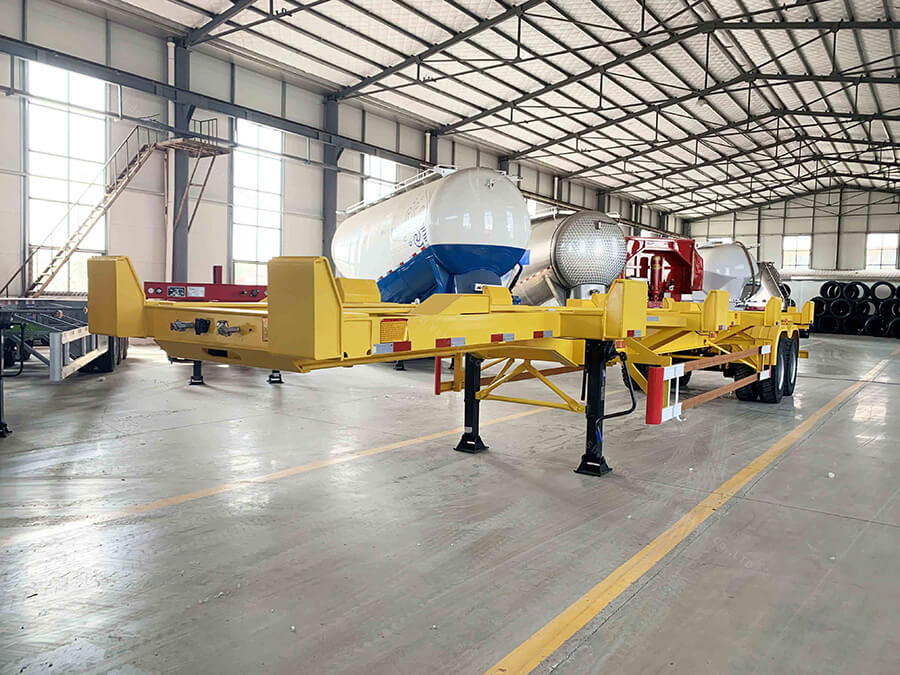
In commercial logistics, the wheelbase serves as a fundamental structural baseline. For a semi-trailer, engineers measure this dimension from the center of the kingpin to the center of the rear axle group. The kingpin is the crucial pivot point connecting the trailer to the fifth wheel of the tractor. If the trailer features multiple axles, the measurement extends to the center point between those specific axles. This distance dictates the physical footprint of the vehicle. A standard 40ft chassis typically features a wheelbase ranging from 250 to 300 inches. The exact number depends on the chosen axle configuration and regional bridge weight laws. Grasping this geometry is the critical first step in optimizing fleet operations.
Enclosed box trailers rely on solid paneled walls for rigidity. A skeletal trailer relies entirely on its exposed steel framework. Consequently, the wheelbase determines exactly where the structural stress points concentrate when a crane forcefully lowers a massive shipping container onto the chassis. Furthermore, this dimension dictates the pivot point of the entire rig. The location of the rear axles relative to the kingpin determines how the trailer reacts to steering inputs from the terminal tractor. A poorly chosen wheelbase leads to rapid structural fatigue. It also significantly impairs the driver’s ability to navigate tight spaces safely.
The turning radius of any articulated vehicle heavily depends on its wheelbase. Drilling down into the mechanics reveals a strict inverse relationship. A shorter wheelbase generally results in a smaller and tighter turning radius. When a driver attempts a 90-degree turn in a congested port yard, the tractor must drag the trailer through the corner. A shorter distance between the kingpin and the axles allows the trailer to pivot sharply. It closely follows the tractor's initial trajectory. This capability proves critical when containers are stacked mere feet apart, leaving a minimal margin for error during aggressive cornering maneuvers.
Off-tracking occurs when the rear wheels of a trailer follow a different, tighter path than the wheels of the towing tractor during a turn. In low-speed port operations, engineers call this low-speed off-tracking. The severity of this swing effect scales directly with the length of the wheelbase. Simply put, a longer wheelbase increases off-tracking. The trailer will cut the corner much sharper than the truck itself. Fleet operators must account for this physical reality. Excessive off-tracking makes it incredibly difficult for drivers to avoid clipping concrete barriers or stacked freight. Proper driver training combined with selecting an appropriate wheelbase mitigates these daily collision risks.
Reversing a semi-trailer involves complex pivot dynamics that challenge even veteran drivers. Interestingly, a short wheelbase is vastly superior for forward cornering, but slightly longer wheelbases can sometimes be easier to reverse in a straight line. A longer wheelbase reacts much more slowly to steering inputs. This affords the driver extra seconds to correct the angle before the trailer inevitably jackknifes. Conversely, a short wheelbase responds almost instantly to reversing inputs. Overcorrecting leads to rapid jackknifing. However, in highly confined port spaces, the urgent need for a tight forward turning radius almost always outweighs straight-line reversing advantages.
Global shipping volumes continue to surge, yet terminal footprints remain largely static. Recent logistics industry analyses highlight a rapid shift toward high-density storage layouts. Modern port authorities are engineering container aisles to the absolute minimum required width to maximize storage capacity. This dynamic pushes terminal congestion to unprecedented levels. Industry experts note a growing trend where fleet operators now prioritize optimized maneuverability over sheer payload capacity.
Specifically, navigating these narrow corridors means the wheelbase dictates the vehicle's swept path. This term refers to the total ground area covered by the tractor and trailer during a turn. A premium port skeleton trailer is engineered with precise wheelbase dimensions that optimize this sweep path. Drivers can thread through complex yard layouts efficiently. Clearing tight roundabouts without stopping to reverse directly impacts how many containers a driver moves per shift.
Loading and unloading operations require millimeter precision. When a truck approaches a Rubber-Tired Gantry crane or a reach stacker, the driver must align the trailer perfectly beneath the descending spreader. The handling characteristics dictated by the trailer's wheelbase play a direct role here. Trailers with a shorter and highly responsive wheelbase allow drivers to make micro-adjustments to their positioning. They require minimal forward or backward travel. If a trailer has a cumbersome turning radius, drivers spend excessive time shunting the vehicle back and forth to align the twist locks. This delays crane operations and compounds financial inefficiencies.
The number of axles on a trailer directly interacts with the wheelbase to affect maneuvering dynamics. On a standard tandem trailer, the effective wheelbase is measured from the kingpin to the center point between the two axles. Because only two axles resist the lateral forces of a turn, the trailer pivots relatively easily. This configuration results in significantly less tire scrub. Tire scrub is the dragging friction that occurs when tires are forced sideways during a tight maneuver. Consequently, a 2-axle setup remains highly responsive to steering inputs. For example, a well-designed lightweight container chassis typically features a tare weight around 4.8 to 5.5 tons. This makes it an excellent choice for standard loads where extreme weight capacity is not the primary concern.
When operational requirements dictate the transportation of overweight containers, fleets must upgrade. You need a container skeleton semi trailer equipped with a tridem configuration to comply with legal weight limits. These models can handle payloads up to 40 or even 60 tons depending on the specific structural reinforcement. However, adding a third axle fundamentally changes how the trailer maneuvers. It effectively lengthens the wheelbase footprint. During sharp port maneuvers, the front and rear axles of the tridem group fight against each other. The tractor must exert considerably more engine torque to pull the trailer through a tight corner. Drivers must allow for a wider turning angle to prevent dragging tires from damaging the suspension. This is a necessary trade-off for heavy-duty stability.
To simplify your procurement process, review this direct comparison of wheelbase impacts on port operations:
Feature / Metric | Short Wheelbase Chassis | Long Wheelbase Chassis |
|---|---|---|
Turning Radius | Highly compact; excellent for narrow aisles. | Wide; requires sweeping corner clearances. |
Off-Tracking Effect | Minimal swing; trailer follows tractor closely. | Severe swing; high risk of clipping obstacles. |
High-Speed Stability | Prone to sway at highway speeds. | Highly stable; excellent crosswind resistance. |
Ideal Cargo Profile | Dedicated heavy 20ft containers. | Standard 40ft and high-cube 45ft containers. |
Tire Wear Rate | Lower friction translates to extended tire life. | Higher scrub rate increases tread degradation. |
Selecting the optimal trailer requires a data-driven approach. Do not guess. Measure your most frequent loading dock spaces and port terminal lane widths. If your primary port features older infrastructure with legacy narrow aisles, prioritizing a shorter wheelbase is a logistical necessity. It yields long-term efficiency gains. In contrast, if your operations span modern mega-terminals with wide sweeping lanes, a longer wheelbase easily accommodates your fleet without sacrificing speed.
Always align procurement decisions with your primary cargo profile. Deploy short wheelbase trailers for dedicated 20ft container hauls to maximize yard agility and minimize dead weight. Utilize standard or long wheelbase trailers for 40ft and 45ft containers to ensure strict compliance with weight distribution regulations. Regardless of length, invest in equipment built with high-yield strength steel. This ensures the structural frame withstands the intense twisting forces generated during tight port maneuvers over its entire lifespan.
Ultimately, the wheelbase is the defining factor in how a port chassis handles. Shorter wheelbases provide unmatched agility in tight spaces. They allow drivers to navigate congested yards with ease. Conversely, longer wheelbases deliver the mandatory stability and weight distribution required for heavy elongated container loads. Better maneuverability directly reduces port accidents, minimizes tire wear, and boosts overall logistics efficiency. Evaluating your specific terminal constraints before purchasing equipment ensures your operations remain safe and profitable. Ready to upgrade your fleet? Explore the comprehensive range of specialized chassis at Huayu Vehicle to find the exact wheelbase configuration tailored to your port operations.
The standard wheelbase for a 40ft chassis generally ranges between 250 to 300 inches. This specific measurement depends heavily on the kingpin setting and the rear axle configuration. Engineers precisely calculate this length to safely support the structural integrity of a fully loaded 40ft shipping box while maintaining a compliant turning radius.
Yes. From a dynamic handling perspective, a lightweight model maneuvers much more efficiently. Carrying significantly less unladen tare weight means the trailer exhibits less physical inertia. It responds much quicker to steering inputs, stops in shorter distances, and accelerates with less engine strain. These agile characteristics prove highly advantageous in constant stop-and-go terminal traffic.
This is a very common logistics practice. Most high-quality 40ft trailers feature additional twist locks positioned near the center of the chassis frame specifically to secure a heavy 20ft container. However, drivers must remember that the physical length and wheelbase remain that of a 40ft trailer. The vehicle still requires the wider turning radius associated with a longer trailer.
Tire scrub occurs during tight turns when multiple axles naturally resist rotational movement. This causes the tires to drag laterally across the pavement rather than roll forward smoothly. This intense friction acts as an anchor. It forces the truck's engine to work much harder to complete the maneuver. Consequently, tire scrub makes steering feel sluggish and significantly accelerates tire tread wear.
Calculating the exact turning radius requires knowing the tractor's steering angle, the trailer's wheelbase, and the track width. Engineers use the Ackermann steering geometry formula. For practical fleet management, you primarily look at the distance from the kingpin to the center of the rear axle group. A shorter distance mathematically guarantees a smaller swept path and a tighter minimum turning radius.
A standard 3-axle port chassis is engineered for heavy-duty transport. Depending on the steel quality and regional weight regulations, these trailers safely handle payloads ranging from 40 tons up to 60 tons. The tridem axle configuration distributes this massive weight effectively across the pavement, preventing localized stress fractures on the chassis frame.


