
Views: 0 Author: Site Editor Publish Time: 2026-08-17 Origin: Site


Dock bottlenecks, staging delays, and extended turnaround times drain fleet profitability and asset utilization. Traditional enclosed dry vans restrict forklift access to a linear, rear-only loading process. This creates strict "first-in, last-out" (FILO) constraints. Fleets rely heavily on limited loading dock infrastructure. A single delayed truck disrupts the entire daily schedule and leaves warehouse staff waiting. Shifting from a rear-loading model to a parallel loading model fundamentally changes freight handling dynamics. A Side Curtain Trailer removes these structural barriers entirely. It allows operators to bypass congested docks and handle freight directly from the ground level. We will evaluate the operational mechanics, efficiency gains, and implementation realities of adopting curtain-side equipment. You will see exactly how unrestricted side access optimizes fleet performance and accelerates turnaround times across your entire logistics network.
Unrestricted side access eliminates FILO constraints, allowing forklifts to load, unload, or sequence freight from any point along the trailer length.
Transitioning to a side loading semi trailer can reduce loading and unloading times by an estimated 25% to 40%, enabling fleets to complete additional daily runs.
A weather protected curtain side trailer combines the environmental security of a dry van with the dimensional loading flexibility of a flatbed, while significantly improving driver safety by eliminating manual tarping.
Successful adoption requires strict adherence to internal load securement protocols, as standard curtains provide weather protection, not load-bearing structural support.
Linear loading creates severe operational inefficiencies across the supply chain. Drivers depend entirely on available loading docks to move freight. Staging areas become heavily congested as outbound cargo waits for an open door. You cannot access partial loads without unloading blocking freight first. This rigid sequence forces warehouse teams to stage shipments perfectly before the truck arrives. Any change in routing or delivery priority requires complete repacking of the trailer.
The linear loading sequence highlights the wasted time inherent in rear-only access:
The driver backs the trailer into a designated, elevated dock door.
Warehouse staff open the rear doors, secure the dock plate, and verify the load sequence.
A single forklift enters the dark, narrow trailer tunnel to begin loading.
The operator drives to the front wall, places the first pallet, and reverses all the way out.
This repetitive in-and-out process occurs up to 26 times for a standard 53-foot trailer.
Forklift operators face tight maneuvering constraints inside enclosed trailer spaces. Driving a forklift down a narrow, poorly lit trailer tunnel increases safety risks. Operators must constantly watch for wall impacts and floor damage. The linear process means only one forklift can operate inside the trailer at any given time. This single-file limitation artificially caps your maximum loading speed, regardless of how many forklifts you have available on the warehouse floor.
Parallel loading flips this restrictive dynamic. Forklifts approach the trailer from the ground level along its entire length. You eliminate the need for elevated loading docks completely. Trucks can park in any flat, open area of the yard. Drivers release the tensioners, pull back the curtain, and expose 40 to 53 feet of deck space instantly. This immediate access transforms how warehouse teams stage and move freight.
Facilities can deploy multiple forklifts simultaneously. Independent operators load the front, middle, and rear of the trailer concurrently. Space optimization improves drastically in challenging environments. You can execute complete one-sided loading or unloading in narrow urban environments. Alleys and congested yards with restricted bilateral access no longer halt operations. Forklifts simply approach the open side, place the pallets, and reverse safely without entering a confined space.
Operational Metric | Traditional Dry Van | Side Curtain Trailer |
|---|---|---|
Loading Access Point | Rear doors only (requires dock) | Full length of both sides (ground level) |
Forklift Deployment | Single forklift (linear sequence) | Multiple forklifts (parallel sequence) |
Freight Sequencing | Strict First-In, Last-Out (FILO) | Random access to any pallet |
Space Requirement | Requires deep backing clearance | Requires parallel side clearance |
Less-Than-Truckload (LTL) and multi-stop routing benefit immensely from 360-degree access. Route planning traditionally dictates the exact loading order. If a customer cancels a delivery mid-route, dry van drivers face massive delays. They must break down the load, remove the canceled freight, and restage the remaining pallets. This wastes hours of driving time and exhausts the operator.
Curtain systems eliminate this sequencing nightmare. Drivers retrieve specific pallets front-to-back, back-to-front, or from either side. You never have to break down and restage the rest of the load. This routing flexibility severs dock-door dependency. Fleets load and unload in open yards, urban logistics centers, or directly at active job sites. You deliver the freight exactly where the customer needs it, rather than where a dock dictates.
Hardware features directly dictate operational speed. Premium aluminum guide rails and high-strength tensioners allow a single driver to retract the curtain in minutes. The driver walks along the ground, unclips the lower buckles, releases the front tensioner, and slides the curtain back like a shower drape. There is no heavy lifting, climbing, or complex mechanical deployment required.
This rapid access translates to highly measurable outcomes. A 25% to 40% reduction in turnaround time enables fleets to complete an additional load combination per shift. Asset utilization climbs rapidly when trucks spend less time parked at a facility and more time moving freight on the highway. Faster turnarounds also improve driver satisfaction. Operators spend their hours logging miles rather than waiting in staging queues at congested distribution centers.
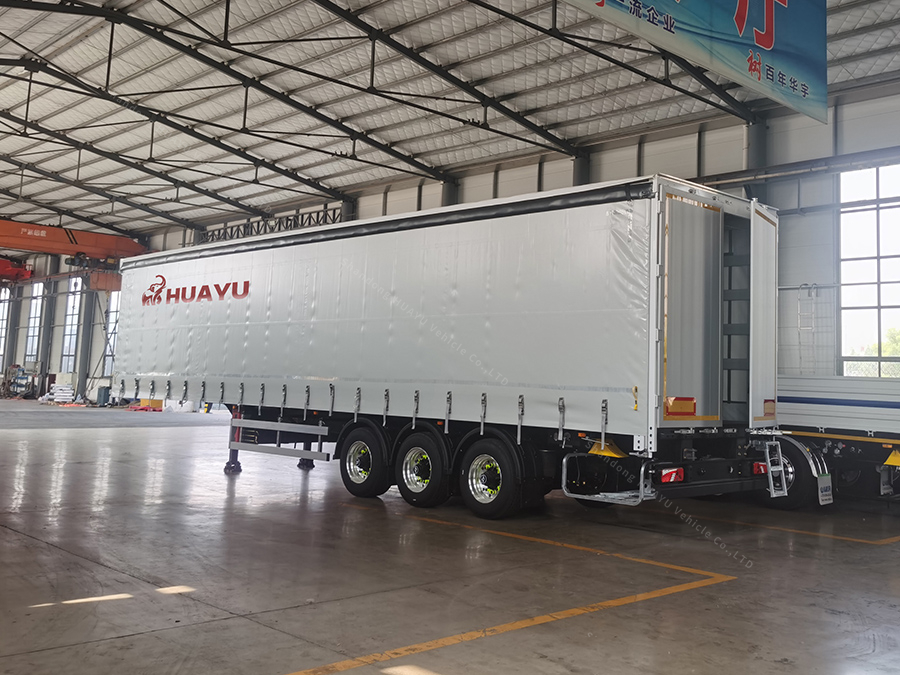
Material durability defines a weather protected curtain side trailer. Tensioned PVC-coated polyester curtains offer robust shielding compared to rigid aluminum or composite walls. Manufacturers use high-frequency welding on the seams to prevent water intrusion. Overlapping valances at the roofline keep rain and snow from penetrating the cargo area during transit.
These systems meet strict moisture, UV, and road debris protection standards. Cargo integrity matches dry van expectations while maintaining flatbed-style access. The heavy-duty PVC resists tearing and withstands extreme temperature fluctuations. When properly tensioned, the curtain forms a drum-tight seal that prevents wind flap and aerodynamic drag. This keeps sensitive freight completely dry and secure across long distances.
Rear doors restrict oversized, irregularly shaped, or wide palletized freight. Standard dry vans cannot accommodate building materials, long extrusions, or wide machinery easily. Side access accommodates these awkward loads effortlessly. Forklifts maneuver wide items straight onto the deck without attempting impossible turning radiuses inside a box.
Structural design impacts overall payload capacity. We must compare tare weights carefully when specifying equipment. A side loading semi trailer requires a reinforced roof and floor structure. The front bulkhead and rear door frame provide the primary structural rigidity. This adds some weight compared to a standard bare flatbed but offers immense dimensional flexibility. You gain the ability to haul flatbed-style freight on the outbound leg and dry-van-style palletized freight on the return leg. This drastically reduces empty miles and maximizes revenue per trip.
Manual flatbed tarping presents severe occupational hazards. Drivers face constant fall risks when climbing over uneven freight to secure heavy canvas tarps. Severe weather exposure and musculoskeletal strain lead to frequent workplace injuries. High winds can catch tarps, pulling drivers off the deck. Ice and rain make the freight slippery and dangerous to navigate.
Curtain systems operate rapidly from ground level. Drivers stay safely outside the trailer during the entire loading process. They walk the perimeter, unbuckle the straps, and slide the curtain. They remain safely separated from active forklift paths. This ergonomic shift drastically reduces workplace injuries, lowers fatigue, and helps fleets retain experienced drivers who no longer want to wrestle with frozen flatbed tarps.
Standard curtains are not load-bearing. This critical safety distinction requires strict internal protocols. The curtain keeps the weather out, but it will not stop a shifting two-ton pallet from spilling onto the highway. Fleets must enforce mandatory internal strapping, edge protectors, and proper load distribution. Drivers must secure every pallet to the floor deck using heavy-duty ratchet straps.
Specialized compliance standards exist for specific applications. EN 12642 Code XL certification provides reinforced, load-retaining curtains. These specialized curtains feature interwoven synthetic webbing that acts like a net. You must evaluate if your freight requires this advanced certification. Even with Code XL curtains, positive load securement practices remain the safest approach to prevent freight damage and ensure highway safety.
Standard load securement procedures for side-loaded freight include:
Applying friction mats beneath pallets to prevent lateral sliding during transit.
Securing heavy-duty ratchet straps over the top of the freight, anchoring them to the side rails.
Placing edge protectors under the straps to prevent damage to the cargo and the webbing.
Verifying that the load is evenly distributed across the axles before closing the curtain.
Curtain systems demand specific maintenance routines to ensure operational longevity. Technicians must perform curtain tear repairs immediately. A small puncture from a forklift tine will expand rapidly under highway wind pressure. Roller track lubrication keeps the curtain sliding smoothly. Dirt, ice, and debris build up in the upper aluminum rails and must be washed out regularly.
Strap replacement and tensioner upkeep prevent operational delays. Weather degradation affects curtains differently than rigid dry van walls. UV exposure hardens the PVC over many years. Freezing temperatures require proactive inspections of the buckles and straps. Driver training remains essential. Operators must understand safe curtain operation, proper tensioning sequences, and securement techniques to prevent equipment damage and maintain the weather seal.
Component | Inspection Frequency | Common Maintenance Action |
|---|---|---|
PVC Curtain Fabric | Daily (Pre-trip) | Patch small tears; clean off road grime. |
Upper Roller Tracks | Monthly | Wash out debris; apply dry silicone lubricant. |
Tensioning Buckles | Weekly | Check for bent mechanisms; replace frayed straps. |
Roof Seals | Quarterly | Inspect overlapping valances for water leaks. |
Identify your ideal use cases before procurement. High-frequency urban logistics, building materials transport, and automotive parts delivery see the highest efficiency gains. These sectors require rapid loading of mixed-dimension freight. If you only haul uniform pallets from one dedicated dock to another, a standard dry van might suffice. If your routing involves multiple stops, varying freight sizes, and limited dock access, curtain sides excel.
Evaluate your ground-level infrastructure carefully. Yard surfaces must support heavy forklift traffic running parallel to the trailer. Soft gravel, deep mud, or heavily potholed pavement will negate your loading speed advantages. Forklifts require smooth, stable concrete or asphalt to lift heavy pallets safely alongside the trailer. Ensure your facility has adequate turning radius space for forklifts to approach the trailer at a perpendicular angle.
Procurement requires a strict technical checklist to ensure reliability. Roof lifting systems provide extra clearance for exceptionally tall freight. Hydraulic or manual roof pumps allow the driver to raise the roofline slightly during loading, preventing snagged curtains. Reinforced flooring handles heavy point-loads from forklift tires, ensuring the deck does not warp over time.
High-quality, low-friction roller mechanisms ensure drivers can open curtains without excessive force. Cheap rollers bind and jam, causing immense frustration and slowing down turn times. Always evaluate the availability of replacement parts. Local repair expertise for your specific curtain system minimizes downtime. Ensure your maintenance provider stocks replacement buckles, straps, and PVC patching materials.
When specifying your equipment, verify these technical requirements:
Confirm the floor rating can handle the combined weight of your heaviest forklift and maximum pallet load.
Select a curtain material weight (e.g., 900gsm) appropriate for your regional weather conditions.
Ensure the front bulkhead is reinforced to prevent forward freight shift during hard braking.
Specify stainless steel tensioners and buckles to prevent rust in high-salt winter environments.
Conduct a time-motion study on your current rear-loading or flatbed-tarping processes to identify exact bottleneck durations.
Audit your yard infrastructure to ensure concrete or asphalt surfaces can support parallel forklift traffic safely.
Develop a comprehensive driver training program focused on ground-level curtain tensioning and internal load securement protocols.
Specify EN 12642 Code XL certified curtains if your operation frequently transports shifting or heavy palletized goods.
A: Transitioning to parallel side loading typically reduces loading and unloading times by 25% to 40%. Multiple forklifts can access the freight simultaneously from ground level, eliminating the linear constraints and staging delays of a single dock door.
A: Yes, high-quality PVC-coated polyester curtains provide excellent weather resistance. When properly tensioned and maintained, overlapping valances and high-frequency welded seams protect cargo from moisture, UV rays, and road debris just as effectively as an enclosed dry van.
A: Yes, but standard curtains are not load-bearing. Heavy or shifting loads require internal strapping and edge protectors secured to the floor deck. For maximum safety, fleets can specify EN 12642 Code XL certified curtains, featuring reinforced webbing designed to retain shifting freight.
A: It completely eliminates manual tarping. Drivers operate the curtain system entirely from the ground, removing fall risks, musculoskeletal strain, and exposure to severe weather. Drivers also remain safely separated from active forklift paths during the loading process.
A: Dry vans require minimal exterior maintenance beyond washing and occasional panel repair. Curtain side trailers demand more frequent inspections. Technicians must lubricate roller tracks, adjust tensioners, and patch PVC tears immediately to prevent wind damage and maintain a tight weather seal.
A: Yes. Drivers must learn how to properly operate the tensioning mechanisms, slide the curtains without damaging the rollers, and execute strict internal load securement protocols, since standard curtains do not provide structural support for the freight.
A: The addition of a roof structure, front bulkhead, rear doors, and curtain mechanisms adds tare weight. This slightly reduces the maximum payload capacity compared to a bare flatbed, but offers superior weather protection, aerodynamic benefits, and eliminates heavy manual tarps.


