
Views: 0 Author: Site Editor Publish Time: 2026-11-03 Origin: Site


Picture a driver pulling onto the scales at a weigh station. In the commercial hauling and transportation industry, the physics of profitability are governed by a strict, unforgiving equation. Every extra pound of trailer mass is a pound of lost payload and diminished profit. Because highway regulations strictly enforce Gross Vehicle Weight Ratings, operators must work within a fixed maximum weight limit. Hastily stripping away metal to maximize cargo capacity is not the answer. Such shortcuts inevitably lead to catastrophic structural failures, costly operational downtime, and severe highway safety hazards.
Fleet owners and owner-operators constantly face a frustrating dilemma. They must choose between a heavy, seemingly indestructible rig that eats into their profit margins, and a lightweight alternative that maximizes payload but might buckle under the punishing impact of abrasive materials. Fortunately, modern manufacturing has evolved far beyond this compromise.
This comprehensive guide explores the engineering principles behind modern trailer construction. We will highlight how industry-leading builders utilize advanced metallurgy, innovative structural geometry, and cutting-edge robotic welding techniques to achieve an optimal equilibrium between a low empty weight and unyielding durability. By understanding material choices, geometric design innovations, and component weight-saving strategies, you will be better equipped to select the exact manufacturing partner for your specific hauling requirements.
To truly grasp the engineering decisions behind commercial trailer construction, one must first define the core metrics that dictate daily operations. Tare weight refers to the total empty weight of the vehicle. This encompasses the chassis, body, and all permanent components. Conversely, the Gross Vehicle Weight Rating is the absolute maximum legal operating weight of the entire configuration, mandated by federal and local transportation authorities.
The math is brutal but simple. Your payload capacity is simply the maximum legal weight minus the combined tare weight of the truck and trailer. Therefore, any reduction in the equipment empty weight directly translates to an equivalent increase in allowable cargo.
The financial mathematics behind lightweight hauling solutions are highly compelling. If an engineered rig weighs 2,000 pounds less than an outdated model, the operator can legally haul an additional 2,000 pounds of aggregate per trip. Multiply that across multiple loads per day, over hundreds of working days a year, and the return on investment becomes highly quantifiable. Increased revenue generated from extra payload capacity routinely offsets the higher initial purchase price of a specialized lightweight unit within the first few years of operation.
Nevertheless, the pursuit of maximum payload cannot supersede structural integrity. Choosing a rig that is excessively light for its intended application introduces severe operational risks. Utilizing a thin-walled aluminum tub to haul large, jagged boulders will inevitably lead to metal fatigue, cracking, and severe denting. Balancing this equation requires a rigorous, objective approach to material selection and structural engineering.
| Material Type | Relative Tare Weight | Durability & Impact Resistance | Best Hauling Application |
|---|---|---|---|
| Traditional Mild Steel | Very Heavy | Moderate to High | General construction, short-haul heavy debris |
| High-Tensile Steel | Optimized / Medium | Extremely High | Demolition rubble, riprap, large abrasive boulders |
| Aerospace Aluminum | Ultra-Lightweight | Moderate | Sand, gravel, agricultural grain, corrosive materials |
The foundation of balancing mass and durability lies in advanced metallurgy. Historically, trailers were constructed using thick, heavy mild steel like A36 to prevent bending and puncturing. Today, leading builders frequently utilize specialized high-tensile and wear-resistant steel plates. Materials like Hardox 450 possess a yield strength that is significantly higher than standard carbon steel.
Because the material is inherently stronger and vastly more resistant to abrasive wear, manufacturers can achieve the required structural integrity using much thinner plates. When engineering a modern end dump trailer, this metallurgical substitution drastically drops the tare weight. It does this without compromising the unit ability to withstand heavy, punishing impacts from falling debris.
For applications requiring the lowest possible empty weight, aerospace-grade aluminum alloys remain the preferred choice. Aluminum is naturally about one-third the weight of steel, offering an immediate and massive reduction in tare weight. Furthermore, it is naturally corrosion-resistant. This makes an aluminum rig highly advantageous for hauling wet sand, gravel, road salt, and agricultural products.
To capture the unique advantages of both materials, many manufacturers have developed sophisticated hybrid configurations. This approach typically involves constructing the primary chassis and lower structural frame out of high-strength steel, ensuring ultimate rigidity and towing stability. The steel foundation is then paired with a lightweight aluminum tub. Consequently, the overall tare weight remains highly competitive while the critical stress points possess unyielding strength.
Beyond material science, structural geometry plays a critical role in balancing weight and strength. The traditional square-box design relies on flat metal plates, which tend to bow or deflect under heavy loads. To prevent this, builders historically added heavy vertical side posts and horizontal bracing ribs.
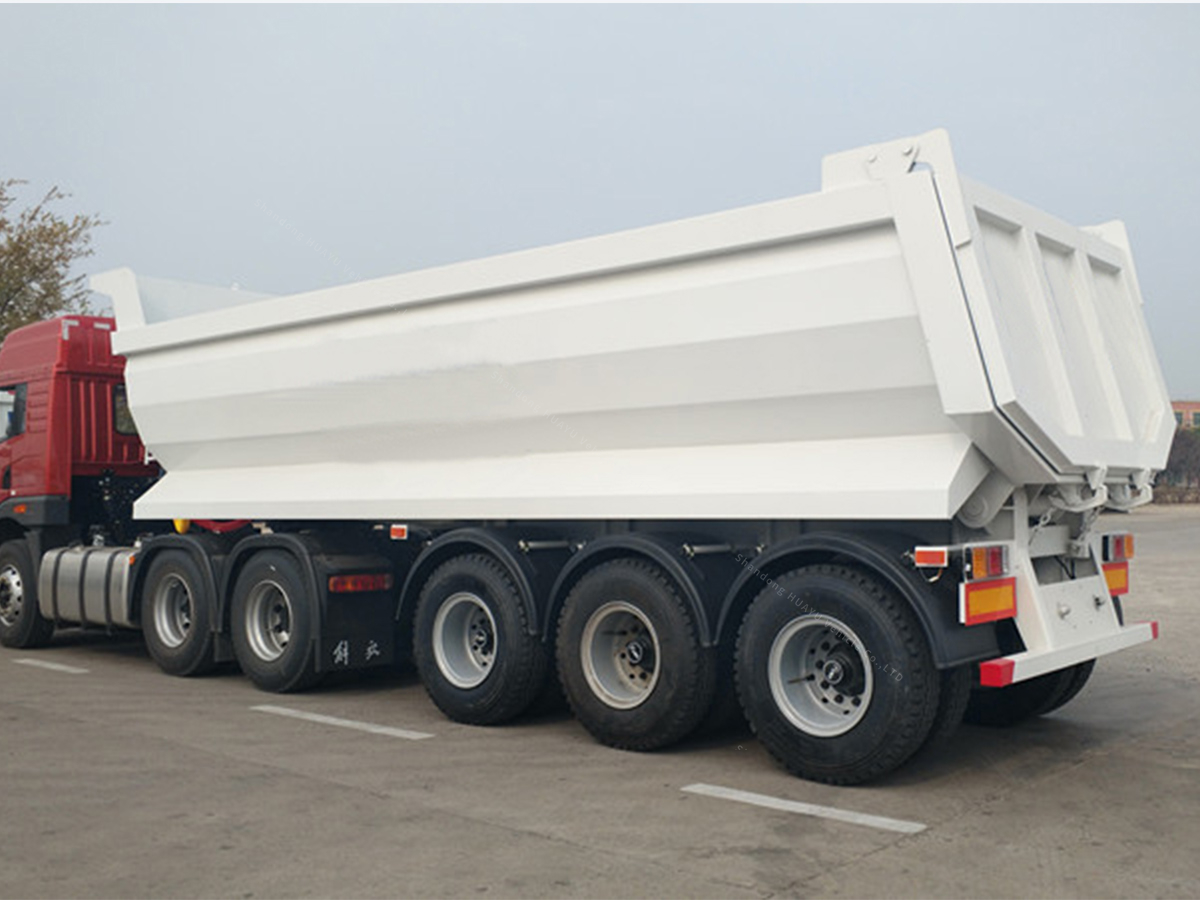
In contrast, the U-shape body design represents a massive engineering advancement. By curving the high-tensile steel into a semi-circle, the trailer naturally resists bending and torsional twisting. This curved geometry mimics the load-bearing properties of an arch, distributing the kinetic energy of falling materials evenly across the surface.
Take a highly optimized U-shape tipper trailer engineered for massive 60-ton payloads. Because the shape itself provides structural rigidity, it entirely eliminates the need for heavy exterior reinforcements. Removing these traditional ribs sheds hundreds of pounds while simultaneously offering a smoother interior that promotes faster, cleaner dumping operations.
The structural framework supporting the tub is another major factor. Frameless units are significantly lighter due to the absence of traditional, heavy lower steel frame rails. They utilize the trailer body itself as the primary load-bearing structure. Frame-type designs feature a full steel chassis beneath the tub. While this increases empty weight, it offers superior stability on uneven or soft terrain, making them indispensable for rugged construction zones.
The modern commercial hauler is not designed by guesswork. It is the product of rigorous computer simulation. Before a single piece of metal is cut on the shop floor, engineers employ Finite Element Analysis software. This digitally simulates the physical stresses, payload loads, and high-impact forces the unit will endure in the real world.
This data-driven approach allows designers to identify exact zones of low stress where metal thickness can be safely reduced. Conversely, it highlights high-stress areas, such as pivot points and suspension mounts, that require localized reinforcement. The result is a highly optimized structure with zero wasted mass.
The method of assembling these optimized materials is just as important. Traditional manual welding is subject to human error. Inconsistent heat application can create weak points, forcing engineers to over-engineer joints with excess overlapping metal. Top-tier manufacturers utilize robotic welding systems to solve this inefficiency. Automated robotics provide perfect, continuous seams with exact heat penetration. By maximizing the structural integrity of every single joint, builders safely eliminate unnecessary overlapping bulk.
While the body and frame account for the majority of a vehicle mass, the undercarriage presents massive opportunities for optimization. Historically, heavy-duty haulers relied on massive steel leaf spring suspensions. Today, swapping solid steel beams for fabricated tubular axles removes internal dead weight.
When specifying a heavy-duty dump trailer, integrating 13-ton or 16-ton high-strength axles paired with advanced air ride suspension systems drastically minimizes overall mass. These setups provide a smoother ride, reducing shock-related fatigue on the chassis, while weighing significantly less than traditional mechanical springs.
The unsprung weight of a rig is a prime target for reduction. A standard tandem-axle setup utilizes eight heavy steel wheels and eight tires. Switching to single wide-base tires mounted on forged aluminum rims saves hundreds of pounds per axle group. Aluminum wheels also dissipate brake heat more efficiently than steel, contributing to longer component lifespans.
The hydraulic lifting mechanism is a dense, heavy component. Modern telescopic hydraulic cylinders, like industry-standard HYVA systems, are manufactured using high-strength steel alloys. This allows for thinner cylinder walls that safely contain higher hydraulic pressures. These optimized cylinders require less hydraulic fluid and operate faster, yet remain fully capable of lifting multi-ton loads safely.
Where is the heavy hauling industry heading? Strict environmental emission regulations and volatile fuel costs are pushing fleet operators toward hyper-optimized payload efficiencies. The demand for lightweight equipment is no longer just about hauling more dirt. It is about reducing the carbon footprint per ton of material moved.
As global supply chain constraints occasionally affect aluminum availability, manufacturers are forced to innovate further with ultra-high-strength steel alloys. The industry goal is to match aluminum weight savings while maintaining steel lower upfront cost and superior abrasion resistance. We are also seeing a rapid rise in smart weighing systems. On-board telematics and integrated digital load cells are rapidly becoming standard. By knowing the exact weight of the load down to the pound, operators perfectly maximize their hauling capacity on every single trip without risking overload fines.
Selecting the optimal equipment requires a strict assessment of your operational realities. The strength-to-weight ratio required by a demolition crew hauling concrete rubble is vastly different from that of an agricultural operator hauling grain. Document the specific gravity of your primary materials, the typical terrain of your drop sites, and your regional bridge law weight restrictions before consulting a manufacturer.
Leading manufacturers operate as engineering partners rather than mere assembly lines. They do not force buyers into one-size-fits-all solutions. A reputable builder will adjust the thickness of the floor plates, modify the tailgate configuration, and select the exact suspension system needed to perfectly balance your payload goals with structural requirements.
An objective indicator of a well-balanced design is the manufacturer warranty. If a builder has successfully reduced weight without compromising strength, they will stand behind their engineering with a robust warranty covering frame integrity and weld quality. Review these terms as a proxy for the manufacturer confidence in their own stress-testing.
Balancing tare weight and structural strength is no longer about making blind compromises. It is a testament to smart, data-driven engineering. Through the strategic use of high-tensile materials, innovative U-shape geometric designs, and highly optimized ancillary components, modern trailers achieve performance metrics that were once thought impossible.
For fleet owners and independent operators, investing in a well-engineered, lightweight hauling solution pays for itself rapidly through increased payload revenue and noticeable fuel savings. The key to profitability lies in matching the right technology to your specific operational environment. Ready to maximize your payload and upgrade your fleet? We encourage you to explore the specialized, high-performance hauling solutions at Huayu Vehicle to spec out a rig that perfectly aligns with your daily demands and long-term financial goals.
A standard tare weight generally ranges from 9,000 to 14,000 lbs. This variance depends heavily on the unit overall length, the primary material used in construction, and the architectural framework. Frameless configurations are inherently lighter than traditional frame-type models.
Aluminum is highly durable and more than strong enough for hauling aggregates, sand, and agricultural grain. However, it does not possess the same impact resistance or hardness as high-tensile steel. For high-impact loads like large demolition debris or heavy boulders, steel remains the required industry standard to prevent severe structural damage.
Reputable manufacturers utilize a comprehensive combination of digital simulation and physical testing. This process begins with Computer-Aided Design modeling and Finite Element Analysis to simulate stress distribution mathematically. Following the digital phase, prototypes undergo rigorous real-world stress testing under maximum payload conditions to verify weld durability.
Federal and local bridge laws dictate how much weight can be carried based on the distance between the axles. To maximize legal payload while keeping tare weight low, engineers often design longer wheelbases or integrate drop axles. This spreads the gross vehicle weight over a larger area, ensuring compliance without unnecessarily beefing up the main chassis frame.
When properly matched to its intended application, a lightweight rig can easily last 10 to 15 years. The lifespan depends entirely on operating within the designed payload limits and avoiding highly abrasive materials if the tub is made of thin-walled aluminum. Regular maintenance of pivot points and hydraulic cylinders also significantly extends operational life.
Yes, typically it does. Advanced materials like aerospace-grade aluminum or wear-resistant steel, combined with specialized engineering and robotic manufacturing processes, carry a higher initial price tag. However, fleet operators usually realize a rapid return on investment through increased per-trip payload revenue and improved empty-mile fuel efficiency.


