
Views: 0 Author: Site Editor Publish Time: 2026-11-08 Origin: Site


Every single day, a cement tanker trailer handles massive internal pressure. When discharging heavy bulk materials, these specialized vessels transform into highly pressurized environments. Consequently, weak tank shells risk fatal blowouts. They cause catastrophic safety hazards and result in significant lost cargo. How do engineering experts pressure test these vessels? This exact diagnostic process guarantees total safety, quality, and longevity for buyers and fleet operators.
To comprehend why pressure testing is strictly enforced, you must first understand the operational mechanics at play. Unlike standard liquid tankers relying on gravity, these specialized trailers utilize a pneumatic discharge system. An onboard or external air compressor forces compressed air into the tank shell. The air passes through a fluidizing bed, temporarily giving the solid powder fluid-like properties. As a result, the material pushes out efficiently through the discharge valves and into storage silos.
The tank shell plays a fundamental role in this process. Take a standard powder pneumatic trailer for example. A 40CBM tri-axle unit relies heavily on its V-shape or W-shape design to optimize gravity feeding toward the bottom discharge points. Manufacturers construct the shell from high-tensile carbon steel, lightweight aluminum alloys, or corrosion-resistant stainless steel. Because the entire vessel becomes a sealed environment during unloading, its structural integrity remains absolutely paramount.
The standard operating pressure generally hovers around 0.2 MPa, roughly 29 PSI. However, engineering safety protocols dictate testing the shell to withstand pressures significantly higher than its normal operating threshold. This critical safety margin accounts for potential pressure spikes, compressor malfunctions, or blockages in the discharge pipeline. It ensures the vessel remains intact under unexpected stress.
Extensive welding seams hold the primary structural framework of a tank shell together. Modern manufacturers utilize automated submerged arc welding to join the metal plates. This process creates deep, uniform welds. Despite advanced manufacturing techniques, microscopic flaws can occasionally occur in the heat-affected zones. Pressure testing intentionally stresses these welds beyond their standard operational limits. By applying elevated pressure, inspectors verify there are no hidden flaws, internal cracks, or weak points in the metal joints. Such defects could easily propagate under the continuous vibration of highway transit.
Dry bulk materials like cement and fly ash are highly sensitive to environmental factors. If moisture enters the tank shell, it reacts with the cement. The material hardens instantly, rendering the cargo completely useless. Conversely, microscopic leaks allow valuable fine powder to escape into the atmosphere during transit. Rigorous testing ensures a hermetic seal. It confirms external moisture cannot penetrate the vessel and internal cargo remains completely secure.
A pressurized tank blowout represents a severe industrial hazard. If a shell ruptures while holding 0.2 MPa of compressed air, the sudden release of energy causes catastrophic damage. It hurls metal debris at high velocities. Operating a properly tested dry powder trailer directly protects the heavy-duty truck driver, the silo unloading crew, and the general public sharing the road. Documented testing provides definitive engineering proof that the vessel poses no explosive risk under normal operating conditions.
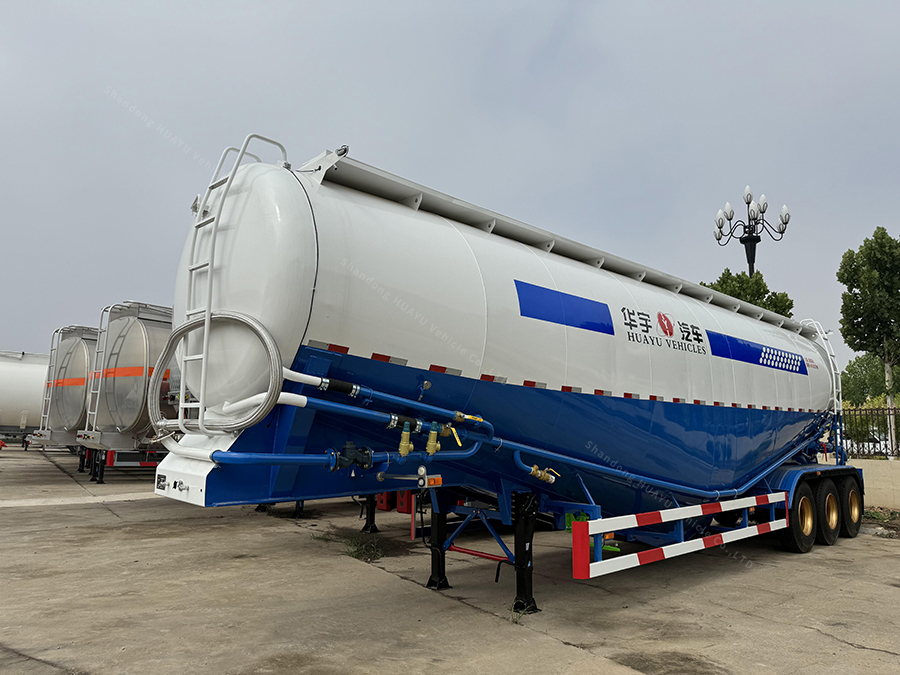
Before applying any pressure to the tank shell, technicians follow a rigorous preparation protocol. This ensures accurate results and maintains workplace safety.
Visual Inspection: The process begins with a comprehensive physical examination of the interior and exterior. Inspectors meticulously look for obvious manufacturing defects, surface rust, metal fatigue, or remaining welding debris. They address any sharp edges or structural anomalies before subjecting the vessel to high stress.
Sealing the Vessel: To evaluate the ability to hold pressure, the environment must be completely airtight. Technicians systematically close and secure all manhole covers. They tighten the bolted clamps to specified torque ratings using heavy-duty wrenches. Furthermore, all discharge valves, air intake valves, and blow-off valves are shut completely. Technicians often temporarily cap the pressure relief valve or calibrate it to a higher threshold specifically for the diagnostic test duration.
Calibrating Test Equipment: Accurate data collection relies on precise instrumentation. Engineers install highly sensitive pressure gauges at multiple points on the tank shell. These gauges require recent calibration against recognized metrological standards. This prevents false positives or missed leaks during the evaluation.
The actual testing procedure is a highly controlled, methodical operation. It safely monitors how the tank responds to extreme stress.
Whether utilizing air or water, technicians slowly introduce the pressurization medium into the tank. They never spike the pressure abruptly. Instead, they increase it in measured, incremental stages, typically 0.05 MPa at a time. This gradual increase allows engineers to listen for structural groans. They monitor how the metal shell expands, providing a critical window to halt the test immediately if a major structural failure begins to manifest.
The internal pressure steadily rises until it reaches the designated test target. According to standard engineering practices for pressure vessels, this target is typically 1.25 to 1.5 times the standard working pressure. For a trailer operating at 0.2 MPa, the test pressure generally hits between 0.25 MPa and 0.3 MPa. Reaching this elevated threshold without incident proves the vessel possesses the necessary safety margin.
Once achieving the target pressure, technicians close the input valves. The system enters the holding period, usually lasting between 15 to 30 minutes. During this time, the internal environment must remain absolutely constant. Inspectors monitor the calibrated gauges closely. Even a fractional drop in pressure indicates the compressed medium is escaping the shell, signaling an active leak.
For pneumatic tests, inspectors employ a highly effective leak detection method. They generously spray a soapy water solution over all welding seams, mechanical joints, manhole seals, and valve connections. Should air escape through a micro-fracture, it continuously blows bubbles in the soapy solution. This instantly reveals the exact location of the defect for the welding team to repair.
Manufacturers typically choose between two primary pressure testing methods. Each offers unique diagnostic advantages for verifying vessel safety.
| Testing Feature | Hydrostatic Testing | Pneumatic Testing |
|---|---|---|
| Test Medium | Incompressible Water | Compressed Air |
| Safety Level | Extremely High. Ruptures result in harmless water leaks. | Requires strict protocols. High potential energy risks blowouts. |
| Primary Application | Initial manufacturing certification of the bare metal shell. | Final assembly verification mimicking real-world conditions. |
| Defect Visibility | Visual water droplets identify exact leak locations easily. | Requires soapy water solution to spot escaping air bubbles. |
Leading manufacturers often combine these methods to ensure maximum reliability. Hydrostatic tests verify the raw shell's baseline integrity. In contrast, pneumatic tests confirm the entire assembled system is ready for the road.
Looking at recent developments across the industrial transport sector, there is a clear shift toward digital integration during pressure testing. Modern regulatory bodies and fleet managers increasingly demand real-time data logging rather than relying solely on manual gauge readings. Advanced acoustic emission sensors are now frequently attached to tank shells during the pressurization phase. These sensors detect the high-frequency sound waves generated by microscopic crack propagation long before a visual leak occurs.
Additionally, lightweight aluminum alloys are becoming prevalent to maximize payload capacity. Consequently, testing protocols are growing stricter. Aluminum possesses different fatigue characteristics than carbon steel. This prompts the industry to adopt prolonged holding periods and automated stress-strain mapping to guarantee long-term structural resilience.
The primary goal of pressure testing is diagnostic. Identifying flaws early prevents costly accidents on the road.
Welding Porosity and Slag Inclusions: Welds act as critical stress points. During manufacturing, tiny gas bubbles can become trapped in the molten metal, causing porosity. Alternatively, flux residue accidentally welds into the joint. Both issues create microscopic tunnels through the metal. Under high pressure, these weak spots yield, causing measurable pressure drops on the testing gauges.
Faulty Manhole Seals: The rubber gaskets lining the top manhole covers are frequent culprits for pressure loss. If the rubber is deformed, improperly seated, or degraded, it cannot maintain an airtight seal against the immense upward force of compressed air. Replacing a compromised gasket in the factory is exponentially cheaper than dealing with an on-site product leak.
Valve and Piping Misalignments: A cement transport trailer features an intricate network of air intake pipes, check valves, and discharge conduits. High-pressure testing often reveals loose flange connections, misaligned pipe threads, or faulty butterfly valves. These components might function fine under normal conditions but fail entirely under peak stress.
How do you choose a reliable bulk power tanker based on engineering specifications? Buyers must look beyond the paint job and focus on certified mechanical parameters.
First, demand certified test pressure documentation. If the standard working pressure is 0.2 MPa, the manufacturer must provide proof of a successful test at 0.25 MPa to 0.3 MPa. Second, evaluate the shell material thickness. A standard 40CBM tri-axle tanker should feature a shell thickness of 4mm to 6mm, depending on the alloy type, to withstand thousands of repeated pressurization cycles. Finally, inspect the discharge valve quality. Ensure the manufacturer installs premium butterfly valves and check valves that have passed independent pneumatic stress tests.
International engineering codes strictly govern the manufacturing and testing of pressure vessels.
International Standards: In the United States, the Department of Transportation and the ASME Boiler and Pressure Vessel Code outline exact testing parameters. In China, the GB/T 150 standard governs pressure vessel safety. These regulations dictate test pressure ratios, holding period durations, and acceptable gauge fluctuation tolerances. Upon passing, a metal certification plate is permanently welded to the trailer chassis, displaying the maximum working pressure and test date.
Lifecycle Testing Frequency: Pre-delivery testing is absolutely mandatory for every new unit. Due to the abrasive nature of dry bulk materials, fleet operators should conduct routine pressure tests annually or bi-annually. Furthermore, if the tank shell sustains damage requiring welding repairs or component replacements, the original safety certification instantly voids. A full, documented pressure test must occur to recertify the vessel.
Pressure testing a cement transport vehicle shell is a highly controlled, multi-step process designed to push the vessel beyond its normal limits. This rigorous evaluation guarantees the structural safety and operational reliability of your heavy equipment. When expanding your fleet, prioritize high-quality, rigorously tested equipment to protect your crew, secure your cargo, and extend your operational lifespan.
Looking for engineered reliability and proven performance? Explore the full range of certified, heavy-duty transport solutions at Huayu Vehicle. Their expertly manufactured trailers guarantee maximum payload efficiency and total compliance with international safety standards. Contact Huayu Vehicle today to upgrade your bulk material transport fleet with confidence.
The standard working pressure for most cement transport trailers is typically around 0.2 MPa, which is roughly 29 PSI. Engineers intentionally test the shell at a higher threshold, usually 0.25 MPa to 0.3 MPa, to ensure a robust safety margin.
The actual holding phase of the test usually takes 15 to 30 minutes. However, the entire diagnostic process takes several hours. This includes meticulous preparation, sealing all valves, gradual pressurization, and thorough soapy water inspections.
Yes, if tested pneumatically with compressed air and a major structural flaw exists, a dangerous rupture can occur. This is exactly why pneumatic testing executes in controlled environments with strict safety protocols. Manufacturers often utilize hydrostatic testing with water first to mitigate explosive risks.
If a failure occurs, inspectors carefully identify the exact location of the leak or structural weakness. They safely release the pressure, and the welding team repairs the defect. Following the repair, the trailer undergoes a completely new test from scratch.
Yes. Because these trailers operate as active pressure vessels on public highways, transportation and safety authorities worldwide legally require them to pass strict pressure tests before commercial registration.
Temperature fluctuations directly impact the internal pressure of a sealed vessel. Testing must occur in stable ambient temperatures. If the temperature drops significantly during the holding period, the pressure gauge will drop, potentially causing a false leak reading. Engineers account for ambient temperature variables when logging test data.
Absolutely. If a shell cracks or suffers impact damage, certified welders can patch and repair the structural integrity. However, the vessel cannot return to service until it passes a comprehensive, newly documented pressure test to verify the repair work.


