
Views: 0 Author: Site Editor Publish Time: 2026-07-21 Origin: Site


Hauling a 100-ton payload is not a matter of simply buying a trailer with a high structural capacity rating; it requires a precise mathematical balance between gross vehicle weight, axle distribution, and strict regulatory compliance. Miscalculating axle requirements for extreme heavy haul operations leads to structural fatigue, catastrophic equipment failure, denied transport permits, and severe regulatory fines under federal or regional bridge laws. When you put that much steel on the deck, the physics of the road change entirely. You cannot rely on guesswork or standard trailer specs. To determine exactly how many axles are required for a 100 Ton Lowbed Trailer, fleet managers must evaluate payload weight, trailer tare weight, per-axle load limits, and the specific configurations like jeeps, boosters, and modular lines necessary to legally distribute the load across the pavement.
Understanding the difference between payload and Gross Combination Weight (GCW) is the absolute foundation of heavy haul logistics. The payload is simply the 100-ton machine you need to move. The GCW dictates your actual axle requirement. GCW includes the payload, the trailer, the tractor, and any additional load-distributing attachments you bolt on. Regulatory bodies do not issue permits based solely on payload. They evaluate the GCW and how that total weight transfers to the pavement. If you ignore the tare weight of your equipment, you will fail the permit application before the truck even fires up.
A heavy-duty trailer designed for this class requires massive structural steel. The empty trailer itself can weigh between 25 and 40 tons. This variance depends on deck length, steel thickness, and necessary reinforcements. When you add a heavy-haul tractor, you quickly add another 10 to 15 tons to the equation. Your 100-ton payload instantly creates a 135-ton to 155-ton gross problem. You have to account for every single pound of steel, rubber, and fuel when calculating your axle spread.
The prime mover absorbs a specific portion of this weight. A standard 3- or 4-axle heavy-haul truck connects via the fifth wheel. This connection transfers a percentage of the load forward onto the tractor's drive and steer axles. The remaining weight pushes directly down onto the trailer axles. You must calculate this exact split to avoid overloading the rear axle groups. If your fifth wheel placement is off by just a few inches, you can overload your drives and blow a tire at highway speeds.
You must also differentiate between a trailer's total weight rating and its concentrated weight rating. Hauling 100 tons over a short 10-to-16-foot span alters stress dynamics drastically. A fully distributed deck span spreads the load evenly across the main beams. A concentrated load acts like a blade, focusing immense pressure on a small section of the frame. A trailer rated for 100 tons distributed might snap in half if that same weight is concentrated in a 10-foot footprint. We see this happen when operators try to load massive transformer units onto standard decks without proper load distribution engineering.
Lowboy double-drop designs utilize well decks to manage these forces. These well decks lower the load's center of gravity. This optimizes lateral stability during transport. It also ensures uniform weight transfer across the front and rear axle clusters, preventing dangerous sway during transit. When you drop the deck height to 18 or 24 inches off the ground, you clear overhead obstacles and keep the trailer tracking straight behind the tractor.
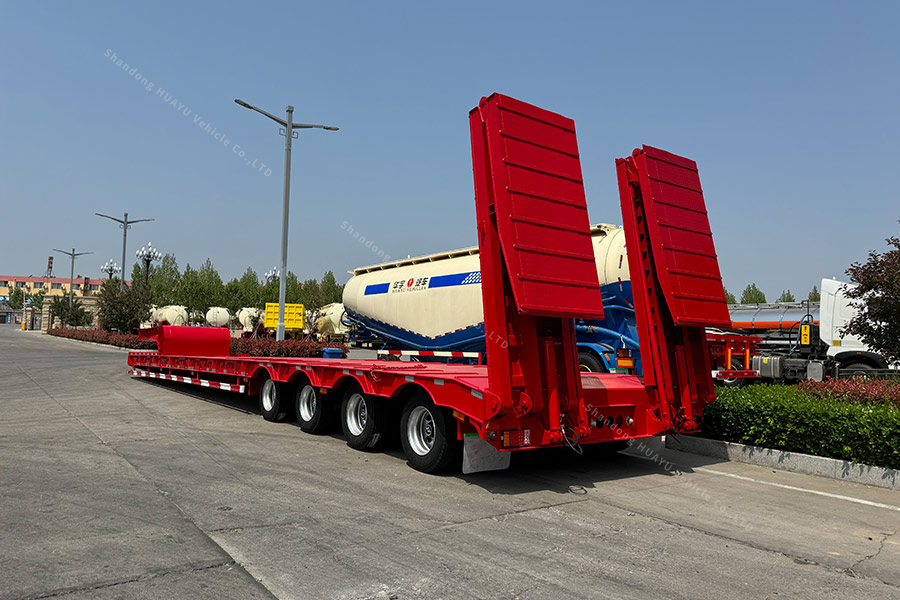
Axle requirements scale aggressively as load weights increase. You cannot simply add one axle for every extra 10 tons of payload. The structural dynamics change entirely as you move into extreme weight classes. You have to build a combination vehicle that satisfies both the physical limits of the steel and the legal limits of the road surface.
The baseline regulatory math is rigid. Many jurisdictions enforce a standard 20,000 lbs (10-ton) per-axle limit. If your GCW is 140 tons, you need at least 14 axles distributing that weight perfectly. This is a simplified baseline, but it dictates your starting configuration. You cannot cheat the scales. If you roll across a weigh station with 25,000 lbs on a single axle, you will be parked, fined, and forced to bring in a crane to re-distribute the load.
The Federal Bridge Gross Weight Formula dictates more than just axle counts. It regulates the required spacing between those axles. Tightly grouped axles damage bridges faster than widely spaced axles. You must extend the wheelbase to comply with bridge laws. This often requires adding jeeps and stingers to stretch the load footprint. The longer the distance between the extreme front and extreme rear axles, the more total weight the bridge formula allows.
| Trailer Configuration | Typical Payload Capacity | Common Application |
|---|---|---|
| 3-Axle Lowboy | Up to 35 Tons | Standard construction equipment |
| 4-Axle Lowboy | Up to 50 Tons | Mid-sized excavators and dozers |
| 5-Axle Lowboy | 50 to 60 Tons | Heavy mining equipment parts |
| Modular / Multi-Axle (10+ total) | 100+ Tons | Extreme heavy haul, transformers |
To distribute a 100-ton payload, you must calculate the exact percentage of tongue weight resting on the tractor's fifth wheel. If the tractor handles 25 tons, the remaining weight sits on the trailer's rear axle groups. You must divide that remaining weight by the legal limit per axle to find your minimum rear axle count. This requires precise load placement. Moving a 100-ton machine forward or backward by just six inches can shift thousands of pounds between axle groups.
This math explains why a standard 4-axle trailer falls short. Placing a 100-ton payload on a 4-axle trailer yields an illegal and structurally catastrophic 25+ tons per axle. The tires will blow out, the suspension will fail, and the frame will likely crack under the concentrated stress. You cannot force a mid-weight trailer to do a heavy-haul job. It always ends in equipment failure and massive liability.
For extreme payloads, operators rely on multi-axle and modular lowbeds. These include 7-to-10 axle continuous line trailers designed specifically for extreme payloads. These trailers distribute weight evenly across a massive footprint. They utilize hydraulic suspensions to ensure every tire maintains equal contact with the road surface. When you hit a dip or a bump, the hydraulic cylinders adjust instantly, preventing any single axle from taking the full brunt of the 100-ton load.
Distributing a 100-ton load often requires a combination approach. Operators utilize jeeps in the front and boosters (stingers) in the rear. A common setup might include a 3-axle jeep, a 4-axle lowboy, and a 3-axle booster. This spreads the footprint over a much longer span. The jeep absorbs weight before it reaches the tractor. The booster extends the rear bridge measurement, satisfying strict regional bridge formulas. Setting up this combination takes time and expertise, but it is the only legal way to move this much weight down a public highway.
When loads exceed standard lowboy capabilities, operators turn to Self-Propelled Modular Transporters (SPMTs). You must compare traditional heavy equipment trailer setups against hydraulic modular lines. SPMTs offer independent steering on every axle. This provides unmatched maneuverability for 100-ton loads in tight industrial environments. However, traditional heavy haul configurations remain the standard for highway transport due to speed capabilities. SPMTs max out at walking speed, making them useless for cross-country transport.
The gooseneck configuration dictates how efficiently you can load and transport your equipment. Hydraulic Removable Goosenecks (RGN) are superior for 100-ton loads. They assist in load transfer and simplify the loading process. An RGN allows you to detach the neck, creating a gentle ramp for heavy tracked equipment. Mechanical and fixed-neck designs require cumbersome ramps and struggle to manage extreme weight transfer effectively. When you are loading a 100-ton excavator, you want the deck flat on the ground. RGNs make this possible.
Physical dimensions of the 100-ton load dictate your well length and axle spacing. You must measure the track length of the machine. The deck must fully support this footprint. If the deck is too long, you add unnecessary tare weight. If it is too short, you risk concentrating the load dangerously. Proper axle spacing ensures you meet bridge laws while maintaining structural integrity during oversized load transport. Every inch of deck space must be engineered for a specific purpose.
Suspension choice is another critical factor. Air ride suspensions work well for lighter loads, but 100-ton payloads demand heavy-duty hydraulic or mechanical trunnion suspensions. Hydraulic systems allow you to raise and lower the deck to clear railroad tracks or navigate under low bridges. They also provide superior load equalization across all axles. If you run a rigid mechanical suspension on a 100-ton load, the frame will take a beating on uneven roads, leading to premature weld cracking.
Tire selection cannot be ignored. You need heavy-ply tires rated for extreme weight. Standard commercial truck tires will shred under the lateral forces generated by a 100-ton load navigating a tight turn. You must spec tires that match the axle capacity and the intended speed of the transport. Heat buildup is a major issue in heavy haul, so maintaining proper tire pressure is a daily requirement on the job site.
Finally, consider the braking system. Stopping a 150-ton GCW vehicle requires massive braking power. You need oversized drum brakes or heavy-duty air disc brakes on every single axle. The tractor's engine brake will help, but the trailer must be able to stop itself. If the trailer brakes fade on a steep downgrade, the entire combination will jackknife. Spec your trailer with the largest, most aggressive braking system available.
A: No. A standard 4-axle lowboy is typically rated for up to 50 tons. Placing 100 tons on four axles will exceed legal per-axle weight limits and cause catastrophic structural failure.
A: Payload is the weight of the cargo being hauled. Gross Combination Weight (GCW) includes the payload, the trailer, the tractor, and any attached load-distributing equipment.
A: Jeeps and boosters add axles and extend the wheelbase of the combination vehicle. This distributes the massive weight over a larger area, satisfying strict bridge weight formulas.
A: An empty trailer designed to haul 100 tons typically weighs between 25 and 40 tons, depending on the deck length, steel thickness, and specific configuration.
A: A concentrated load rating specifies how much weight the trailer can support over a short specific distance, typically 10 to 16 feet, rather than spread across the entire deck.
A: Yes. Moving a 100-ton payload always requires specialized heavy haul permits, route surveys, and often police escorts to ensure the road infrastructure can handle the weight.


