
Views: 0 Author: Site Editor Publish Time: 2026-11-09 Origin: Site


A single overweight violation at a highway scale can cost a fleet thousands of dollars in Department of Transportation fines. Worse, it triggers cascading delivery delays that frustrate clients. On the flip side, chronically underloading your shipping container trailer out of an abundance of caution simply leaves hard-earned revenue sitting on the loading dock. Balancing legal weight constraints with maximum operational profit remains one of the most persistent challenges in modern logistics.
These specialized trailers serve as the critical backbone of intermodal transport. They bridge the massive capacity of ocean vessels with the strict realities of highway infrastructure. In this comprehensive technical guide, we break down exact payload capacities and explore how different equipment types impact your bottom line. We will also navigate the complex web of road limits. By the end, you will have the actionable engineering insights needed to optimize your fleet carrying capacity safely and legally.
To accurately determine how much mass a transport setup can legally handle, operators must first establish a crystal-clear understanding of fundamental industry terminology. Miscalculating these metrics is the fastest route to regulatory penalties and accelerated mechanical failure.
Tare weight refers to the unladen, empty weight of your transport equipment. In intermodal drayage, this calculation must factor in the weight of the empty shipping box itself, alongside the empty weight of the trailer and the semi-truck pulling it. Every single pound of tare weight directly subtracts from the amount of profitable freight you can legally haul. Older chassis manufactured with heavy-duty carbon steel inherently limit your operational payload compared to modern, lightweight alternatives.
The Gross Vehicle Weight Rating is the absolute maximum operating weight of a vehicle system. Manufacturers specify this limit, and transportation authorities regulate it strictly. The gross weight encompasses the tractor, the chassis, the empty box, fuel, the driver, and the actual goods combined. Pushing past this rating compromises the structural integrity of the axles, braking systems, and suspension components. This creates severe highway hazards.
Payload is the net weight of the goods generating revenue. Dispatchers and logistics professionals rely on a strict empirical formula to calculate the maximum legal carrying capacity for a specific trip. You subtract the combined empty weights of your equipment from the maximum allowable gross limit of the jurisdiction you are traveling through.
Maximum Payload = Gross Weight Limit - Truck Weight + Trailer Weight + Container Tare Weight
Manufacturers build shipping containers to rigorous International Organization for Standardization specifications. These engineering standards dictate the absolute physical limits a box can withstand before structural failure occurs. When paired with a reliable chassis, these units exhibit impressive load-bearing capabilities.
The standard 20-foot dry freight box is structurally robust. Engineers designed it primarily to transport heavy, high-density materials. According to standardized specs, a 20-foot unit typically features a maximum engineered payload capacity of approximately 62,000 lbs or 28,120 kg. Because of its compact footprint and high structural rigidity, this size is the optimal choice for industries dealing in raw metals, industrial machinery, dense agricultural bulk, and construction materials like ceramic tiles.
A standard 40-foot unit offers double the internal volume of a 20-foot box. This makes it the preferred choice for palletized goods, retail apparel, and furniture. However, it presents a fascinating logistical paradox. Despite its larger size, its maximum engineered payload capacity is slightly lower, typically capping around 59,000 lbs or 26,760 kg.
This reduction occurs because the 40-foot unit itself requires substantially more steel to construct. The increased empty weight of the larger box eats into the total allowable gross mass. Consequently, fleets heavily utilize 40-foot units for volume-driven freight rather than weight-driven cargo.
| Container Type | Max Engineered Payload | Typical Tare Weight | Optimal Cargo Profile |
|---|---|---|---|
| 20-Foot Standard | ~62,000 lbs | ~5,000 lbs | High-density raw materials, machinery, liquids |
| 40-Foot Standard | ~59,000 lbs | ~8,400 lbs | Palletized retail goods, furniture, electronics |
| 40-Foot High Cube | ~58,000 lbs | ~8,700 lbs | Lightweight, high-volume consumer goods |
A critical challenge in intermodal transport is the massive discrepancy between what a box is engineered to hold, what a cargo ship can legally carry, and what local highway infrastructure can actually support. A load packed to its maximum engineered capacity is often perfectly legal for ocean transit but strictly illegal the moment it hits the interstate.
Under the Safety of Life at Sea convention, shippers must declare the Verified Gross Mass of a packed unit before port operators load it onto a vessel. Modern ships and port cranes are engineered to handle massive, concentrated loads. Therefore, ocean freight regulations generally permit packing right up to the maximum engineered limit, provided the weight is accurately documented to ensure proper vessel stowage and stability.
Once that same box is discharged at a port and placed onto a chassis, it becomes subject to local road regulations. In the United States, the Department of Transportation and the Federal Bridge Gross Weight Formula govern highway limits. The standard federal gross vehicle weight limit for a conventional 5-axle tractor-trailer combination is 80,000 lbs.
When you account for the tare weight of an average semi-truck, a standard chassis, and the empty box, the equipment alone consumes roughly 36,000 lbs of your allowance. This mathematical reality restricts the actual road-legal cargo weight of a standard setup to approximately 44,000 to 45,000 lbs. Shippers must proactively plan their loads based on the most restrictive leg of the journey.
As operating margins in the transport sector tighten due to fluctuating fuel prices and strict emission mandates, a clear industry trend has emerged. Fleets are aggressively pushing toward equipment lightweighting combined with smart compliance technology. Market analysis shows a significant surge in demand for chassis manufactured utilizing advanced high-yield steel, such as T700, and aerospace-grade aluminum alloys.
These advanced materials allow manufacturers to shave thousands of pounds off the tare weight without sacrificing structural yield strength. This engineering shift effectively claws back lost payload capacity for carriers. Furthermore, modern fleets are increasingly adopting dynamic load-planning software. Rather than relying on static 80,000 lbs estimates, logistics managers use predictive routing algorithms that analyze specific state-by-state bridge laws and real-time weigh station data. This tech-driven approach allows carriers to push their payloads to the absolute legal maximums for specific routes.
The specific type of rig selected for intermodal drayage has a direct, measurable impact on payload capacity and operational flexibility. Logistics operators must choose equipment that aligns perfectly with their primary cargo profiles.
Skeleton frames, commonly referred to as container chassis, are purpose-built structures designed exclusively for transportation from ports and rail yards. They feature a minimalist, bare-bones structural design equipped with standardized twist locks to secure the load at its corner castings.
The primary advantage of a skeleton chassis is its exceptionally low tare weight. By eliminating the solid decking and heavy side rails found on other rigs, manufacturers significantly reduce the unladen weight. For example, a high-quality 2-axle skeleton trailer for sale from top manufacturers typically weighs around 5,600 kg. This weight savings translates directly into a higher legal cargo allowance. For fleets focused strictly on port drayage, this is the most efficient method to maximize legal highway limits.
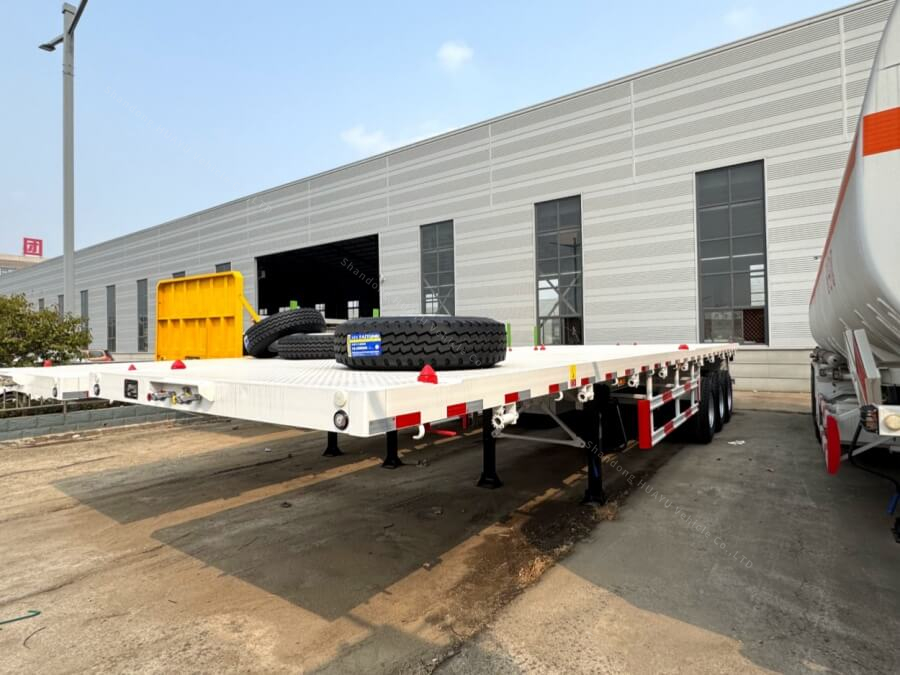
Flatbed semi-trailers offer a high degree of operational versatility. Unlike skeleton chassis, flatbeds feature a solid, continuous deck. This design allows operators to haul shipping boxes using integrated pop-up twist locks, as well as a wide variety of other freight, such as palletized goods, oversized machinery, and construction materials.
However, this versatility comes with a distinct payload tradeoff. The solid steel decking, additional cross-members, and reinforced side rails add substantial empty weight to the vehicle. A robust 3-axle flatbed trailer for sale might weigh around 7,500 kg. Consequently, when hauling a box on a flatbed, the maximum legal cargo weight drops by nearly two tons compared to a skeleton frame. Fleets requiring multi-purpose functionality accept this slight reduction in exchange for broader freight opportunities.
Operating a rig that exceeds legal gross weight or axle weight limits carries severe operational, financial, and safety repercussions. Highway patrols enforce these limits strictly to protect public infrastructure.
Imagine pulling into a commercial weigh station off the interstate, only to be flagged because a heavy industrial lathe was loaded too far to the rear. This overloads your tandem axles. Authorities issue substantial fines for these infractions. Even worse, the vehicle is typically placed out-of-service until the weight is corrected. This nightmare scenario requires dispatching a second truck and a forklift to offload and redistribute the freight right there at the scale.
Beyond the immediate financial hits, the physical toll on the rig is severe. Empirical data demonstrates that chronic overloading accelerates the mechanical degradation of transport equipment. It places immense stress on the suspension systems, increases the risk of tire blowouts due to excessive heat generation, and causes premature axle fatigue.
Specifically, an overweight setup drastically increases the stopping distance of the vehicle. It also raises the center of gravity, making the truck highly susceptible to catastrophic rollovers when navigating sharp highway off-ramps.
Maximizing your carrying capacity is not solely about the total numbers on the scale. It is equally dependent on how that mass is distributed within the box. Proper loading protocols ensure compliance with axle weight regulations and maintain vehicle stability.
Cargo must be distributed evenly across the entire floor space. If dock workers place heavy machinery entirely at the nose, it will overload the tractor drive axles. If placed at the rear, it overloads the trailer tandem axles. Logistics planners must calculate the center of gravity meticulously, ensuring the load is balanced both front-to-back and side-to-side.
Once the weight is perfectly balanced, it must be immobilized. Freight shifting during transit alters the weight distribution dynamically. This can cause a perfectly legal load to become non-compliant mid-journey. Operators must utilize proper dunnage, heavy-duty ratchet straps, and blocking techniques.
Furthermore, the most effective preventative measure is empirical verification. Before entering interstate highways, drivers should route their rigs to a certified commercial scale, such as a CAT scale. Obtaining an accurate gross weight and individual axle weight breakdown allows the driver to adjust the sliding tandems. This corrects minor weight distribution issues before encountering strict enforcement.
Selecting the appropriate rig requires a systematic evaluation of your specific logistical requirements. Making an informed purchasing decision ensures regulatory compliance while optimizing your revenue per mile. Use these actionable criteria to guide your fleet upgrades.
1. Assess Your Primary Cargo Profile: Analyze the density and volume of the freight you transport most frequently. If your operations are dedicated exclusively to hauling heavy, dense goods directly from ports, a lightweight skeleton chassis is the optimal choice. It strips away unnecessary steel to give you maximum payload.
2. Evaluate Axle Requirements: If your loads frequently push the boundaries of standard tandem axle limits, upgrading to a tri-axle setup is necessary. A tri-axle rig distributes the mass over a larger surface area, keeping you compliant with bridge formulas when hauling heavy 20-foot units.
3. Determine Need for Versatility: If your fleet alternates between intermodal drayage and general freight, a versatile flatbed provides necessary business adaptability. You will sacrifice roughly 2 tons of payload capacity due to the heavier deck, but you gain the ability to haul oversized machinery when port freight is slow.
While modern shipping boxes possess the physical engineering to hold over 60,000 lbs of cargo, the reality of intermodal logistics dictates that your actual road payload is strictly governed by highway laws. For standard 5-axle setups, local regulations usually cap this legal carrying capacity at around 44,000 lbs.
Navigating this gap requires strategic equipment selection. Choosing the right rig is the single most effective way to maximize your legal capacity, avoid devastating fines, and boost overall profitability. If you are looking to upgrade your fleet with equipment engineered for maximum payload and durability, assess your cargo profile and explore the high-quality, lightweight trailer solutions from HUAYU Vehicle. Ensure your loads are always balanced, secure, and supported by the right chassis before hitting the road.
Yes, surprisingly. Because a 20-foot box is structurally more compact and possesses a lower empty weight, its maximum engineered payload is often slightly higher than that of a 40-foot unit. This structural advantage makes the 20-foot size ideal for transporting dense, heavy goods like raw metals and industrial machinery.
The empty weight varies significantly based on the specific design and material composition. A standard 40-foot skeleton chassis typically weighs between 11,000 and 13,000 lbs. In contrast, a 40-foot flatbed, which includes a solid reinforced deck for versatile hauling, can weigh between 15,000 and 17,000 lbs.
If your loaded box pushes your total gross vehicle weight over the standard 80,000 lbs limit, or if the weight cannot be balanced to meet tandem axle restrictions, specialized equipment is necessary. A tri-axle rig legally distributes the excess mass across more axles, ensuring strict compliance with federal bridge laws and preventing localized axle overloads.
A skeleton trailer is a bare-bones, specialized frame designed exclusively to lock in and haul shipping boxes. This minimalist design offers a much lighter empty weight, optimizing payload. A flatbed features a solid, continuous deck, allowing it to haul boxes as well as other types of oversized or palletized freight, though it is inherently heavier.
You calculate the true payload by taking the maximum allowable Gross Vehicle Weight Rating for your jurisdiction and subtracting the combined empty weights of your entire setup. This includes the weight of the semi-truck, the empty chassis, the empty shipping box, and the fuel.
In the United States, federal highway regulations generally cap the maximum gross vehicle weight for a standard 5-axle tractor-trailer combination at 80,000 lbs. This total includes the truck, trailer, cargo, and all equipment. Exceeding this limit requires special overweight permits and specific routing.


