
Views: 0 Author: Site Editor Publish Time: 2026-07-29 Origin: Site


Port operations run on razor-thin margins where equipment reliability directly dictates terminal turnaround times, demurrage avoidance, and overall fleet profitability. Deploying substandard, under-engineered, or improperly specified chassis leads to premature structural fatigue, compliance violations, and catastrophic downtime in high-stress, high-salinity port environments. Selecting the right 40FT Container Chassis Trailer requires a rigorous engineering-first evaluation of structural integrity, axle and suspension configurations, and long-term operational value to ensure uninterrupted port container transport. You need equipment built to handle continuous crane loading, uneven terminal surfaces, and heavy-duty cycle counts without bending or breaking. We will break down the exact specifications, steel grades, and mechanical components required to keep your fleet moving efficiently and safely.
Establishing baseline requirements for maximum payload capacity is the first step in chassis selection. Operations must define whether the equipment will handle standard loads or heavy-duty industrial freight. Daily cycle counts and terminal compatibility dictate the necessary robust nature of the frame. High-frequency operations demand reinforced stress points to handle the continuous cycle of loading and unloading without structural deformation. You cannot afford to guess your payload requirements; you must engineer for the maximum possible stress your fleet will encounter.
Environmental stressors play a massive role in equipment degradation. Port environments expose metal components to high-salinity marine air, accelerating corrosion exponentially compared to inland routes. Continuous high-impact crane loading subjects the frame to severe vertical shock, while uneven terminal surfaces induce torsional stress across the main beams. Equipment must be specified to withstand these exact conditions through advanced metallurgy and surface treatments.
Navigating regional weight limits and regulatory baselines ensures legal compliance and prevents costly fines. Federal Highway Administration (FHWA) guidelines, local Department of Transportation (DOT) regulations, and port-specific safety mandates dictate axle spacing, braking requirements, and lighting configurations. Fleet managers must align chassis specifications with the strictest regulations in their operating regions.
Evaluating cargo versatility requirements determines the specific chassis architecture. Operations must decide if the unit will exclusively haul single 40ft ISO containers or if it must accommodate dual 20ft containers. Handling heavy-duty high-cube containers often requires specialized gooseneck designs to maintain legal height limits. Understanding these operational parameters prevents deploying the wrong equipment for specialized freight.
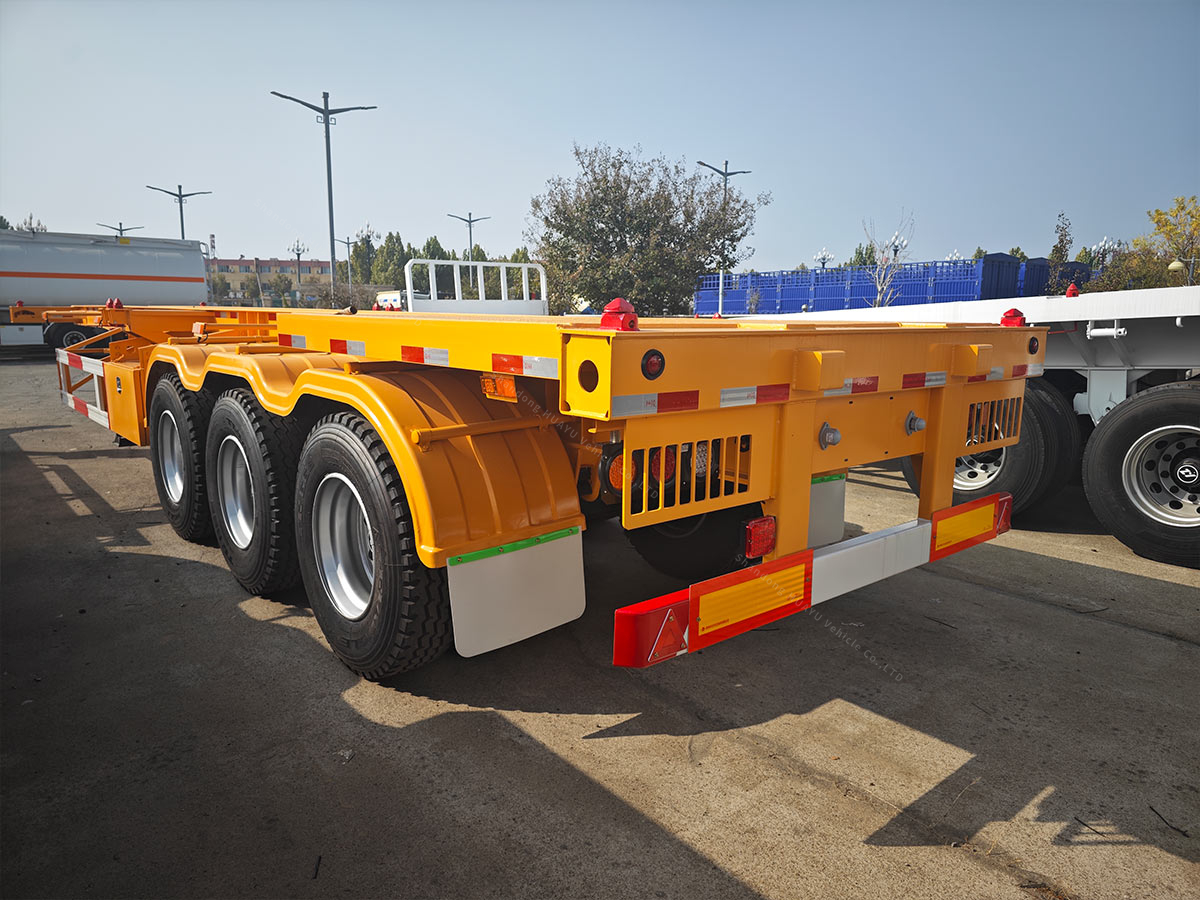
The foundation of any heavy-duty container chassis trailer lies in its metallurgical composition. Standard carbon steel, such as ASTM A36 or Q235, offers basic structural support but falls short under the extreme dynamic loads of port operations. High-strength low-alloy steel, specifically Q345B, provides a superior yield strength that resists bending and twisting. For operations demanding maximum payload optimization, ultra-high-tensile steel like T700 reduces the chassis tare weight significantly while maintaining exceptional structural rigidity.
The choice of steel directly impacts fuel efficiency and payload capacity. Lighter, stronger steel allows fleets to haul heavier containers without exceeding gross vehicle weight ratings. High-tensile steel exhibits superior memory, meaning it can flex under heavy crane impacts and return to its original shape without permanent deformation. This characteristic prevents the permanent sagging often seen in cheaper, low-grade steel frames after a few years of hard port use.
| Steel Grade | Yield Strength (MPa) | Primary Application | Weight Impact |
|---|---|---|---|
| Q235 (Standard Carbon) | 235 | Light-duty, flat terrain | Heavy tare weight |
| Q345B (High-Strength) | 345 | Standard port operations | Moderate tare weight |
| T700 (Ultra-High-Tensile) | 700 | Heavy-haul, payload optimization | Lightest tare weight |
Beam profiles dictate the load-bearing capacity of the trailer. Standard web plate thickness typically ranges from 6mm to 8mm, while flange dimensions usually fall between 12mm and 16mm. Port duty cycles often require specifying the upper end of these ranges. A thicker bottom flange prevents the main beam from bowing under concentrated loads, especially when transporting unevenly distributed cargo.
Reinforcing plates at critical high-stress zones prevent premature metal fatigue. The areas directly above the suspension hangers and the rear bolsters experience the highest concentration of kinetic energy during transit and loading. Integrating heavy-duty gussets and double-plated webs in these specific zones drastically reduces the risk of micro-cracking and catastrophic frame failure.
Manual welding introduces human error and inconsistent penetration, leading to weak joints. Automatic submerged arc welding ensures deep, uniform penetration along the entire length of the main beams. This automated process prevents micro-cracking, eliminates porosity in the weld seam, and creates a monolithic structure capable of withstanding severe torsional stress.
Identifying high-stress concentration points is necessary for structural longevity. Gooseneck transitions and crossmember connections are notorious for fatigue failures if improperly engineered. Manufacturers must utilize properly sized gusset plates and continuous weld beads at these junctions to distribute stress evenly across the chassis frame, rather than allowing it to concentrate at a single pinpoint.
Gooseneck designs feature a stepped frame that lowers the center of gravity and the overall deck height. This design is specifically engineered to accommodate 40ft high-cube containers, allowing the chassis to remain under strict highway bridge clearance limits. The lower center of gravity also improves high-speed stability and reduces rollover risks during aggressive maneuvering.
Straight frame designs are traditional, flat structures suited for standard ISO containers. When evaluating these designs, fleet managers must analyze the clearance and approach angle requirements for specific port terminal ramps and loading docks. A chassis that bottoms out on steep terminal inclines will suffer severe undercarriage damage, making the approach angle a critical specification.
Mapping axle count directly correlates to maximum gross vehicle weight rating (GVWR) and regional axle load distribution laws. Tandem axles are standard for typical highway runs and standard container weights. Tri-axle configurations become necessary when hauling heavy industrial materials or liquids, distributing the weight over a larger footprint to comply with strict bridge formulas and regional weight restrictions.
Evaluating premium axle brands ensures bearing reliability and aftermarket parts availability. Brands like BPW, FUWA, and SAF-Holland provide engineered solutions designed specifically for heavy-duty applications. Selecting a globally recognized axle brand guarantees that replacement parts, such as brake shoes and wheel seals, are readily available at local heavy-duty parts distributors, minimizing equipment downtime.
Mechanical leaf-spring suspensions offer a rugged, low-maintenance solution for aggressive port environments. Multi-leaf configurations, utilizing 7-leaf, 8-leaf, or 10-leaf packs, provide exceptional durability under extreme loads. They represent a lower initial investment and allow for straightforward port-side repairs without specialized diagnostic equipment.
Air ride suspensions deliver superior shock absorption, protecting both the chassis frame and fragile cargo. This system significantly reduces stress on the trailer during empty runs, extending tire life and preventing structural fatigue. Automatic load sensing capabilities adjust the air pressure dynamically, maintaining a level ride height regardless of the container's weight distribution.
Bogie or single-point suspensions serve as a heavy-duty alternative for the most severe port environments and off-road terminal transport. These systems articulate freely, keeping all tires in contact with the ground over deeply rutted or uneven terrain, providing maximum traction and load stability where standard suspensions would fail.
Modern port operations require advanced stopping capabilities. Anti-lock Braking Systems (ABS) prevent wheel lockup during emergency stops, maintaining directional control. Electronic Braking Systems (EBS) provide faster response times by transmitting electronic signals to the brake valves, ensuring all axles apply braking force simultaneously, which drastically reduces stopping distances and prevents trailer swing.
Specifying dual-line pneumatic systems with premium brake chambers, such as T30/30 units, optimizes stopping power. Fast-release valves are critical in port environments; they rapidly exhaust air from the brake chambers when the pedal is released, preventing brake drag. This eliminates excessive heat buildup, premature brake shoe wear, and the risk of blown tires due to overheated drums.
Landing gear must withstand high-frequency dropping and hooking operations. Specifications should demand a minimum 28-ton continuous lifting capacity and an 80-ton static load capacity. Selecting reputable brands ensures the internal gearing can handle the stress of lifting fully loaded containers without stripping. Sand shoes should be specified to prevent the landing gear from sinking into soft terminal asphalt.
Selecting the appropriate kingpin size depends on the tractor fleet. Standard 2-inch kingpins suit most highway applications, while 3.5-inch kingpins are reserved for extreme heavy-haul operations. Assessing the integrated structural plate thickness around the kingpin is vital; a minimum of 10mm to 12mm plate thickness prevents the kingpin from tearing out of the upper coupler during aggressive shunting.
The securement of the container relies entirely on the twist lock mechanisms. Evaluating the metallurgy is crucial; forged steel twist locks offer vastly superior shear strength compared to cast steel alternatives. Forged locks resist the violent lateral forces generated during transit and the upward pull experienced during rapid crane unloading operations. A purpose-built container lock trailer must prioritize these components.
Choosing between retractable and non-retractable locks depends on fleet flexibility requirements. Retractable locks drop below the deck surface, allowing the chassis to haul different container configurations without interference. A standard 40ft chassis equipped with 12 retractable locks can safely transport a single 40ft container, two 20ft containers, or a single heavy 20ft container mounted in the center.
Front and rear bolsters absorb the brunt of structural impact during aggressive port crane positioning. These components must be fabricated from heavy-gauge steel and reinforced with internal webbing to prevent crushing. When a crane operator lowers a container off-center, the bolsters must guide the box into place without bending.
The integration of corner guides and self-steering guide rollers accelerates container alignment. These physical guides allow crane operators to drop containers into the twist locks with greater speed and precision. Reducing the time spent aligning the container directly increases terminal throughput and reduces driver wait times.
Saltwater corrosion destroys standard electrical systems rapidly. Evaluating wiring harness protection requires specifying fully sealed, moisture-proof LED wiring harnesses. Systems rated at IP67 or IP69K resist high-pressure water spray and complete submersion, ensuring that the lighting system remains operational despite constant exposure to marine environments.
Strategic placement of reflective conspicuity tape and high-visibility LED lights complies with strict port safety protocols. Recessing the LED light fixtures into the rear bolster protects them from dock impacts and crane damage. Reliable lighting prevents accidents in dimly lit terminal yards and ensures highway compliance during night transit.
Comparing standard primer and paint against marine-grade polyurethane topcoats reveals massive differences in longevity. Sandblasting to a Sa 2.5 standard removes all mill scale and rust before painting, ensuring proper adhesion. Hot-dip galvanizing (HDG) provides the ultimate protection by metallurgically bonding zinc to the steel, creating an impenetrable barrier against saltwater.
Specialized coatings in humid, high-salinity coastal port environments prevent structural thinning. Rust does not just look bad; it eats away at the web and flange thickness, reducing the load-bearing capacity of the chassis over time. Investing in proper surface treatments upfront prevents catastrophic frame failures years down the line.
Analyzing the impact of tire sizing on chassis deck height and load capacity is necessary for fleet standardization. Options like 11R22.5, 12R22.5, or super singles change the rolling resistance and overall height of the 40ft container chassis. Super singles reduce weight but leave the trailer vulnerable if a blowout occurs, whereas dual tires provide a safety margin.
Steel wheels offer rugged durability at a lower cost, while lightweight aluminum wheels optimize payload and dissipate brake heat faster. The integration of Automatic Tire Inflation Systems (ATIS) keeps tires at optimal pressure, reducing tread wear and preventing blowouts caused by under-inflation in hot port environments.
Analyzing manufacturer warranty terms requires separating main beam structural coverage from wear parts coverage. A robust structural warranty, typically 5 to 10 years, indicates the manufacturer's confidence in their welding and steel quality. Wear parts like brake shoes and airbags will always have shorter coverage periods.
Premium engineered chassis maintain higher resale values compared to low-cost imports. Fleets looking to cycle their equipment every seven to ten years will recover a significant portion of their initial investment if the chassis features standardized components, high-tensile steel, and documented maintenance records.
Extended chassis downtime often stems from proprietary or hard-to-source imported components. If a specialized brake valve or unique suspension bushing fails, the equipment remains out of service until parts arrive. This supply chain vulnerability severely impacts fleet utilization rates and operational efficiency.
Mitigating this risk requires specifying universally compatible, industry-standard wear components. Ensure that braking components, landing gear, twist locks, and wheel ends match the existing inventory of local heavy-duty parts suppliers. Standardization allows maintenance teams to perform rapid repairs, keeping the chassis in active revenue-generating service.
Marine road spray accelerates the deterioration of slack adjusters, brake chambers, and electrical connections. Without aggressive intervention, rust and corrosion will seize moving parts and degrade structural integrity, leading to DOT violations and unsafe operating conditions.
A: A standard 40ft container chassis typically weighs between 5,500 and 7,500 lbs. Utilizing high-tensile steel, such as Q345B or T700, minimizes this tare weight, allowing fleets to maximize their legal payload limits without sacrificing structural integrity.
A: Yes, provided it is engineered with a 12-lock or 8-lock configuration. It must feature heavy-duty middle bolsters to support the concentrated weight of dual-container loads and ensure proper load distribution across the main beams.
A: Gooseneck designs feature a stepped frame that recesses into the tunnel of a high-cube container, lowering the overall ride height to meet highway bridge restrictions. Straight frames are flat and suited only for standard-height ISO containers.
A: Humid, salty coastal air causes rapid chemical degradation of bare or poorly painted steel. Advanced protective coatings, like marine-grade polyurethane or galvanizing, seal the metal, preventing rust, structural thinning, and eventual frame failure.
A: Standard tandem axles suit normal highway container weights. For handling overweight containers or industrial materials, tri-axle or spread-axle configurations are required to distribute the load and comply with regional bridge laws.
A: Twist locks require daily pre-trip visual inspections to check for cracks, missing springs, or seized pins. Additionally, they need monthly mechanical lubrication and tolerance checks to ensure they lock securely and release smoothly.


