
Views: 0 Author: Site Editor Publish Time: 2026-07-16 Origin: Site


Transporting palletized goods creates massive operational friction for fleets relying on traditional equipment. Dry vans impose rigid loading constraints that limit efficiency, forcing drivers to wait hours for an open loading dock. Flatbeds require labor-intensive, high-risk manual tarping that exposes operators to severe weather and potential falls. Fleet managers and owner-operators lose thousands of dollars annually to dock bottlenecks, weather-damaged freight, and driver injuries related to manual tarping. You need equipment that streamlines loading without sacrificing cargo protection.
The side curtain trailer offers a proven hybrid solution. It frames the unobstructed deck space of a flatbed with the enclosed protection of a dry van. This article serves as a technical buyer’s guide for fleet operators evaluating specifications and structural trade-offs for palletized operations. We will break down how to match trailer configurations to your specific freight demands, ensuring you maximize payload capacity while eliminating the hazards of traditional open-deck transport.
Dry vans present severe spatial constraints for oversized or irregularly shaped pallets. They require precise dock-leveling and restrict loading entirely to the rear doors. This creates massive bottlenecks at busy distribution centers, where drivers often burn their hours of service waiting in the yard. You cannot load a dry van from the side with a forklift, which means mixed freight requires complex, time-consuming staging before it ever enters the box.
Traditional flatbeds offer open deck access but expose cargo to harsh elements. Drivers must manually deploy heavy tarps over uneven freight. This process is dangerous, time-consuming, and physically exhausting in adverse weather conditions. Tarping a complex load of machinery or building materials can take a driver over two hours. High winds and icy decks multiply the risk of falls, leading to severe injuries and sidelined personnel.
Evaluating new trailer equipment requires strict baseline metrics. Turnaround time remains the primary indicator of operational efficiency. You must track minutes spent per stop during loading and unloading. A successful implementation should cut a two-hour live load down to forty-five minutes. Driver retention heavily depends on equipment ergonomics and safety. Eliminating manual tarping directly improves job satisfaction and extends the career lifespan of your operators.
Cargo integrity demands zero weather-related freight claims. Your equipment must protect sensitive goods from moisture, road salt, and debris. If a customer receives waterlogged drywall or rusted steel components, the freight claim wipes out the profit margin for the entire run. The equipment must provide a reliable, repeatable seal against the elements regardless of the driver's physical strength.
Curtain siders successfully bridge the gap between open and enclosed transport. A dedicated pallet freight trailer provides complete side access for multiple forklifts. This allows simultaneous loading from both sides of the deck, drastically reducing yard time. Once loaded, the flexible curtains slide shut and tension down quickly, securing the perimeter against the weather.
You gain the loading speed of a flatbed with the environmental protection of a dry van. Forklift operators can place heavy pallets exactly where they need to go for optimal weight distribution over the axles. There is no need to push freight down the length of a wooden floor, which prevents product damage and reduces wear on the trailer decking.
Specific regions and industries heavily rely on curtain side configurations. Wet climates like the Pacific Northwest demand constant cargo protection. Agricultural products, building materials, and beverage logistics require rapid side access. A well-spec'd curtain side semi trailer dominates these sectors because it keeps the freight dry while allowing high-speed cross-docking.
Beverage distributors use these trailers to access specific pallets along a multi-stop route without unloading the entire trailer. Lumber yards load long bunks of wood from the side in minutes. The flexibility to handle mixed LTL routes efficiently without waiting for standard loading docks makes this equipment highly sought after in regional haul operations.
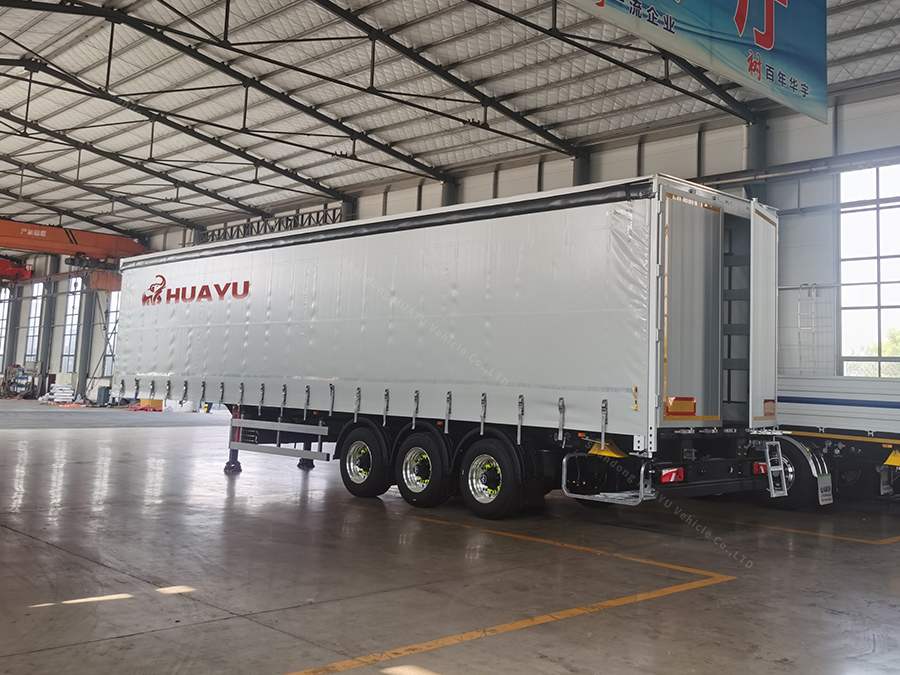
Many operators confuse curtain siders with Conestoga systems. A curtain sider features a permanent, rigid roof structure. Flexible side curtains hang from top tracks and tension at the bottom. The front bulkhead and rear doors are solid, structural components. This design provides excellent rigidity and a permanent shield against overhead weather.
A Conestoga utilizes a rolling tarp system mounted on an external track. The entire accordion-style frame rolls forward or backward over a standard flatbed. When fully open, the flatbed is completely exposed, allowing overhead cranes to drop heavy steel coils or machinery directly onto the deck. The Conestoga provides overhead crane access, while the curtain sider offers superior structural rigidity and faster side access.
Weight penalties heavily influence equipment selection. Conestoga systems add significant tare weight due to their heavy rolling frames and complex track mechanisms. They also create substantial aerodynamic drag from the external track mechanisms protruding past the rub rails. This drag reduces fuel efficiency on long highway runs.
Modern curtain siders feature tensioned, flush sides that improve airflow. The permanent roof structure of a curtain sider is generally lighter than a full Conestoga frame. This maximizes your legal payload capacity on every run. When hauling heavy commodities like tile or liquid totes, saving a thousand pounds of tare weight directly translates to higher revenue per load.
Selecting the right equipment depends on your typical freight profile. A true side loading trailer outperforms a Conestoga on multi-stop LTL routes. The independent side curtains allow drivers to access specific pallets without exposing the entire load to the weather. You simply unbuckle a small section, pull back the curtain, and extract the pallet.
Curtain siders also excel in operations with strict width restrictions. Conestoga tracks often push the trailer width to the absolute legal limit, making tight urban deliveries difficult. If your freight requires a permanent rigid roof for top-loading protection and you primarily load with forklifts rather than overhead cranes, the curtain sider is the optimal choice.
| Feature | Curtain Side Trailer | Conestoga System |
|---|---|---|
| Roof Structure | Permanent, rigid aluminum or composite roof | Retractable accordion-style tarp frame |
| Loading Access | Full side and rear access | Full side, rear, and overhead access |
| Aerodynamics | Flush sides, lower drag | External tracks, higher drag |
| Ideal Freight | Palletized goods, building materials, LTL | Machinery, steel coils, crane-loaded freight |
| Tare Weight Penalty | Moderate (1,500 - 2,500 lbs) | High (2,000 - 3,500 lbs) |
The curtain material dictates the lifespan of your trailer. Specify heavy-duty PVC-coated polyester for commercial operations. A 28 oz. per square yard fabric resists tears better than standard 26 oz. materials. The heavier fabric withstands the constant whipping of highway winds and accidental scrapes from forklift masts. You must also verify UV resistance and cold-crack temperature ratings for your specific operating region to prevent premature degradation.
Tensioning mechanisms are critical for maintaining a true weatherproof cargo trailer. Ratchet tensioners located at the front and rear bulkheads provide reliable mechanical force to pull the curtain tight horizontally. Pneumatic systems offer faster operation but require more maintenance and are susceptible to freezing in winter climates. Proper tensioning prevents the curtain from ballooning at highway speeds, which destroys aerodynamics and damages the fabric.
Curtain buckles endure constant mechanical stress, road salt, and environmental exposure. Avoid cheap plastic or zinc-plated alternatives that rust and seize quickly. Stainless steel over-center buckles provide superior mechanical durability and operate smoothly even when covered in winter grime. Drivers will refuse to properly secure a trailer if the buckles require a hammer to close.
Identify high-wear strap zones along the curtain length. You must ensure the manufacturer uses vertical reinforcement webbing inside the curtain. This prevents the tensioning straps from tearing through the exterior PVC fabric. The straps should be welded or heavily stitched into the curtain matrix to distribute the load evenly across the entire height of the trailer.
Side-loading operations subject trailer floors to intense forklift traffic. Standard flatbed decking often fails under this concentrated weight, especially near the edges. Compare apitong wood, extruded aluminum, and composite flooring options based on your freight weight and loading frequency.
You must demand a forklift-rated floor capacity of at least 20,000 lbs. This ensures the deck survives rigorous daily loading cycles without buckling or splintering.
Roof configuration impacts both loading flexibility and interior volume. Fixed aluminum roofs provide maximum structural integrity and weather protection. They do not leak and require zero maintenance. Sliding or retractable roofs allow limited overhead crane loading but introduce complex tracks and seals that eventually degrade and allow water intrusion.
You must carefully evaluate interior clearance dimensions. The top track system for the curtains consumes vertical space. This directly impacts your maximum pallet stacking height and overall cubic capacity. Measure your tallest typical pallet configuration and ensure the trailer offers at least four inches of clearance below the roof bows to prevent snagging during loading.
Load securement remains a critical compliance factor. Captive sliding strap systems suspend from the roof track. They allow drivers to secure pallets rapidly from ground level without throwing heavy straps over the freight. These systems slide along the length of the trailer, allowing precise placement over each pallet row.
Standard floor-mounted winch straps require throwing straps over the freight, which is difficult in an enclosed space. Address DOT compliance carefully when evaluating internal load securement. The flexible curtain itself is never rated to contain shifting freight. You must secure all cargo directly to the deck using approved straps, chains, or edge protectors.
Transitioning to curtain siders requires specific driver training. The learning curve involves mastering proper tensioning sequences. Drivers must learn to tension the rear ratchet first, then secure the bottom buckles from back to front. They must learn efficient strap management to prevent tangles inside the trailer.
Drivers must also recognize track debris and clean the rollers regularly. Failure to maintain the tracks leads to severe mechanical binding. If a driver forces a jammed curtain, they will rip the rollers right out of the track. Proper training prevents premature wear, ensures the equipment operates smoothly, and keeps your drivers happy with the new technology.
Side loading fundamentally changes facility infrastructure requirements. Standard loading docks become obsolete for this specific equipment. Side loading requires significant open yard space. Forklifts must maneuver parallel to the entire length of the trailer, requiring at least twenty feet of clear space on either side.
You must assess the yard layouts at your primary shippers and receivers. Ensure they have the ground-level space and equipment to handle side-loading operations. If a receiver only has a sunken loading dock and no yard ramp, you will not be able to unload a curtain sider efficiently, defeating the purpose of the equipment.
Weather severely impacts curtain sider operations. High crosswinds create a dangerous sail effect on empty trailers. Drivers must understand how to manage wind loads safely, sometimes requiring them to open the curtains slightly to allow wind to pass through during extreme weather events.
Freezing temperatures introduce unique mechanical challenges. Ice accumulation in the bottom tensioning tracks prevents the curtains from sliding. Operators in northern climates must carry de-icing equipment, rubber mallets, and clear the tracks before operation. Specifying trailers with enclosed bottom tracks or heated rail options can mitigate some of these winter operational hazards.
A Side Curtain Trailer is an optimal investment for fleets handling high-volume, multi-stop palletized freight. It provides massive efficiency gains where dock access is limited and weather protection is mandatory. Prioritize floor rating and track durability over aesthetic features when specifying your build. Match the curtain weight and tensioning system directly to your primary geographic operating region to ensure maximum uptime.
A: A curtain sider features a permanent rigid roof with sliding flexible side curtains. A Conestoga uses an entirely retractable accordion-style tarp and frame that rolls over a standard flatbed.
A: They are highly weather-resistant but require proper tensioning, intact seals, and undamaged PVC fabric to function as a fully weatherproof cargo trailer.
A: Yes, rear doors allow for standard dock loading. However, the primary operational advantage is realized through ground-level side loading via forklifts.
A: A curtain side system typically adds between 1,500 to 2,500 lbs to a standard flatbed, depending on the roof material, track system, and rear door configuration.
A: No. Standard curtains provide weather protection, not load securement. Freight must still be independently secured to the deck using straps or chains per DOT regulations.
A: With proper tensioning and routine maintenance, commercial-grade curtains last 5 to 7 years. Excessive UV exposure and physical abrasions will shorten this lifespan.


