
Views: 0 Author: Site Editor Publish Time: 2026-07-27 Origin: Site


Transport inefficiency in dry bulk logistics directly impacts fleet profitability. Slow discharge times, excessive material residue, and poor payload optimization drain margins on every run. Selecting the wrong equipment introduces severe operational risks. You face material compaction, excessive residual weight, structural fatigue, and non-compliance with local axle weight regulations. A V-Shape Bulk Cement Tanker provides a specialized solution for these challenges. This single-silo unit delivers high-efficiency pneumatic discharge for uniform powders. You must establish a strict technical framework to evaluate and specify the right trailer for your fleet. This guide covers the exact specifications, fluidization mechanics, and structural trade-offs needed to optimize your powder transport operations without wasting payload capacity.
The physics of the V-shape design rely heavily on gravity. Steep internal wall angles funnel dry bulk material downward toward a single discharge manifold. This geometry prevents bridging and ensures a continuous feed of material to the bottom of the tank. Powder fluidization drives the actual extraction process. Compressed air enters through a bottom fluidizing bed. This bed typically uses canvas or synthetic airslides. The air breaks the cohesion of materials like fly ash and cement. It aerates the powder into a liquid-like state. The material then flows easily through the discharge piping. The angle of repose dictates the exact tank geometry. Engineers calculate this angle to eliminate dead zones within the single silo. Proper angles ensure material does not get trapped along the sidewalls. When you operate these units on site, you notice immediately how the steep angles prevent material hang-ups compared to flat-bottom designs.
Fluidization requires precise air pressure management. If you push too much air, you risk blowing out the filter bags at the receiving silo. If you push too little, the material drops out of suspension and clogs the discharge hose. The canvas airslide acts as a permeable membrane. It allows air to pass upward into the powder while preventing the powder from falling into the air plenum below. Over time, moisture in the air supply can blind this canvas. You must drain your compressor air tanks daily to prevent moisture carryover. A blinded airslide forces you to increase tank pressure to achieve the same discharge rate, which stresses the entire vessel.
Fleet managers must choose between single-silo V-shape and double-silo W-shape designs. V-shapes dominate the mid-range capacity market. They are highly efficient for volumes between 15m³ and 45m³. The structural simplicity of a single point of discharge reduces mechanical complexity. W-shape trailers accommodate larger volumes but require multiple discharge cones and complex piping. V-shapes have a distinct center-of-gravity profile. They typically sit higher than W-shape designs. This higher center of gravity impacts route planning. Drivers require specific training to handle cornering and shifting loads safely.
| Feature | V-Shape (Single Silo) | W-Shape (Double Silo) |
|---|---|---|
| Optimal Volume | 15m³ - 45m³ | 45m³ - 70m³+ |
| Discharge Points | Single manifold | Multiple cones |
| Center of Gravity | Higher | Lower |
| Maintenance | Simplified | Complex piping |
| Cleanout Speed | Fast | Moderate |
When you look at the piping underneath a W-shape trailer, you see a manifold connecting the front and rear hoppers. This manifold introduces friction loss during discharge. The V-shape eliminates this manifold. The material drops directly into the discharge line. This direct path reduces the chance of blockages, especially when handling coarse or damp materials. However, the single deep cone of the V-shape forces the overall tank height upward. You must verify bridge clearances on your standard routes before committing to a high-capacity V-shape design.
Dry bulk cement trailers differ fundamentally from liquid or chemical tankers. Liquid tankers use internal baffles to prevent fluid surge. Dry bulk trailers rely on pressurized fluidization. They do not need baffles because powders do not surge like liquids. Safety relief systems also differ. A V shape cement tanker requires high-capacity pressure relief valves. These valves handle high-volume compressed air during the discharge phase. Liquid tankers use vacuum relief valves to manage temperature and vapor expansion.
The structural integrity requirements differ as well. A liquid tanker deals with dynamic sloshing forces. A dry bulk tanker deals with static pressure cycles. Every time you unload a dry bulk trailer, you inflate it like a balloon. This repeated pressurization and depressurization causes metal fatigue over time. The welds on a dry bulk trailer must withstand these constant expansion cycles. You inspect the longitudinal seams and the dish head attachments regularly for hairline cracks.
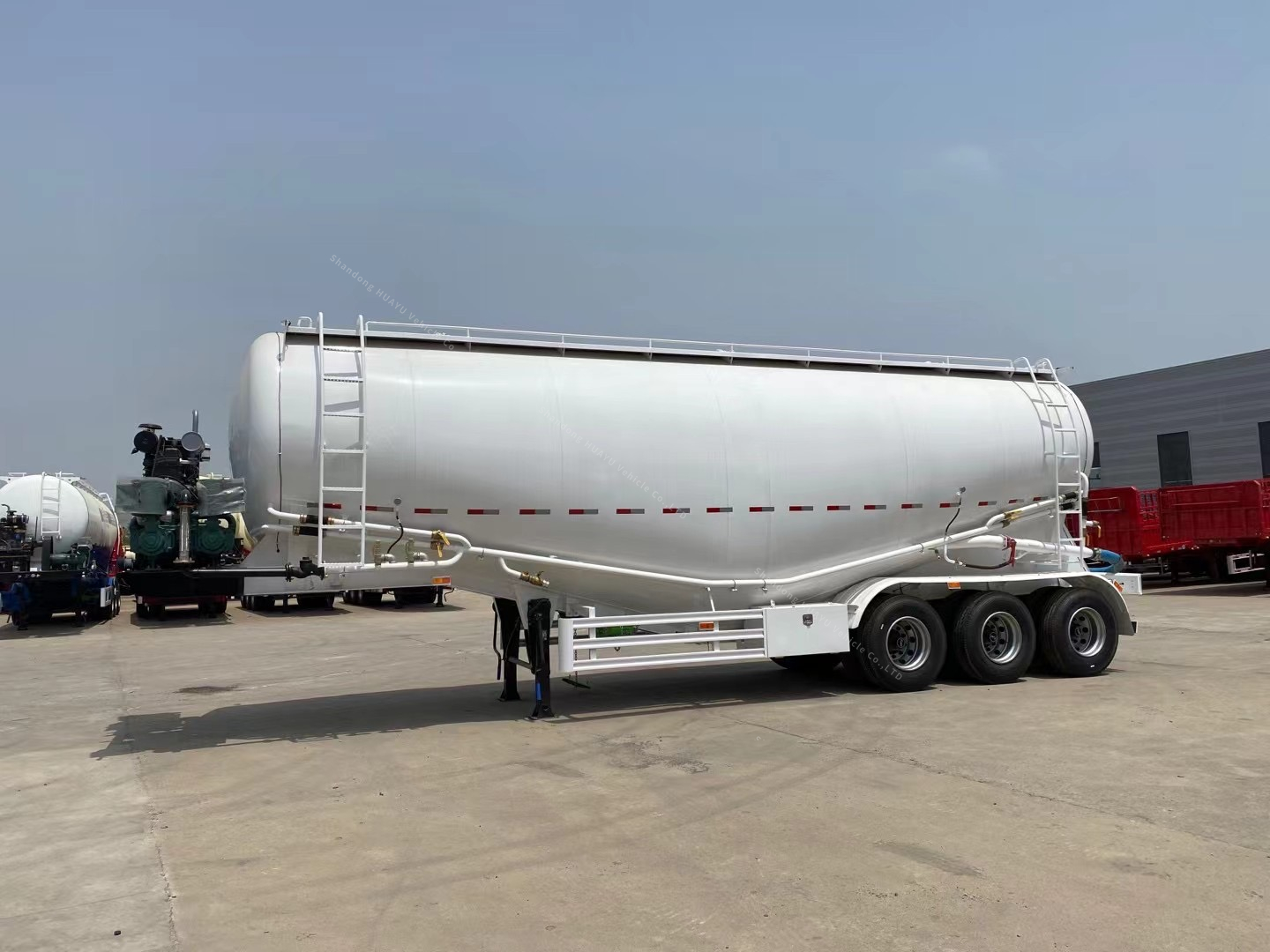
You must calculate the required cubic capacity based on specific bulk density. Transported materials vary significantly in weight per cubic meter. Standard Portland cement weighs approximately 1.5 tons per cubic meter. Fly ash is much lighter, averaging around 1.0 ton per cubic meter. A 30m³ tank holds 45 tons of cement but only 30 tons of fly ash. You must align tank volume with regional Gross Vehicle Weight restrictions. Tanks ranging from 15m³ to 45m³ provide the best balance for standard road limits. Oversizing the tank for heavy materials leads to illegal axle weights. Under-sizing it for light materials wastes potential payload.
If you haul multiple materials, size the tank for the lightest material you plan to carry frequently. You can always under-load a large tank when hauling heavy cement, but you cannot overfill a small tank when hauling light fly ash. Just remember that running a partially empty tank raises the center of gravity slightly because the material does not pack down as tightly against the upper walls.
Specification requirements change based on the payload. A dedicated fly ash transport trailer needs specific fluidization cloth to handle fine particulates. Standard cement, coal powder, or lime powder trailers require different internal treatments due to varying abrasiveness. Tank shell thickness is a safety and durability factor. Standard carbon steel shell bodies typically measure 5mm thick. The front and rear dish heads require 6mm thickness. These dimensions withstand internal pneumatic working pressures. Normal working pressure sits at 0.2 MPa. The structural test pressure reaches 0.3 MPa. Thinner shells risk deformation under repeated pressurization cycles.
Abrasive materials like silica sand or coarse ground slag will wear out the bottom of the discharge cone quickly. If you plan to haul these materials, specify wear plates or thicker steel in the lower cone section. The discharge piping also takes a beating. Standard steel pipes will wear through at the elbows. Specify heavy-wall pipe or induction-hardened elbows for the discharge line if you handle abrasive loads daily.
Material selection dictates payload efficiency. Aluminum alloy tanks significantly reduce tare weight. This reduction translates directly to increased payload per trip. Aluminum resists corrosion, keeping the payload clean. However, aluminum requires higher initial procurement capital. It also demands specialized welding for repairs. High-strength carbon steel offers superior durability against highly abrasive materials. Steel costs less upfront and is easier to repair in standard fleet shops. You must weigh the tare weight advantage of aluminum against the ruggedness of steel.
When you operate in regions with strict axle weight enforcement, aluminum often pays for itself through increased payload. You can haul an extra ton or two on every trip. However, aluminum fatigues differently than steel. You must inspect the suspension hangers and the fifth wheel plate area closely on aluminum trailers. Steel trailers handle rough, unpaved construction site roads better. The rigid steel frame absorbs the twisting forces of uneven terrain without cracking as easily as aluminum.
Axle setups must align with payload distribution. Standard heavy-duty configurations use 3-axle setups. These typically feature 13-ton or 16-ton axle ratings. Proper placement ensures legal weight distribution across the tractor and trailer. Lift axles offer significant operational advantages. Integrating a lift axle reduces tire wear during empty return trips. It also improves fuel economy by decreasing rolling resistance. You drop the axle only when fully loaded.
The spacing between the axles affects your bridge law compliance. Spread axle configurations allow you to carry more weight on the trailer tandem, but they scrub the tires heavily during tight turns. A closed tridem setup maneuvers better in tight construction sites but may limit your maximum allowable gross weight depending on local regulations. You must match the axle spacing to the specific laws of the states or provinces where you operate.
Air compressors drive the entire discharge operation. You must select output capacity based on required discharge speeds. A 12m³/min compressor handles standard horizontal discharges. A 14m³/min unit is necessary for high vertical discharge heights or dense materials. Power source options vary. Auxiliary diesel engines provide independent operation. They add weight but allow discharge without the tractor running. Power Take-Off driven systems save weight. They rely entirely on the tractor's engine, tying the truck to the trailer during unloading.
If you deliver to older batch plants with tall silos, you need the extra volume of a 14m³/min compressor. The vertical lift requires sustained air volume to keep the material suspended in the pipe. If the air volume drops, the material falls back down the pipe and plugs the line. Clearing a plugged vertical line is a miserable, time-consuming job that ruins your daily schedule.
Suspension choice impacts tank longevity. Mechanical leaf spring suspensions are rugged and handle high loads. They cost less to maintain. Air ride suspensions offer better shock absorption. They reduce structural fatigue on the tank shell. Some jurisdictions mandate air ride for heavy bulk transport. Tire specifications must match the heavy-duty application. Standard requirements include 12R22.5 or 315/80R22.5 tires. These sizes provide the necessary load index and sidewall strength for shifting dry bulk loads.
Air ride suspensions require leveling valves to maintain the correct ride height. If a leveling valve fails, the trailer leans to one side, increasing the rollover risk. You must train your drivers to check the ride height during their pre-trip inspections. Mechanical suspensions do not have this issue, but they transfer every bump in the road directly into the tank shell. Over years of operation, this vibration causes fatigue cracks around the suspension hangers.
Industry-standard benchmarks define operational success. A well-configured powder tanker trailer achieves discharge speeds of 1.2 to 1.5 tons per minute. Slower speeds indicate poor fluidization or inadequate compressor output. Residual material is a critical metric. A properly engineered V-shape tank minimizes leftover powder. The target residual rate is less than 0.3%. High residual rates create dead weight on return trips. They also increase the risk of cross-contamination if you switch materials between loads.
You can monitor discharge efficiency by watching the pressure gauges. When the tank is full and discharging normally, the pressure holds steady. As the tank empties, the pressure begins to drop. When the pressure drops to zero, the tank is empty. If the pressure spikes during discharge, you have a blockage forming in the line. The operator must react quickly, reducing the material flow valve and increasing the booster air valve to clear the line before it plugs completely.
Routine maintenance prevents catastrophic failures. You must establish strict inspection intervals. Fluidization cloth requires regular replacement. Clogged cloth stops material flow entirely. Pressure relief valves demand frequent testing. A failed valve leads to tank rupture. Discharge valve seals must maintain integrity to prevent leaks during transit. The single-silo design offers excellent accessibility. Mechanics can easily enter the tank for internal cleaning and routine maintenance.
| Component | Inspection Interval | Replacement Indicator |
|---|---|---|
| Fluidization Cloth | Monthly | Hard spots, tears, blinding |
| Pressure Relief Valve | Weekly | Fails to pop at 0.22 MPa |
| Discharge Butterfly Valve | Bi-weekly | Leaking powder during transit |
| Manhole Seals | Monthly | Cracked rubber, air leaks |
Entering a dry bulk tank requires strict confined space entry procedures. The atmosphere inside the tank can lack oxygen, especially if the tank sat closed for a long period. You must ventilate the tank thoroughly and use a gas monitor before sending a mechanic inside. The steep walls of the V-shape make footing difficult. Mechanics should use proper fall protection and non-slip footwear when working inside the vessel.
Moisture ingress destroys dry bulk operations. Wet powder clumps and blocks discharge pipelines. Improper fluidization also causes severe blockages. You must specify high-quality moisture traps in the air system. These traps remove water from the compressed air before it enters the tank. Strict loading protocols prevent loading wet material. Operators must verify hatch seals are watertight before transit.
If you load hot cement directly from the mill, condensation becomes a major issue. The hot material heats the air inside the tank. When the tank cools during transit, the moisture in the trapped air condenses on the cold steel walls. This condensation drips onto the cement, forming hard lumps. You prevent this by leaving the top hatches cracked open slightly during the cooling period, allowing the hot, moist air to escape before sealing the tank for transit.
Over-pressurization is the highest risk during discharge. Operators must monitor pressure gauges constantly. The system requires reliable safety equipment. Specify high-quality blow-off valves and check valves. Safety exhaust valves are mandatory. They prevent hose decoupling and blowout hazards. If a discharge hose blows off under pressure, it causes severe injury and material loss.
Never stand directly in front of the cam-lock fittings when pressurizing the system. If the fitting fails, the hose whips violently. You must secure the discharge hose to the silo fill pipe with a safety chain or whip check. This simple cable prevents the hose from thrashing if the connection fails. Train your operators to depressurize the tank completely before attempting to open any manholes or disconnect any hoses.
The V-shape design has an inherent rollover risk. The higher center of gravity makes cornering dangerous. Shifting dry bulk loads amplify this risk. You must implement mitigation tactics. Specify wider track axles to increase the trailer's footprint. Install electronic stability control systems. Mandatory driver training is non-negotiable. Drivers must understand how to navigate curves with a high-center-of-gravity bulk cement trailer.
A sudden lane change at highway speeds can easily roll a loaded V-shape trailer. The material inside acts like a solid block. It does not slosh, but its high mass pulls the trailer over if the lateral forces exceed the suspension's resistance. You must enforce strict speed limits for your bulk fleet, especially on highway off-ramps and winding rural roads. Electronic stability control applies individual wheel brakes automatically to help keep the trailer upright during evasive maneuvers.
A: A V-shape trailer uses a single silo with one discharge point, ideal for 15-45m³ volumes. A W-shape features a double silo with multiple discharge cones, designed for larger capacities but with more complex piping.
A: These tankers transport dry, uniform powders. Common materials include Portland cement, fly ash, lime powder, and coal powder. The fluidization system must match the specific material.
A: A properly configured pneumatic system discharges material at a rate of 1.2 to 1.5 tons per minute, depending on the compressor output and material density.
A: Standard carbon steel tanks require a 5mm thick shell body. The front and rear dish heads must be 6mm thick to withstand internal pneumatic pressure.
A: The standard operating pressure is 0.2 MPa (2 Bar). The structural test pressure used during manufacturing and safety inspections is 0.3 MPa (3 Bar).
A: Yes. However, because fly ash is lighter than cement, you need a larger cubic capacity tank to maximize your legal payload weight.


