
Views: 0 Author: Site Editor Publish Time: 2026-07-22 Origin: Site


Moving oversized, overweight, or awkwardly shaped machinery introduces severe logistical bottlenecks. A single clearance miscalculation or loading error can halt a multi-million dollar project. Utilizing standard flatbeds or step-decks for extreme loads leads to unsafe loading angles, center-of-gravity instability, and costly height-clearance violations under bridges or power lines. A Removable Gooseneck Trailer eliminates these barriers by allowing front-loading and ultra-low deck heights. This guide breaks down the specific equipment profiles, weight classes, and operational realities that dictate when a detachable gooseneck trailer is the only viable heavy equipment transport solution.
Standard flatbeds and drop-decks present distinct physical failure points when tasked with moving top-heavy or tracked machinery. Rear-loading ramps often suffer from slippage under the steel tracks of large excavators. Driving a massive machine up a steep incline creates a dangerous break-over angle. If the machine crests the ramp and tips forward too quickly, it risks severe damage to the trailer deck and endangers the operator. Standard decks also position the load higher off the ground. This raises the center of gravity and increases the risk of rollover during transit.
Successful heavy equipment transport requires zero equipment damage during loading. It demands strict adherence to Department of Transportation (DOT) height and weight regulations. It also requires minimized loading times. Traditional trailers struggle to meet these criteria simultaneously when handling extreme loads. Operators often waste hours building custom ramp extensions just to get a crawler crane onto a step-deck safely.
The mechanics of a detachable gooseneck trailer directly solve these hazards. By uncoupling the front gooseneck from the trailer deck and pulling the truck forward, the deck rests flat on the ground. This creates a ground-level ramp. Operators can drive machinery directly onto the trailer from the front with a loading angle as low as 6 to 10 degrees. This eliminates the steep climb, prevents break-over tipping, and keeps the machine's center of gravity safely near the ground from start to finish. The entire loading process becomes a controlled, low-risk operation.
Heavy construction equipment relies heavily on specialized transport. Excavators, trenchers, and demolition shears feature tall profiles and long booms. The deep well of an RGN accommodates the tracks while allowing the boom and bucket to sit low. Operators often rest the bucket in a specialized boom trough at the rear of the trailer. This configuration ensures the entire load remains under overhead clearance limits. Without this deep well, a standard 80,000-pound excavator would easily strike highway overpasses.
Bulldozers and wheel loaders benefit immensely from front-loading. Driving a heavy bulldozer onto an RGN lowbed trailer prevents the steel tracks from tearing up rear ramps. It mitigates the risk of lateral tipping. Low-clearance machinery, such as asphalt pavers, cold planers, and compactors, physically cannot clear the break-over angle of standard trailer ramps. The ground-level loading of an RGN is the only safe method to load these machines without bottoming out and damaging their undercarriages.
Agricultural machinery presents unique dimensional challenges. Combines and harvesters feature extreme width and height. They are often equipped with oversized flotation tires designed to minimize soil compaction. An RGN accommodates these massive machines by utilizing deck outriggers to support the wide wheelbase while keeping the overall height manageable. The outriggers swing out from the main deck, providing a stable platform for tires that extend far beyond the standard 102-inch trailer width.
Forestry equipment, including feller bunchers, skidders, and log loaders, carries heavy, uneven weight distributions. The robust structural reinforcement of an RGN frame handles these concentrated loads effortlessly. The low center of gravity provided by the drop deck prevents top-heavy forestry machines from causing trailer sway on winding logging roads. Transporting a 60,000-pound feller buncher requires a deck that will not flex under asymmetrical track pressure.
Mining operations require the movement of massive rock crushers and articulated dump trucks. These payload requirements often necessitate multi-axle, heavy-duty setups to distribute the immense weight safely across the pavement. A standard flatbed would buckle under the concentrated weight of a primary jaw crusher.
The renewable energy sector relies on extendable RGNs to transport wind energy components. Tower segments, nacelles, and smaller blade sections fit securely within the extended well. For static, ultra-heavy industrial loads like transformers, turbines, and generators, RGNs provide a stable, ultra-low platform. Crews can crane-load these massive components onto the deck, ensuring overhead height clearances are maintained during highway transit. The rigid frame prevents deck sag even when carrying a 100,000-pound transformer.
Military logistics demand rugged, high-capacity transport solutions. Armored Personnel Carriers (APCs) and main battle tanks represent concentrated, ultra-heavy tracked assets. The structural demands of carrying a 70-ton tank require specialized heavy-duty RGNs. The low deck height ensures these tall military vehicles can pass under standard highway bridges without delay during critical deployments. The reinforced steel decking withstands the aggressive steel treads of armored vehicles without tearing.
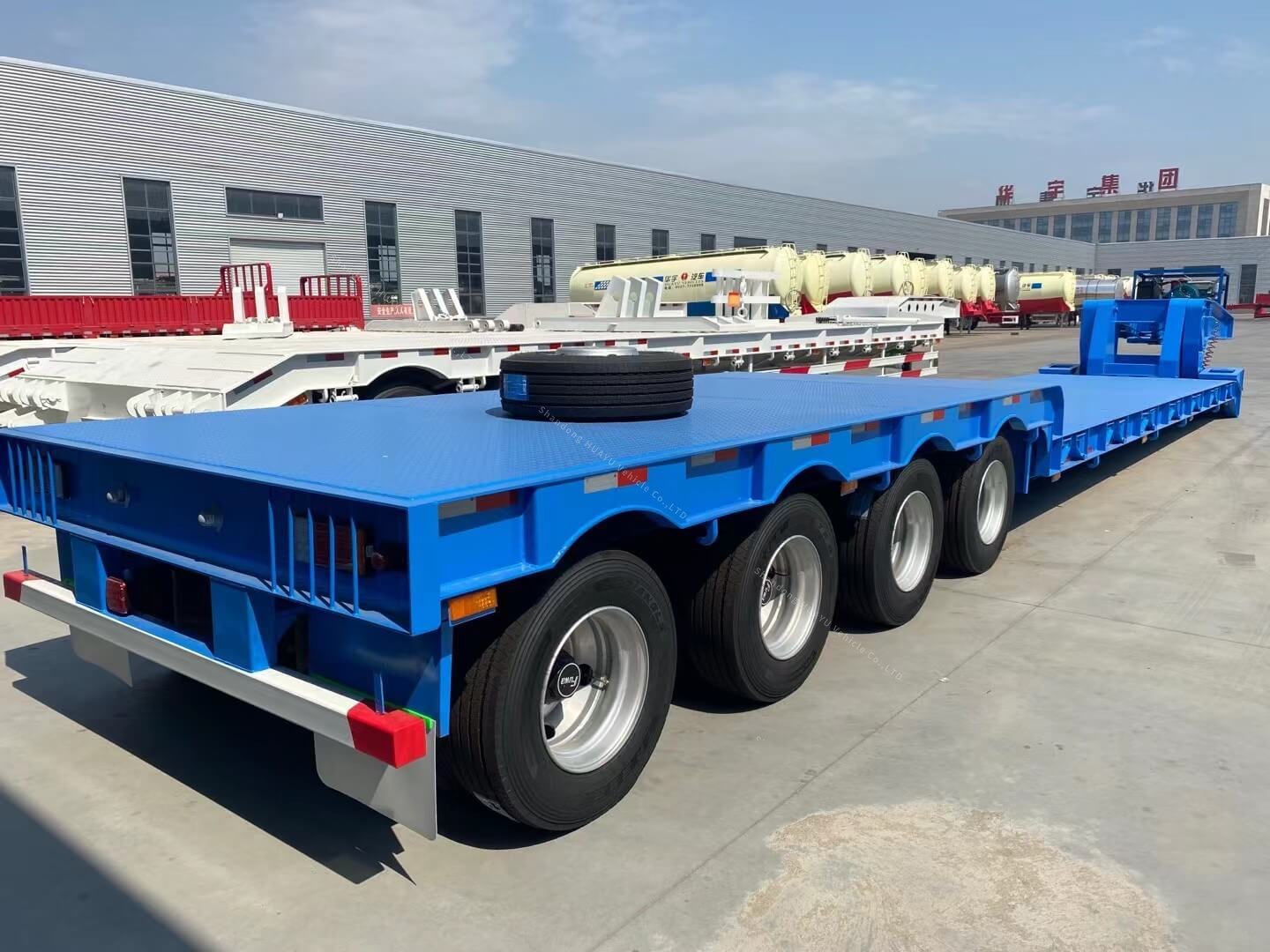
Selecting the correct deck style is critical for load stability and height compliance. Different machinery requires different support structures.
| Deck Type | Design Features | Best Suited For |
|---|---|---|
| Flat Deck (Standard RGN) | Solid, continuous flat surface in the well. Wood or steel flooring. | General heavy equipment, crawler tractors, standard excavators. |
| Drop Side Deck | Outside beams are lower than the center spine. | Maximizing height clearance for tall machinery; wheels/tracks sit lower. |
| Beam Deck | Heavy steel I-beams with an open center. No solid floor. | Machinery with large tires (wheeled loaders, scrapers) that straddle the beams. |
Standard trailer decks measure 8.5 feet wide. Many pieces of heavy machinery exceed this dimension. Heavy-duty RGN trailers use cast-iron or steel swing-out outriggers to extend the deck width to 10.5 feet or more. Operators place heavy-duty timber transition boards over these brackets to safely support oversized tracks or wide agricultural tires. This ensures the load remains stable and fully supported along its entire footprint. Failing to use outriggers on wide loads causes the equipment to hang off the edge, creating severe rollover risks.
Evaluating weight limits dictates the required axle configuration. A standard 2-axle RGN typically carries around 70,000 lbs. Upgrading to a 3-axle model pushes capacity near 100,000 lbs. For extreme loads, operators add flip axles, jeeps (front axle assemblies), and stingers or boosters (rear axle extensions) to push capacity beyond 150,000 lbs.
The Federal Bridge Gross Weight Formula strictly dictates axle spacing and the total number of axles required to legally distribute concentrated loads over highway bridges. Proper axle configuration prevents infrastructure damage and ensures compliance with weigh station regulations. You cannot simply load 120,000 pounds onto a 3-axle trailer; the concentrated weight will destroy the road surface and result in massive DOT fines.
The "well" is the usable deck space between the front gooseneck incline and the rear axle incline. Standard well lengths range from 24 to 29 feet. Extendable models can stretch beyond 50 feet. Transport planners must measure the equipment's footprint to ensure it fits entirely within the well without riding up on the inclines. If a machine's tracks rest on the incline, the load becomes unstable.
Ground clearance presents a constant trade-off. An ultra-low deck height (sometimes running just 12 to 18 inches off the ground) is perfect for tall equipment. However, the road clearance underneath the trailer may be reduced to a mere 6 inches. Drivers must navigate railroad crossings and uneven terrain carefully to avoid bottoming out the trailer frame. High-centering a loaded RGN on a railroad crossing is a catastrophic failure that halts train traffic and destroys the trailer.
Choosing between hydraulic and mechanical detachment mechanisms depends entirely on operational workflows. Hydraulic models feature built-in lifting cylinders powered by a wet kit on the truck or a standalone pony motor. They offer rapid detachment and coupling, making them ideal for multi-stop routes or uneven, muddy construction sites. The hydraulics can lift the trailer deck to clear obstacles.
Mechanical models lack these heavy cylinders, resulting in a lower tare weight. This allows for higher legal payloads. Mechanical necks require level ground for coupling and are best suited for long, uninterrupted, dock-to-dock hauls where maximum payload efficiency is the priority. If you haul on flat pavement, mechanical saves weight. If you haul out of muddy logging camps, hydraulic is mandatory.
The operational efficiency of a removable gooseneck trailer drastically reduces labor costs. Loading a hydraulic RGN is often a safe, one-person job completed in under 15 minutes. In contrast, loading a standard step-deck with oversized machinery may require expensive crane rigging or the construction of custom, temporary ramps. The time saved on the job site translates directly to increased transport volume. You spend less time loading and more time moving freight.
While an RGN requires a higher initial investment and entails maintenance of hydraulic systems, the versatility it provides is unmatched. A detachable gooseneck trailer easily doubles as a standard lowboy for static, crane-loaded freight. Fleet managers must evaluate their transport volume. If moving tall, driven machinery is a weekly requirement, owning an RGN prevents the constant delays and expenses of outsourcing to specialized heavy haul logistics providers. The ability to self-load heavy equipment keeps project timelines intact.
Transporting massive equipment introduces severe risks regarding infrastructure damage. Low-clearance bridges, tight turning radiuses in urban environments, and weight-restricted rural roads pose constant threats. Mitigation requires the mandatory use of specialized heavy-haul routing software. For extreme loads, physical route surveys using height poles are necessary, alongside strict coordination with state DOTs to ensure safe passage. You cannot rely on standard consumer GPS when hauling a 14-foot tall load.
Oversize and overweight (OS/OW) permits vary drastically by state, county, and municipality. A load that is legal in one state may require a complex permit in the next. Navigating these regulations requires partnering with dedicated permit agencies. Mitigation strategies include utilizing escort vehicles, such as pilot cars and lead cars equipped with high poles. You must also plan routes around restricted travel hours, including holiday and weekend bans. Running without proper permits results in immediate impoundment.
Load securement failures during transit can result in catastrophic accidents. Heavy machinery shifting on a trailer alters the center of gravity instantly. Mitigation demands strict compliance with Federal Motor Carrier Safety Administration (FMCSA) cargo securement rules. Operators must use grade 70 or higher transport chains, heavy-duty D-rings, and utilize robust tie-down points integrated directly into the trailer frame. Four-point tie-downs are the absolute minimum for heavy tracked vehicles. Boomers and binders must be checked after the first 50 miles of travel.
RGNs endure immense physical stress. Hydraulic systems face wear-and-tear on pumps, pony motors, and cylinder seals. Mechanical necks carry the risk of improper coupling if locking pins fail to engage fully. Mitigation relies on strict preventative maintenance schedules. Crews must regularly inspect gooseneck locking pins, lubricate wet kits, and ensure mandatory operator certification for all detachment and coupling mechanisms. A blown hydraulic line during coupling can drop the deck unexpectedly, causing severe injury.
A: A standard 2-axle RGN carries around 70,000 lbs. By adding multiple axles, jeeps, and boosters, specialized heavy-duty configurations can transport payloads exceeding 150,000 lbs safely and legally.
A: A standard lowboy has a fixed neck, requiring equipment to be loaded from the rear over the axles. An RGN features a front neck that detaches, allowing machinery to be driven directly onto the deck from the ground.
A: The standard well length typically ranges from 24 to 29 feet. Extendable RGN models feature a telescoping deck that can stretch the well length to 50 feet or more to accommodate exceptionally long loads.
A: Pulling the empty trailer does not require a permit if it falls within legal dimensions. If the loaded equipment causes the total vehicle dimensions or weight to exceed state legal limits, oversize/overweight permits are mandatory.
A: Most states mandate a maximum legal height of 13.6 feet. Because an RGN deck sits roughly 18 to 24 inches off the ground, it can legally transport equipment that is up to 11.5 to 12 feet tall without requiring special height permits.
A: Hydraulic necks are better for frequent loading and unloading on uneven terrain due to their built-in lifting cylinders. Mechanical necks are better for long-haul routes where maximizing payload weight is critical, as they have a lighter tare weight.


