
Views: 0 Author: Site Editor Publish Time: 2026-07-25 Origin: Site


Moving massive quantities of dry, granular, or powdered materials presents a strict logistical challenge. Fleet managers must transport thousands of pounds of product rapidly without exposing it to moisture, contamination, or loss. Traditional flatbeds, dump trailers, or bagged transport methods are labor-intensive and slow to unload. They fail to protect sensitive bulk commodities from environmental factors, leading to supply chain bottlenecks and product degradation.
The industry landscape frequently uses terms like dry bulk tanker trailer, pneumatic bulk tanker, and powder transport trailer interchangeably. While nomenclature varies, these terms refer to specific pressure-conveying configurations designed to move dry solids efficiently. A Pneumatic Tanker Trailer stands as the industry standard for sealed, pressure-assisted bulk transport. This guide breaks down how these trailers operate, their primary industrial applications, and the technical criteria required to evaluate and specify the right trailer for your fleet.
Navigating industry nomenclature often causes confusion for operators expanding their fleets. Terms like dry bulk trailer, pneumatic bulk tanker, and pneumatic conveying tank semi-trailer describe the same class of vehicle designed specifically for dry solids. The core function remains identical. They transport unbagged, loose materials in a sealed environment. Regional preferences or specific industry sectors often dictate which term is most popular. The underlying engineering principles align perfectly across these naming conventions.
When you hear a dispatcher refer to a bulk rig, they usually mean a trailer equipped with a blower system. You will find that cement haulers prefer specific terminology compared to plastic pellet transporters. Understanding these subtle differences helps when ordering parts or communicating with maintenance facilities. It ensures everyone understands the exact equipment specifications required for the job.
You must distinguish between general dry bulk trailers and specialized pneumatic bulk tankers. General dry bulk trailers might rely solely on gravity discharge. Some integrate mechanical belt conveyors to move material out of the vessel. A true pneumatic trailer strictly uses pressurized air for pneumatic fluidization and conveying. This reliance on air pressure allows the trailer to push materials vertically into tall storage silos.
Standard gravity-drop trailers cannot achieve vertical lift. They require underground pits or ground-level augers to receive the product. Pneumatic systems bypass these limitations. They connect directly to silo fill pipes, using air to carry the product upward. This design distinction makes pneumatic units far more versatile for delivering to diverse industrial sites.
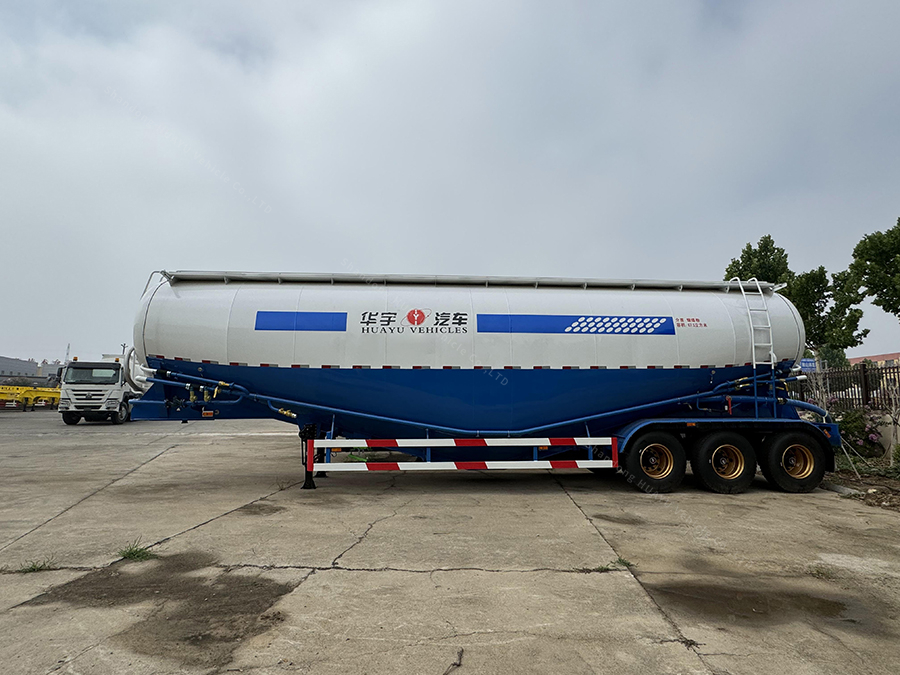
The unloading process relies entirely on generating sufficient airflow and pressure. A tractor-mounted blower or an auxiliary engine mounted directly on the trailer provides this power. These blowers typically generate between 14 and 15 PSI of pressure. This specific pressure range is high enough to move heavy materials but low enough to prevent structural damage to the vessel.
Aeration is the core mechanism of action. Air is injected directly into the hoppers at the bottom of the trailer. This air mixes with the dry bulk materials, separating the particles and fluidizing them. Once fluidized, the dry powder or granular material behaves almost like a liquid. It flows smoothly through the discharge pipe and into the receiving facility.
The engineering behind the conical hopper design ensures maximum efficiency during the unloading phase. Most trailers feature between three and six individual hoppers. The steep, sloped walls of these cones funnel material efficiently toward the bottom discharge valves using gravity. This design minimizes the amount of product left inside the tank after unloading.
Internal piping, check valves, and manifold systems work together to route the fluidized product safely out of the bulk material tanker. Check valves prevent product from flowing backward into the blower system. The manifold collects the material from each individual hopper and directs it into a single discharge line connected to the storage silo.
Different operational environments require specific system configurations to handle loading and unloading efficiently.
| System Type | Operating Principle | Best Application | Key Advantage |
|---|---|---|---|
| Pressure-Differential (PD) | Positive pressure pushes material out | Standard silo deliveries | High discharge speed |
| Vacuum-Pneumatic | Negative pressure pulls material in | Self-loading from railcars | Extreme versatility |
Pressure-Differential systems represent the most common industry standard. Positive pressure pushes material out of the trailer during unloading. The system creates a higher pressure inside the tank compared to the receiving silo. Vacuum-Pneumatic systems pull material into the trailer using negative pressure. They act like giant industrial vacuums, making them ideal for self-loading applications.
Operating these trailers requires strict adherence to a specific workflow to ensure safety and efficiency.
Opening discharge valves too quickly floods the line. This leads to severe plugging and halts the entire operation. Drivers must monitor pressure gauges constantly. They adjust the valves to maintain a steady flow of material without exceeding the system's maximum pressure rating.
The construction industry relies heavily on these trailers to maintain steady supplies at batch plants and job sites. Primary materials transported include cement, fly ash, lime, and frac sand. Success in this sector requires equipment built for extreme durability. The trailer must handle high-density, highly abrasive materials.
Fleet managers must evaluate the need for heavy-duty wear plates. Reinforced hopper cones and robust steel piping prevent premature equipment degradation. The constant friction of sand and cement wears down standard aluminum components quickly. Specifying thicker vessel walls extends the operational lifespan of the trailer significantly.
Agricultural logistics demand high-volume transport with strict environmental protections. Primary materials include grains, flour, animal feed, and fertilizers. Complete weatherproofing is the primary success criterion here. Moisture ingress can ruin an entire load of flour or cause fertilizer to clump and harden inside the tank.
The system must maintain a sealed, pest-free environment. It prevents spoilage during transit, ensuring agricultural products reach processing facilities in optimal condition. Smooth interior welds prevent grain from trapping and rotting inside the hoppers. Regular inspection of manhole gaskets ensures the weather seal remains intact.
Manufacturing facilities require precise, uncontaminated deliveries of raw materials. Primary materials hauled in this sector include plastic pellets, resins, and industrial chemical powders. Avoiding cross-contamination is paramount. A powder transport trailer used for chemicals requires smooth-bore interiors without internal structural rings.
Specialized aeration pads and highly polished internal welds are necessary. They allow for thorough, residue-free cleanouts between different chemical loads. Even a handful of incorrect plastic pellets can ruin an entire extrusion run at a manufacturing plant. Dedicated trailers for specific chemical families reduce this risk.
Transporting ingredients for human consumption involves the highest level of regulatory scrutiny. Primary materials include granulated sugar, starch, salt, and food-grade powders. Success requires strict adherence to FDA and sanitary regulations. Operators must use dedicated food-grade pneumatic bulk tankers.
These specialized units feature advanced filtration systems. They ensure the air used for unloading is completely free of oil, moisture, and particulate contaminants. Food-grade trailers require documented wash tickets from certified facilities before loading. The interior must be completely dry to prevent bacterial growth.
The choice of construction material dictates the trailer's payload capacity and operational lifespan. Aluminum offers a significantly lighter tare weight. This weight reduction allows for higher payload capacity per trip and better fuel efficiency for the tractor. Aluminum is highly corrosion-resistant and serves as the ideal choice for most standard operations.
Steel construction results in a heavier trailer. This inherently reduces the overall payload capacity to remain within legal weight limits. Steel is structurally necessary for hauling highly abrasive materials like heavy quartz silica or roofing granules. It survives under specific high-stress industrial conditions where aluminum would wear through too quickly.
Matching the trailer volume to the specific product is critical for operational efficiency. Trailer volumes typically range from 1,000 to over 1,600 cubic feet. The decision framework requires matching this volume to the bulk density of the product being hauled.
| Material | Bulk Density (lbs/cu ft) | Recommended Trailer Size |
|---|---|---|
| Plastic Pellets | 30 - 35 | 1,600+ cu ft (High Cube) |
| Flour | 35 - 45 | 1,300 - 1,500 cu ft |
| Cement | 85 - 95 | 1,000 - 1,200 cu ft (Low Cube) |
| Frac Sand | 100 - 110 | 1,000 cu ft (Low Cube) |
High-cube trailers are required for lightweight materials like plastic pellets to maximize the payload weight. Low-cube trailers are necessary for heavy, dense materials like cement or sand. Loading a high-cube trailer full of cement would immediately exceed federal bridge laws and gross vehicle weight limits.
The pneumatic system is only as effective as the air supply driving it. Fleet managers must evaluate the CFM (Cubic Feet per Minute) and pressure ratings required. Pushing heavy cement 100 feet vertically requires significantly more air volume and pressure than dropping plastic pellets into a ground-level bin.
Operators must assess the trade-offs between power sources. Tractor-mounted PTO blowers are lighter and utilize the truck's engine. They require the tractor to remain attached during unloading. Self-contained auxiliary engines mounted on the trailer add weight but allow the trailer to be unloaded independently of the truck.
The piping layout impacts both unloading speed and component wear. Straight-Drop configurations drop material directly from the hopper into the discharge line below. This setup is ideal for highly abrasive, heavy materials because it minimizes line wear and directional changes directly beneath the hoppers.
Rear-Discharge setups route all material through a single manifold that exits at the rear of the trailer. This is ideal for situations where maneuverability near the receiving silo is limited. It allows the driver to back directly up to the connection point without needing to route long hoses under the trailer.
The most significant implementation risk involves improper pressurization. Over-pressurization can lead to catastrophic equipment failure, blown hoses, or severe safety hazards for the operator standing near the discharge lines. Mitigation requires mandating rigorous training programs.
Drivers must know how to read pressure gauges accurately. They must operate pressure relief valves and execute safe venting and depressurization procedures before disconnecting any hoses. A sudden release of 15 PSI through an unsecured hose can cause severe injury. Safety glasses and hearing protection are mandatory during the unloading process.
Moisture in the air supply or improper air-to-material ratios can cause the product to pack tightly inside the discharge lines. This stops the unloading process completely and creates a massive bottleneck. Standard operating procedures must be established for identifying line plugs early.
Sudden pressure spikes on the gauges usually indicate a plug forming. Drivers must be trained on utilizing hot-air line blowout techniques safely. They must clear blockages without damaging the equipment. Hitting the aluminum pipes with hammers to clear plugs causes dents, which only leads to more frequent plugging in the future.
Cross-contamination between incompatible loads can ruin entire batches of product. Hauling cement followed immediately by agricultural feed without proper cleaning is a critical failure. Mitigation involves establishing strict wash-out protocols.
Maintenance teams must schedule regular inspections of aeration pads, check valves, and hopper seals. They ensure these components are free of residual buildup, dry, and functioning correctly before the next load is introduced. Replacing worn aeration pads prevents material from flowing backward into the air lines.
Audit your current bulk transport workflows to identify loading and unloading bottlenecks immediately. Calculate your required cubic capacity based on target payloads and specific material densities to avoid purchasing mismatched equipment. Consult directly with manufacturers to specify the optimal hopper configuration, vessel material, and blower system tailored specifically for your daily operational demands. Implement a rigorous driver training program focused on pressure management and safe venting procedures. Schedule routine maintenance checks on all check valves, aeration pads, and manhole gaskets to prevent cross-contamination and equipment failure.
A: A pneumatic trailer is designed exclusively for dry bulk solids like powders and granules, using pressurized air to fluidize and discharge the cargo. A standard liquid tanker is designed for fluids and typically relies on gravity, mechanical pumps, or different pressure systems suited for liquids.
A: Generally, yes. In the transport industry, these terms are used interchangeably. However, "dry bulk trailer" is a broader term that can include gravity-drop trailers, while "pneumatic trailer" specifically refers to units equipped with pressurized air systems for unloading.
A: Legal payload capacity depends on the trailer's tare weight, the tractor's weight, and regional gross vehicle weight regulations. Most aluminum pneumatic trailers can legally haul between 45,000 and 50,000 pounds of product.
A: Most standard pneumatic trailers operate safely between 12 and 15 PSI during the unloading process. Exceeding 15 PSI risks triggering pressure relief valves or causing structural damage to the vessel and discharge hoses.
A: No. Powder transport trailers are engineered specifically for dry solids. Their internal hopper designs, aeration pads, and valve systems are not sealed or structured to transport, contain, or discharge liquid cargo safely.
A: Unloading times vary based on the material's density, the blower's CFM, and the distance to the silo. Typically, a standard 50,000-pound load of cement or sand takes between 45 minutes to an hour to discharge completely.
A: Cleaning involves a thorough dry sweep or vacuuming of the interior, followed by a high-pressure hot water wash if required. The trailer must then be completely dried using forced hot air to prevent any moisture from clumping the next dry bulk load.


