
Views: 0 Author: Site Editor Publish Time: 2026-11-02 Origin: Site


Secure connections form the undisputed backbone of global logistics and supply chain management. In the high-stakes environment of freight transportation, shipping containers face immense dynamic forces during transit. A single mismatched twist lock can trigger catastrophic cargo loss. It destroys expensive equipment. More importantly, it creates deadly safety hazards on the highway. Consequently, the integrity of these chassis mounting points remains an absolute priority for fleet operators and terminal engineers alike.
At the core of this secure connection are ISO corner fittings. These are standardized, heavy-duty steel blocks welded to the eight corners of every shipping container. Matching these standardized castings with the correct twist lock pattern is non-negotiable. It ensures operational safety and maximizes terminal efficiency. Operators managing intermodal chassis fleets must possess a thorough understanding of these compatibility standards. This knowledge facilitates seamless loading, secure transport, and rapid unloading procedures.
This comprehensive guide explores how to identify, match, and maintain the right twist lock patterns for ISO corner fittings. By examining technical specifications and real-world engineering practices, fleet managers can make informed equipment decisions. These evidence-based choices ultimately safeguard both cargo and personnel.
To comprehend how securing mechanisms function safely, one must first understand the universal standard dictating their design. This engineering framework applies across the globe.
The International Organization for Standardization established the ISO 1161 standard many decades ago. This framework dictates the exact dimensions, minimum strength requirements, and aperture shapes of shipping container corner castings. Global standardization ensures incredible logistical flexibility. A container manufactured in Asia can be seamlessly loaded onto a chassis built in Europe. It can subsequently be unloaded by a port crane in the Americas without any hardware conflicts.
The standard mandates the use of high-tensile, weldable cast steel. Furthermore, it specifies the exact geometric tolerances required to withstand lifting, stacking, and lateral securing forces. These extreme forces are common occurrences in everyday industrial container transport.
A standard ISO corner fitting features three distinct apertures. These are located on the top, bottom, and side faces. Overhead cranes and spreaders primarily utilize the top openings for vertical lifting. Meanwhile, dock workers use the side apertures for lashing and interlocking boxes stacked side-by-side on marine vessels.
However, chassis engineers focus primarily on the bottom apertures. These slots connect directly to the trailer's locking hardware. When you back a tractor under a loaded box, these bottom holes must perfectly align with the chassis hardware to receive the steel cone. There is zero margin for error in this alignment.
Looking at recent developments in global logistics, there is a distinct industry-wide shift toward automated securing systems. Freight volumes continue to surge globally. Consequently, port turnaround times become increasingly compressed. Terminal operators are actively moving away from traditional manual locks to mitigate human error and accelerate throughput.
Specifically, emerging smart twist locks equipped with IoT sensors are beginning to surface in advanced logistics markets. These innovative devices allow fleet managers and port authorities to verify lock engagement remotely in real-time. This technology represents a massive leap forward in transit security. In addition, manufacturers are increasingly pairing these advanced locks with high-yield strength steel chassis designs. This combination reduces the overall tare weight of the vehicle, lowering fuel consumption while maintaining absolute structural integrity under heavy loads.
The commercial market offers various hardware designs. Engineers tailor each mechanism for specific operational environments, load types, and chassis configurations.
| Twist Lock Type | Best Application | Operational Speed | Key Advantage |
|---|---|---|---|
| Manual Weld-On | Dedicated container chassis | Standard | Highly reliable, mechanically simple, low maintenance cost. |
| Semi-Automatic | High-volume port terminals | Fast | Spring-loaded mechanism engages automatically upon loading. |
| Retractable | Flatbed and multi-purpose trailers | Moderate | Drops flush with the deck to allow loading of palletized freight. |
| Dovetail Sliding | Specialized custom transport | Slow | Offers lateral adjustability for non-standard container placements. |
Manual securing mechanisms require the operator to physically rotate a lever 90 degrees. This action locks or unlocks the container. While they demand manual labor, they are highly reliable. They remain the most common type found on standard intermodal fleets due to their mechanical simplicity. In contrast, semi-automatic locks feature a spring-loaded mechanism. This system automatically engages when the crane lowers the container onto the cone. The operator only needs to manually release them before unloading. This small change significantly speeds up terminal operations and reduces yard congestion.
Fixed twist locks are permanently welded in an upright position. They are incredibly durable. However, they restrict the trailer to carrying only shipping containers. Retractable locks solve this problem entirely. They can be lowered below the deck level via a simple drop-down mechanism. This versatile feature is essential for multi-purpose trailers. It prevents the thick steel cones from obstructing palletized freight or bulk materials.
Matching the securing hardware to the corner casting is a precise science. It is governed by strict dimensional tolerances and advanced load-bearing physics.
For a connection to function safely, the top cone must fit cleanly into the bottom aperture of an ISO 1161 corner fitting. The standard bottom opening measures exactly 124mm in length and 63.5mm in width. To accommodate this perfectly, manufacturers machine the standard twist lock cone to approximately 82mm in length and 62mm in width. This slight dimensional difference is intentional. It allows for minor alignment deviations during the crane loading process. Once fully engaged, it still ensures a tight, secure fit.
The mechanical clamping action is straightforward but highly effective. The oblong cone enters the aperture parallel to the hole's length. Once the container rests fully on the base, the operator rotates the handle. Experienced drivers can physically feel a satisfying, solid clunk when the cone seats correctly. Completing the 90-degree arc positions the wider section of the cone perpendicularly across the narrower width of the aperture. This geometry physically clamps the container to the chassis frame.
Dimensional fit represents only one piece of the engineering puzzle. The hardware must also survive immense shear and tension forces. These stresses peak during highway acceleration, sudden braking, and sharp cornering. Industry-standard locks are drop-forged from high-grade steel. They provide a minimum shear strength capable of handling the dynamic forces of a fully loaded 30-ton container. Ensuring your hardware meets these rigorous specifications is critical for preventing structural tears under heavy stress.
For fleets dedicated strictly to containerized freight, the layout of the securing points must perfectly align with standard shipping box dimensions. This alignment ensures flawless weight distribution across the axles.
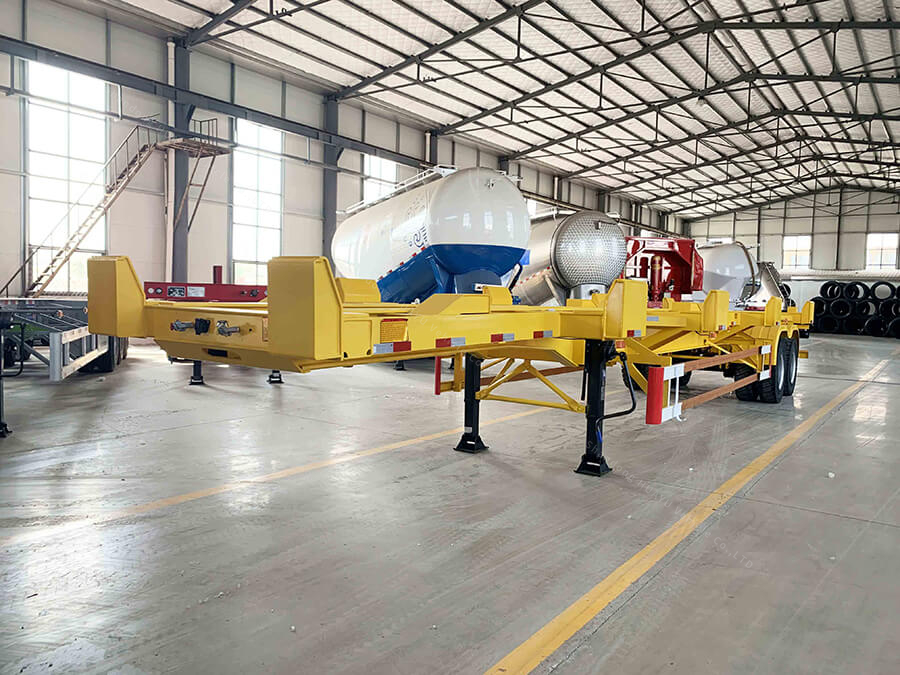
The specific arrangement of securing points on a chassis is dictated by the lengths of the containers it hauls. A dedicated skeleton trailer typically features one of three primary configurations. A standard 20ft chassis features a 4-lock pattern at the extreme corners. A 40ft chassis will often utilize an 8-lock pattern. This allows the equipment to carry either one 40ft container or two heavy 20ft containers simultaneously. Furthermore, extendable or 45ft chassis may feature 12-lock patterns, providing maximum logistical flexibility for mixed-load operations.
Unlike flatbeds, skeletal trailers consist merely of a steel framework without a solid load-bearing deck. There is no floor to support the belly of the cargo. Therefore, the entire weight of the shipping container is concentrated exclusively at the four corner castings. The weight transfers directly through the twist lock housings and down into the longitudinal chassis beams.
Take, for instance, a standard 2-Axle 40-Foot Skeleton Trailer engineered for heavy port duty. These units utilize high-yield strength steel like Q345B for the main beams. They easily support a payload capacity of up to 40 tons while maintaining a low tare weight. If a lock pattern is misaligned on this frame, the container has no secondary support system. The concentrated stress will inevitably crack the chassis welds. This reality makes precision manufacturing an absolute necessity.
When operational versatility is required, logistics providers turn to trailers capable of handling both containerized and non-containerized freight. This dual-purpose requirement demands a distinct approach to hardware implementation.
A flat semi trailer is characterized by its continuous, flat wooden or steel deck. To maintain this unobstructed surface for general freight like steel coils or lumber, these trailers utilize retractable twist locks. The housings are recessed entirely within the floor structure.
Consider a modern Single Tire 13.6m Flatbed Trailer. These heavy-duty units often integrate 12 retractable twist locks flush with a 3mm thick diamond plate deck. When an ISO container needs transport, the operator pulls the lock upward into the active position. Once the box is delivered, the locks drop back down. This instantly converts the equipment back into a standard flatbed, allowing seamless transitions between a 40ft high-cube box and bulk construction materials.
Flatbeds offer unique flexibility regarding hardware positioning. Because the deck is continuous, manufacturers can customize the lock patterns based on specific regional weight distribution laws. Placing a heavy 20ft container at the extreme rear of a 40ft flatbed often causes severe axle weight violations. To solve this, manufacturers frequently install a centrally located mid-mount twist lock pattern. This specific layout allows a single heavy 20ft container to be mounted directly in the middle of the trailer. It ensures optimal weight distribution across the tractor drive axles and the trailer tandem.
Operating heavy machinery on public highways requires strict adherence to legal frameworks. These regulations are designed to protect the public, the driver, and the valuable cargo.
Transportation authorities globally mandate specific securing protocols. Any intermodal container transported by road must be secured using purpose-built, ISO-compatible locking mechanisms. Regulations explicitly forbid securing shipping containers using only chains, nylon straps, or friction mats. Fully functioning twist locks that engage all four bottom corner fittings are a strict legal necessity. Inspectors at commercial weigh stations frequently scrutinize these connections. They verify the locks are properly engaged and free of dangerous structural defects.
Utilizing mismatched patterns or severely worn hardware poses catastrophic safety risks. If a trailer's lock spacing is off by even a few millimeters, the steel cones will not seat properly. This misalignment leads to forced engagements. Forced connections cause point-load failures where the stress literally fractures the steel casting. Additionally, an improperly locked container is highly susceptible to shifting during evasive highway maneuvers. This shift leads to rapid trailer tipping, uneven weight distribution, and severe legal liability for the transport company.
Even the highest quality drop-forged steel degrades over time. Harsh weather exposure and constant mechanical friction take their toll. A proactive maintenance schedule is vital for maximizing fleet longevity.
Fleet managers should enforce strict, routine inspections of all securing assemblies before every dispatch. Key empirical indicators of dangerous wear include excessive rust, deep pitting, or bent locking cones. Bent cones usually result from improper, aggressive crane loading. Additionally, operators should check for stiff handles that require excessive force to turn. Wiping away accumulated road grit from the grease zerk before applying fresh lubrication is a vital step. It ensures that harsh contaminants aren't forced into the internal spring mechanism.
One of the great engineering advantages of modern twist locks is their inherent modularity. When a component fails, it is rarely necessary to cut the entire welded housing off the trailer frame with an acetylene torch. Instead, operators can source specific replacement parts. The internal pins, tension springs, detent balls, and operating handles can usually be extracted by removing a single retaining roll pin. Replacing these individual components is a highly cost-effective strategy. It minimizes trailer downtime and keeps the chassis generating revenue.
The reliability of your securing system begins long before the trailer hits the highway. It starts directly on the manufacturer's assembly line.
Purchasing equipment from a reputable manufacturer ensures exceptional build quality. Factory-installed twist locks are precision-welded using advanced robotic techniques. These locks are perfectly aligned to strict ISO dimensional tolerances. This precision prevents the frustrating binding effect that occurs when a chassis is welded slightly out of square. Top-tier manufacturers also utilize ISO-certified hardware that has been independently tested for shear and tensile strength. This guarantees long-term durability in punishing environments.
Before making a fleet investment, carefully assess your specific operational needs. Do you require a lightweight, dedicated skeletal chassis for high-volume, repetitive port runs? Or does your business model demand the versatility of a flatbed equipped with retractable, mid-mount locks? By consulting with an experienced engineering team, you can customize the exact pattern and trailer configuration required. This customization maximizes your fleet's safety, regulatory compliance, and overall profitability.
Matching the right twist lock pattern to ISO corner fittings is a critical engineering practice. It is rooted in exact dimensions, understanding your specific trailer type, and maintaining robust locking mechanisms. Whether you are hauling freight on a dedicated skeletal frame or utilizing a versatile flatbed for mixed cargo, the twist lock remains the unsung hero of global logistics. By prioritizing standardization, adhering to safety regulations, and conducting routine maintenance, fleet operators can prevent catastrophic failures.
Take the time to inspect your current fleet's hardware today. If you are looking to upgrade your transport capabilities with precision-engineered chassis, explore the robust, fully compliant trailer solutions at Huayu Vehicle. Ensure every connection is secure, legally compliant, and ready for the demanding road ahead.
Yes and no. The top cones are universally designed to fit standard ISO 1161 corner fittings perfectly. However, the base of the twist lock and how it mounts to the trailer varies significantly. Common variations include sliding dovetail bases, retractable drop-down housings, and fixed weld-on designs tailored specifically to different trailer types.
A dovetail twist lock features a sliding base that fits into a specialized 45-degree angled track welded to the deck. Engineers frequently use it on trailers that require adjustable locking positions. This lateral adjustability accommodates varying container sizes or highly specialized, non-standard cargo layouts.
On a standard 40ft chassis, the twist locks are positioned to match the exact corner casting dimensions of a 40ft ISO container. Longitudinally, the center-to-center distance between the front and rear locks is approximately 11,985mm. Transversely, the distance between the left and right locks is 2,259mm. This exact spacing ensures the container seats flawlessly without binding.
While physically possible, welding twist locks to a standard truck bed without proper structural reinforcement is highly dangerous and often illegal. The truck's subframe must be engineered to handle the massive concentrated point loads transferred through the twist locks. Always consult a certified chassis manufacturer before modifying a standard truck bed for container transport.
A standard 40ft container trailer usually features 8 to 12 twist locks. This strategic configuration allows the chassis to safely accommodate a single 40ft container using the outer locks. Alternatively, it can secure two separate 20ft containers simultaneously, depending entirely on the day's shipping requirements.
Yes, provided the trailer is factory-equipped with properly spaced, ISO-compatible retractable twist locks. Securing a shipping container to a standard flatbed using only chains, binders, or nylon straps is highly unsafe. It is strictly illegal in almost all commercial transport jurisdictions.
Drivers should visually and mechanically inspect twist locks before every single trip. You should replace individual internal parts immediately if there is visible bending, severe structural cracking, or if the locking handle seizes and fails to engage smoothly. Preventative maintenance is always cheaper than a highway accident.


