
Views: 0 Author: Site Editor Publish Time: 2026-07-02 Origin: Site


High-volume, irregularly shaped, and bulk freight present unique logistical vulnerabilities on the open road. Standard enclosed trailers or flatbeds often fail to balance loading accessibility with adequate lateral containment. Fleet operators must maximize payload capacity without violating stringent FMCSA cargo securement regulations or risking catastrophic load shifts during transit. Evaluating the structural framework, tie-down architecture, and suspension dynamics of a Fence Cargo Trailer determines its viability for high-volume, high-liability transport operations. We will break down the exact mechanical requirements, hardware specifications, and compliance standards needed to keep heavy freight securely anchored to the deck under extreme dynamic forces.
Standard flatbeds require complex, time-consuming tarping and strapping to achieve basic lateral stability. Enclosed trailers restrict top-loading capabilities and completely block oversize freight. A hybrid approach solves these operational bottlenecks on the loading dock. The sidewall engineering provides essential lateral containment for shifting loads. Vertical fencing utilizes high-tensile steel alloys to maintain structural rigidity under immense outward pressure. This framework acts as a secondary containment barrier. It significantly reduces the lateral stress load on primary tie-downs during evasive maneuvers, hard cornering, or sudden lane changes.
Evaluating a high capacity fence semi trailer requires a deep understanding of payload thresholds. Operators must master deck-weight distribution capabilities to prevent axle overloading. You must analyze the trade-offs between tare weight and maximum legal gross vehicle weight rating (GVWR). Heavier, thicker fencing reduces available payload capacity but massively increases load security for bulk items. Specific use cases dictate the structural requirements you should spec from the manufacturer. Agricultural bulk requires tight mesh fencing to prevent product loss. Palletized irregular freight demands modular tie-down access through the side gates. Construction materials need heavy-duty reinforced sidewalls to prevent puncture damage from shifting steel or lumber.
The deck structure itself plays a massive role in overall stability. Cross-member spacing directly impacts how much weight a specific section of the floor can handle before yielding. Standard spacing might sit at 12 inches, but heavy-duty applications often require 8-inch spacing to support concentrated point loads like heavy machinery or dense steel coils. When you combine tight cross-member spacing with a rigid fence structure, the trailer resists the torsional twisting that normally degrades hardware over thousands of highway miles.
| Cargo Type | Fence Configuration | Deck Requirement | Primary Risk Factor |
|---|---|---|---|
| Agricultural Bulk (Sacked) | Tight mesh, high vertical rails | Smooth steel or sealed wood | Lateral bulging against gates |
| Palletized Mixed Freight | Removable side gates | High-friction wood with E-tracks | Forward shifting under braking |
| Construction Materials | Heavy-duty tubular steel rails | Reinforced steel with D-rings | Puncture damage to sidewalls |
| Scrap Metal / Loose Bulk | Solid lower panels, mesh upper | Abrasion-resistant steel (AR400) | Debris falling through gaps |
Understanding the metallurgical composition of the fencing helps predict failure points. Mild steel bends under impact, offering some energy absorption but permanent deformation. High-strength, low-alloy (HSLA) steel provides better yield strength, allowing the fence to flex and return to its original shape under moderate loads. When securing high-volume freight, the fence must withstand the dynamic outward force generated when a 40,000-pound load shifts slightly during a 45-degree highway curve.
Non-compliance results in immediate Out-of-Service (OOS) violations and severe fines at weigh stations. It creates massive liability in the event of an accident. Understanding Working Load Limits (WLL) is non-negotiable for anyone managing fleet operations. You must calculate the aggregate working load limit accurately for every single dispatch. The aggregate WLL must be at least 50% of the weight of the cargo being secured. Always evaluate the hierarchy of weak points in your setup. The securement system is only as strong as its weakest link. This includes the deck tie-down point, the strap or chain, and the tensioning device itself.
Length and weight-based tie-down ratios dictate exactly how much hardware you must deploy. The FMCSA mandates one tie-down for articles five feet or less weighing under 1,100 lbs. You need two tie-downs for articles up to 10 feet. The 10-foot threshold rule is mandatory for continuous freight like lumber or steel pipe. Utilize at least two tie-downs for the first 10 feet of cargo length. Add an additional tie-down for every 10 feet or fraction thereof.
Blocking, bracing, and friction dynamics play a major role in compliance and physical safety. Calculate and utilize deck friction coefficients to prevent sliding before it starts. Deploy rubber friction mats to minimize dynamic slide coefficients on wooden or steel trailer decks. Securing floor-loaded cargo requires specific blocking techniques at the front of the trailer. This prevents forward movement under hard braking, which generates the highest G-forces a load will experience during normal transit. A standard hard brake can generate 0.8 Gs of forward force, meaning an 80,000 lb gross load pushes forward with immense destructive potential.
Inspectors look closely at the angle of the tie-downs. Straps pulling straight down offer maximum downward pressure but minimal lateral restraint. Straps angled outward provide lateral stability but reduce the effective downward clamping force. The fence structure helps mitigate this by providing a hard physical barrier, allowing drivers to focus their strap angles on maximizing downward pressure to increase deck friction.
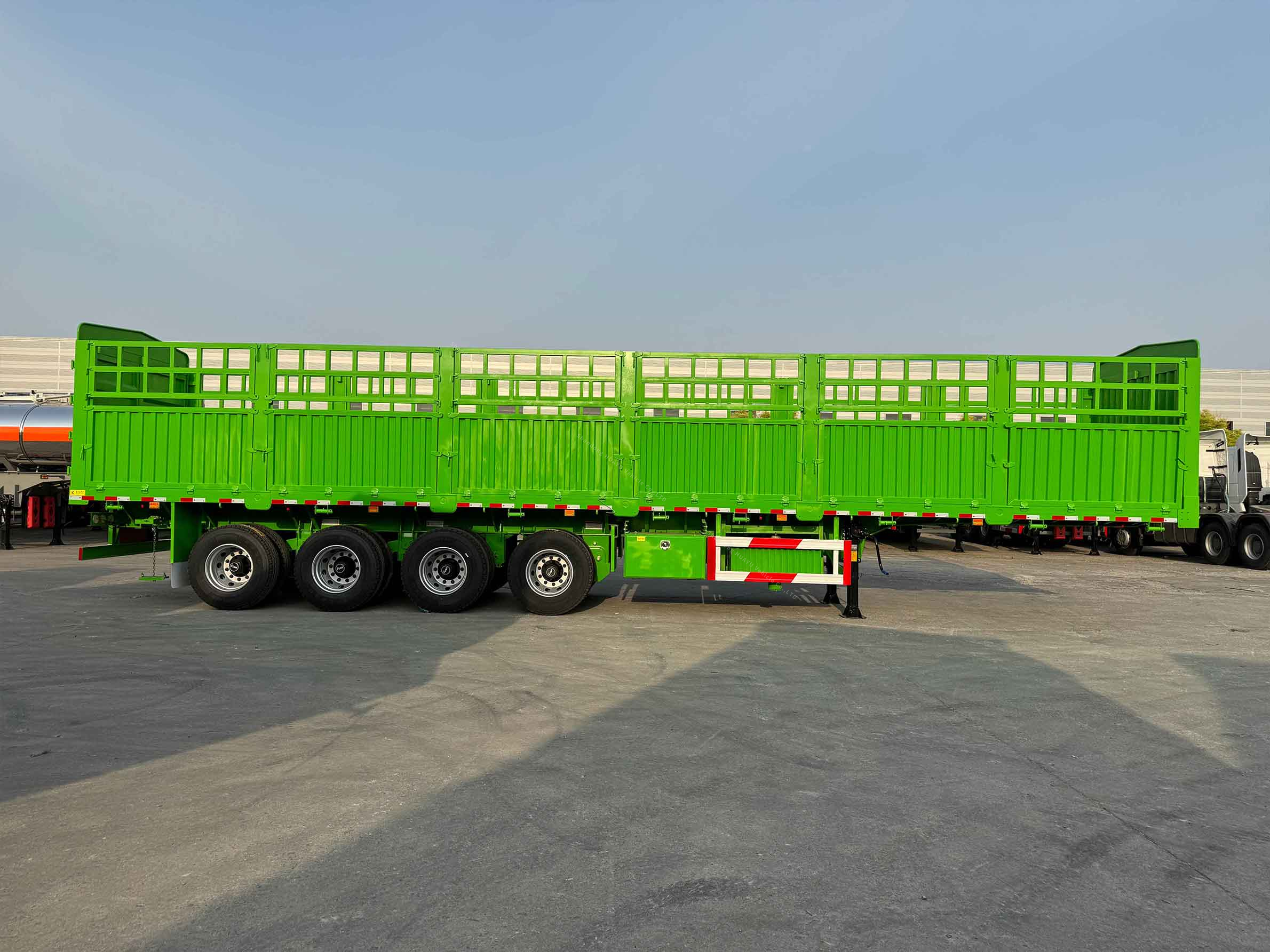
A trailer is only as secure as its integrated anchor points. The hardware attached to them must meet rigorous standards and survive brutal weather conditions. Purpose-built deck tie-down points offer superior reliability compared to retrofitted solutions. Factory-welded D-rings and recessed anchor points outperform aftermarket modifications every time. Cross-member mounting is a structural necessity for heavy-duty D-rings. Surface-mounted rings bolted only to the wood decking will tear out under heavy dynamic loads, leading to catastrophic cargo loss.
Integrating E-tracks and shoring beams maximizes modularity for mixed freight. Install E-track systems along the lower fence line or directly into the deck for modular strap placement. Horizontal E-track rails offer continuous adjustment along the entire trailer length. Vertical rails provide height variations for stacked or palletized freight. Deploy shoring beams and cargo bars to compartmentalize high-volume, mixed-freight loads. This prevents rearward cargo shifting during heavy acceleration or uphill climbs.
| Hardware Type | Primary Application | Typical WLL Rating | Key Limitation |
|---|---|---|---|
| Grade 70 Transport Chains | Wheeled machinery, heavy equipment | 4,700 to 6,600 lbs (varies by size) | Heavy, damages fragile freight edges |
| 4-Inch Ratchet Straps | Palletized goods, lumber, general freight | 5,400 lbs | Susceptible to abrasion and sharp cuts |
| Shoring Beams (Aluminum) | Compartmentalizing mixed freight | 2,000 lbs (deck-dependent) | Requires parallel E-track installation |
| Forged Steel D-Rings | Primary deck anchor points | 10,000+ lbs (when cross-member mounted) | Fixed position, lacks modularity |
Hardware selection depends entirely on the cargo type sitting on the deck. Wheeled machinery requires Grade 70 transport chains and forged load binders to prevent suspension bounce from loosening the securement. Palletized goods require heavy-duty synthetic ratchet straps with hard plastic edge protectors. Bungee cords and unrated ropes are absolutely inadequate for any application. Never use them for any commercial load securement, as they carry zero WLL rating and will result in an immediate citation.
Winch tracks mounted under the side rails offer another layer of securement flexibility. Sliding winches allow drivers to position the strap exactly where the load requires it, rather than forcing the load to align with fixed D-rings. When using sliding winches on a fenced trailer, the strap must route cleanly through the fence structure without rubbing against sharp metal edges. Any friction point will slice through a synthetic web strap within a few hundred miles of highway vibration.
The interaction between road topography, trailer suspension, and cargo inertia directly impacts tie-down fatigue. Mechanical leaf springs transfer harsh road impacts directly into the cargo deck, shocking the freight and the straps. Utilizing an air suspension fence cargo trailer offers distinct mechanical advantages for load stability. Air ride systems absorb high-frequency road vibrations before they reach the deck. They dampen severe vertical impacts effectively when crossing bridge joints or potholes. This prevents the momentary slackening of ratchet straps. Mechanical leaf-spring trailers often cause strap slackening when hitting severe bumps, allowing hooks to disengage from D-rings.
Mitigating transit vibration prevents cargo shift and product degradation. The long-term return on investment of air suspension is significant for fleet operators. It drastically reduces cargo damage claims on fragile freight. It extends the lifecycle of securement hardware by minimizing violent shock loads on the ratchets and chains. Evaluate the maintenance trade-offs carefully before procurement. Air leaks, ride-height valve failures, and compressor loads require active monitoring. However, the operational benefits far outweigh mechanical spring simplicity when hauling high-volume, high-value freight.
The physics of load securement change entirely when the deck floats on air. Vertical G-forces are the primary enemy of synthetic web straps. When a rigid trailer hits a bump, the cargo wants to continue moving upward while the trailer deck drops back down. This creates a split-second of zero tension on the strap. If the hook shifts during that millisecond, the entire securement fails. Air suspension stretches that impact out over a longer duration, keeping constant tension on the hardware and keeping the hooks firmly seated in their anchor points.
Transitioning to a new trailer configuration requires specific operational protocols to prevent accidents. Common failure points plague high-volume transport operations that lack strict oversight. Strap abrasion against metal fencing causes catastrophic failures at highway speeds. Overloaded localized deck zones warp the trailer structure and break cross-member welds. Hardware degradation from weather exposure reduces the effective WLL significantly over a single winter season.
Implement strict hardware integrity audits across your entire fleet. Establish protocols for identifying and rejecting worn, frayed, or cut web straps immediately. Inspect for rusted-out D-rings, bent E-tracks, and unrated binding components before departure. Mandate edge protectors for all strap applications, regardless of the cargo material. Conduct routine WLL hardware inspections monthly. Enforce strict load-distribution mapping to protect the deck and axles from concentrated stress.
Fleet integration demands specialized driver training focused on this specific equipment. Focus heavily on pre-trip securement audits and physical strap inspections. Mid-trip tension checks are legally required and practically essential for safety. Drivers must check straps within the first 50 miles of transit. Freight settles, compresses, and shifts during initial movement, causing straps to loosen significantly. Ignoring this 50-mile check is the leading cause of lost cargo on commercial highways.
Weather plays a massive role in hardware degradation. Synthetic straps absorb water, freeze, and lose flexibility. Chains rust and bind up. Drivers must store hardware in weatherproof underbody boxes when not in use. Lubricate load binders and winches regularly to ensure they can achieve maximum tension. A seized winch prevents the driver from applying the necessary downward force, compromising the entire securement system regardless of the strap's WLL rating.
A: The FMCSA requires two tie-downs for the first 10 feet of cargo length. You must add one additional tie-down for every 10 feet of length, or fraction thereof, for continuous freight.
A: The aggregate working load limit of all securement devices must be at least 50% of the total weight of the cargo being secured. Calculate this by adding the WLL of each individual tie-down used.
A: D-rings are superior for heavy point-loads and heavy equipment due to their high WLL. E-tracks are better for modular, distributed loads and mixed freight requiring adjustable strap placement.
A: No. Fencing provides lateral containment only. Primary tie-downs must anchor to rated deck points unless the specific fence rail is factory-rated with a verified Working Load Limit.
A: Air suspension dampens vertical road impacts and high-frequency vibrations. This prevents cargo damage and stops ratchet straps from momentarily slackening when the trailer hits severe bumps.
A: The FMCSA requires drivers to inspect cargo securement within the first 50 miles of the trip. After that, inspections must occur every 150 miles or every 3 hours, whichever comes first.


