
Views: 0 Author: Site Editor Publish Time: 2026-08-30 Origin: Site


Mismatched equipment accelerates structural wear, increases rollover risk, and diminishes payload efficiency. Fleet managers and owner-operators often over-spec their trailers. They sacrifice payload for unnecessary weight. Conversely, they might under-spec the equipment. This leads to premature structural failure. The core problem stems from failing to align the trailer’s geometry and metallurgy with the specific physical properties of the primary cargo. Sand, stone, and raw ore behave differently during transit and discharge. You must account for these differences.
We will explore a technical evaluation framework for specifying an End Dump Trailer. Material density, abrasiveness, and flowability must dictate your body shape. These factors also determine the required steel grade and hydraulic configurations. Matching the physical properties of your cargo to the correct trailer engineering ensures maximum operational efficiency and safety.
Material dictates geometry: Tub-style (half-round) bodies excel at clean discharge for flowable fines like sand, while square box designs offer the structural rigidity needed for bulky, high-impact stone and demolition debris.
Metallurgy determines lifespan: Abusive, high-abrasion materials like ore require high-yield, abrasion-resistant (AR) steel (e.g., AR450/AR500), whereas sand hauling can leverage lighter-weight aluminum or thinner steel to maximize payload.
Hydraulic stability is non-negotiable: A high capacity hydraulic dump trailer must be paired with the correct draft arm and frame design to manage the torsional stress of discharging dense, shifting loads.
Tare weight vs. durability: Every specification decision is a trade-off between maximizing legal payload and ensuring the heavy duty dump semi trailer survives the operational lifecycle of hauling heavy aggregates.
You must define the physical characteristics of the materials you move before looking at trailer specifications. Fines include sand, topsoil, and agricultural lime. These materials flow easily but retain significant moisture, which alters their discharge behavior. Bulk aggregates consist of gravel, crushed concrete, and 3/4-inch clean stone. They present moderate abrasion and maintain a highly consistent density load after load. Oversized rock includes riprap, large boulders, and raw ore. These are highly abrasive materials that deliver massive impact force during the loading process.
Operators prefer an end dump trailer over a side dump for these specific materials due to site constraints and discharge requirements. End dumps provide superior precision for stockpiling materials in tight yards. They can feed paving machines directly on highway projects. They also operate efficiently in tight loading zones, such as narrow quarry cuts, where lateral space is heavily restricted and side dumps cannot safely deploy.
Payload maximization depends entirely on balancing your target weight against the cubic-volume limits of the trailer body. You must calculate cubic yardage requirements based on the specific weight of the material. Dry sand weighs approximately 2,700 pounds per cubic yard. Wet sand can easily exceed 3,200 pounds per cubic yard. Iron ore is exceptionally dense, often exceeding 4,000 pounds per cubic yard. You cannot treat these materials equally when sizing a trailer tub.
Dense materials require lower-sided trailers. If you load raw iron ore into a high-sided trailer designed for lightweight coal or agricultural products, you will exceed gross vehicle weight ratings (GVWR) long before the tub is even half full. A lower center of gravity improves stability on the road and during the hoist cycle. It physically prevents operators from dangerously overloading the axles under the loading chute.
Wear patterns vary drastically by material type. Sand and gravel cause sliding abrasion. As the load discharges, it acts like heavy-grit sandpaper against the floor and lower sidewalls. Over thousands of cycles, this sliding action shaves millimeters of metal off the tub. Large riprap stone and raw ore cause high-impact gouging. Dropping a three-ton boulder from a wheel loader into an empty tub creates immense localized stress that can puncture standard steel.
You must establish baseline requirements for floor and sidewall impact absorption. Loading methods dictate these requirements just as much as the material itself. Large wheel loaders dropping material from a significant height require much thicker floors and reinforced top rails. Overhead chutes or conveyor belts that distribute material evenly and gently allow for slightly thinner gauge steel, saving valuable tare weight.
Material behavior during the dump cycle dictates site safety. Dry gravel flows predictably and evenly. Wet sand, clay-heavy ore, and frozen topsoil do not. They tend to stick or "bridge" across the upper sections of the tub during the hoist cycle.
Bridging shifts the center of gravity upward and backward as the hydraulic cylinder extends. This uneven weight distribution dramatically increases rollover risk. The trailer frame twists under the uneven load, placing massive strain on the draft arms and pivot pins. Understanding the flowability of your primary cargo helps you specify the correct body shape, hoist angle, and liner material to ensure a clean, safe discharge every time.
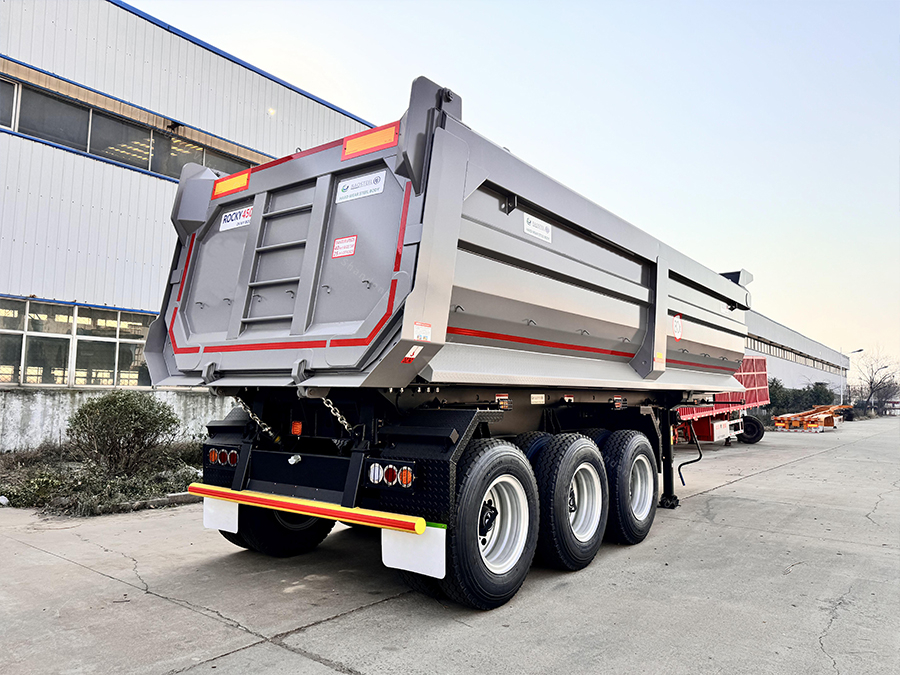
The half-round tub design offers distinct structural benefits for flowable materials. The curved geometric shape naturally funnels material to the center of the floor as the trailer raises. This reduces wear on the upper sidewalls and promotes a clean, even discharge during the hoist cycle. The material essentially self-centers, which maintains lateral stability.
Tub designs eliminate the need for heavy crossmembers under the floor. The curved steel acts as a suspension bridge, distributing the weight of the payload evenly across the entire surface area. This massive reduction in structural framing significantly lowers the tare weight of the trailer. Furthermore, the tub body flexes slightly to absorb minor impacts from small aggregates, preventing rigid stress fractures over time.
Square box architecture features vertical sides and a completely flat floor. Heavy steel crossmembers, often spaced on 12-inch or 8-inch centers, support the entire bed. This highly rigid structure resists twisting, bowing, and warping under extreme stress.
You need this heavy-sided design for oversized stone and abusive materials. Demolition debris contains rebar, concrete chunks, and jagged steel beams. These irregular materials would dent, pierce, or permanently warp a half-round tub. The square box absorbs the chaotic impact of uneven, bulky loads. The flat floor also accommodates larger boulders that would otherwise wedge into the bottom of a curved tub.
You must evaluate the center of gravity for both designs. Tub styles generally sit lower into the trailer frame because they lack under-floor crossmembers. This provides a lower center of gravity when fully loaded. It increases stability during highway transit and during the critical initial stages of the hydraulic lift.
Square boxes sit higher due to the grid of under-floor crossmembers. However, they provide maximum cubic capacity. If you haul lighter, bulkier materials like demolition waste or agricultural products, the square box maximizes your volume per trip. Tub styles prioritize lower tare weight and stability for dense, flowable fines.
Body Design | Primary Cargo | Structural Advantage | Operational Limitation |
|---|---|---|---|
Half-Round (Tub) | Sand, Gravel, Asphalt | Low tare weight, self-centering discharge | Vulnerable to impact gouging from large rocks |
Square Box | Riprap, Demolition, Ore | Maximum rigidity, high impact resistance | Higher tare weight, higher center of gravity |
Standard mild steel cannot survive the daily abuse of raw ore or riprap. You must specify high-yield, Abrasion Resistant (AR) steel. Hardox is a common brand, but AR450 and AR500 are the universal industry standards. The number indicates the Brinell hardness rating. Higher numbers mean harder steel, which translates to better resistance against sliding abrasion and impact gouging.
Thickness requirements scale directly with material aggression. For standard aggregates and gravel, 1/4-inch to 5/16-inch AR450 is sufficient. When specifying a heavy duty dump semi trailer for raw ore or large boulders, you must upgrade to 3/8-inch or 1/2-inch AR500 steel. The harder, thicker steel resists gouging, prevents floor bowing between crossmembers, and extends the operational life of the tub by years.
High-impact loads require targeted structural reinforcements beyond just thicker floor plates. Top rails take a severe beating from loader buckets and falling debris. Specify inverted angle iron or heavy-wall steel tubing for the top rail to deflect impacts. Tailgates endure massive exit impacts as the load shifts backward during the hoist cycle.
Choose high-lift tailgates for large boulders. This configuration lifts the tailgate completely out of the way, preventing the rock from striking the gate on the way out. Barn door configurations work well for demolition debris that might snag on a traditional top-hinged gate. Thicker rear aprons (often 1/2-inch plate) are mandatory. They withstand the final, concentrated impact as heavy materials exit the bed and drop to the ground.
Ultra-High Molecular Weight (UHMW) plastic liners provide significant operational benefits for specific materials. They protect the underlying aluminum or steel floor from sliding abrasion. This is highly effective for sand and gravel hauling, where the constant friction would otherwise wear through an aluminum floor in a few seasons.
Liners also drastically improve flowability. Wet, sticky ore and freezing topsoil often hang up in bare steel tubs. A UHMW liner reduces the coefficient of friction. The material slides out at a much lower hoist angle. This keeps the center of gravity lower during discharge, improving overall stability and reducing the cycle time for each load.
Telescopic hydraulic cylinders lift the payload. You must match the cylinder specifications to the maximum payload weight and the length of the trailer. A five-stage cylinder provides a longer stroke required for longer aggregate trailers. A four-stage cylinder works perfectly for shorter, specialized ore haulers.
A high capacity hydraulic dump trailer must match the cylinder’s lifting force with the material density. Dense ore requires a larger diameter base cylinder (often 8-inch or 9-inch) to initiate the lift from a dead stop. If the cylinder is undersized, the hydraulic system will stall, bypass fluid, or overheat the PTO pump on the tractor.
Discharging an 80,000-pound load exerts massive torsional stress on the trailer frame. If the material shifts unevenly due to bridging or uneven ground, the frame wants to twist. You must evaluate frame designs based on this specific stress.
Frameless trailers rely on the draft arms and the trailer body itself for rigidity. They are lighter and offer better payload capacity, but they are less stable on uneven ground. Frame-type trailers keep all wheels on the ground during discharge. The continuous steel frame absorbs the twisting forces, making them absolutely mandatory for uneven quarry floors and rough landfill sites.
Lateral stability prevents rollovers. Wide-stance draft arms provide a broader base of support during the hoist cycle. Heavy-duty pivot points anchor the tub to the frame. You must inspect these pivot pins regularly, as any wear or play in the pins will allow the tub to lean dangerously during a lift.
Modern stability controls integrate electronic tilt sensors and inclinometers. These sensors detect lateral inclines. If the trailer is parked on an unsafe slope, the system prevents the automatic dump-valve from releasing fluid to the cylinder. This technology physically prevents operators from hoisting in dangerous conditions, saving equipment and lives.
Every specification is a balance between legal payload capacity and structural durability. Lighter trailers haul more payload per trip, increasing efficiency. Heavier trailers survive abusive materials longer, reducing downtime. You must calculate the physical limits of your operation to find the right balance.
Aluminum trailers dominate the sand and gravel sectors. They offer exceptional payload capacity due to their low tare weight. However, aluminum shatters and tears under the impact of raw ore or riprap. For ore and heavy stone, the weight penalty of AR steel is mandatory. You cannot compromise structural integrity for payload when hauling high-impact rock, or the trailer will fail within months.
Material type directly dictates your maintenance intervals. High-abrasion hauling accelerates wear on all moving parts. Tailgate hinges endure constant stress and require frequent inspection. Pivot pins bear the entire weight of the hoisted load and must be greased constantly. Hydraulic seals degrade faster in dusty, abrasive quarry environments.
You must establish strict inspection routines based on your cargo. Check the floor thickness annually using ultrasonic gauges to monitor sliding abrasion wear. Replace pivot pins at the first sign of lateral play. Lubricate draft arm bushings weekly when hauling dense, shifting loads to prevent metal-on-metal binding.
Component | Inspection Interval | Wear Indicator | Maintenance Action |
|---|---|---|---|
Pivot Pins | Weekly | Lateral play, grooving | Grease heavily, replace if worn |
Hydraulic Cylinder | Monthly | Fluid weeping, scoring on stages | Repack seals, check hydraulic filter |
Tub Floor (Steel) | Annually | Thinning metal, bowing between crossmembers | Ultrasonic thickness test, weld patch plates |
Draft Arms | Monthly | Cracked welds, bushing wear | Dye penetrant test on welds, replace bushings |
Highly specialized trailers perform one job perfectly. An extreme heavy-duty ore hauler with half-inch AR500 steel and a short frame is indestructible in a mine. However, it carries a massive tare weight penalty if repurposed for highway sand hauling, making it highly inefficient for general use.
Mid-spec aggregate trailers offer greater versatility. A square box with 1/4-inch AR450 steel handles gravel, small stone, and light demolition debris effectively. Consider your operational scope. Versatile trailers adapt to different contracts and seasonal work, while specialized units maximize efficiency in closed-loop, single-material operations.
Site conditions exacerbate the risks of high-center-of-gravity equipment. Soft ground, cross-slopes, and uncompacted fill dirt are incredibly dangerous. When the hydraulic cylinder extends, the center of gravity rises. Any lateral shift from soft ground can pull the trailer over instantly.
Mitigate this risk by mandating frame-type trailers for uneven quarry floors. Train operators to read the terrain before engaging the PTO. If the ground is soft or rutted, they must reposition the truck. Never hoist a load if the trailer axles are not perfectly level. Utilize inclinometers in the cab to give operators real-time data on trailer tilt.
Wet sand, clay, and freezing ore stick to the top of the tub. This is called bridging. When the lower material falls away, the stuck material remains at the highest point of the hoisted trailer. This creates a severe rollover hazard as the weight is concentrated at the top of the extended cylinder.
Mitigate this by specifying heated bodies. Route the truck's exhaust through the body cavity to prevent freezing during winter operations. Utilize specialized release agents sprayed into the empty tub before loading sticky clay. Install UHMW liners to ensure smooth, predictable material flow at lower hoist angles.
Loading dense ore into a trailer designed for lighter aggregates leads to severe bridge law violations. Axle weight distribution is strictly regulated by federal and local formulas. You must ensure your axle spacing matches the density of your cargo to avoid overloading specific axle groups.
Mitigate this by utilizing multi-axle configurations. Lift axles and spread axles help distribute the weight of dense materials over a larger footprint. Regional builds, like "Florida Spec" trailers, are optimized for specific state weight regulations and local material densities. Always verify local bridge laws and axle spacing requirements before finalizing your trailer layout.
Take the following steps before finalizing your equipment specifications:
Conduct a payload density analysis to determine the exact cubic yardage required for your heaviest materials.
Audit your typical unloading site conditions to choose between a frameless or frame-type chassis.
Verify your Class 8 truck compatibility, ensuring the PTO and hydraulic wet kit match the trailer's cylinder requirements.
Specify axle configurations based on local bridge laws and weight distribution formulas.
Consult with manufacturers to match the steel grade and thickness to your primary cargo's abrasion levels.
A: The half-round (tub style) body is best for hauling sand. Its curved geometry funnels material to the center, promoting a clean, even discharge. It also allows for lighter tare weights, maximizing your legal payload capacity for dense fines.
A: A tub style lacks under-floor crossmembers, using curved steel to absorb stress and reduce weight. A square box features vertical sides, a flat floor, and heavy crossmembers. The square box provides maximum structural rigidity for high-impact materials.
A: End dumps are preferred for precise stockpiling and operating in tight loading zones. They can feed directly into hoppers or paving machines. Side dumps require significant lateral space to discharge, which is often unavailable in narrow quarry cuts.
A: Hauling heavy stone and raw iron ore requires abrasion-resistant steel. You should specify AR450 or AR500 steel. Thickness should range from 3/8-inch to 1/2-inch to withstand the massive impact force and gouging caused by oversized rocks.
A: No. Aluminum lacks the impact resistance required for large riprap. Dropping heavy boulders into an aluminum tub will cause severe denting, structural warping, and eventual puncturing. You must use heavy-gauge AR steel for large rock.
A: Lateral stability prevents rollovers. This is achieved through wide-stance draft arms, heavy-duty pivot pins, and keeping the trailer on level ground. Modern trailers also utilize tilt sensors that lock the hydraulic system if the lateral incline is unsafe.


