
Views: 0 Author: Site Editor Publish Time: 2026-07-01 Origin: Site


Deploying improperly specced trailers introduces severe operational and financial risks to any hauling operation. When side wall heights are mismatched to the intended cargo, operators face frequent load spillage, catastrophic structural deflection, or severe rollover events. Hauling operations constantly navigate the tension between maximizing volumetric capacity for low-density agricultural loads and maintaining structural integrity and weight compliance for high-density building materials. A standard setup rarely fits both extremes perfectly.
Selecting the correct Side Wall Trailer requires a strict technical evaluation framework. Buyers must calculate exact load densities, evaluate trailer construction materials against lateral pressures, and map operational site constraints. By understanding how the trailer interacts with the physical properties of the cargo, fleet managers can optimize payloads without compromising safety or regulatory compliance.
A trailer's cubic capacity remains entirely theoretical until measured against legal weight limits and structural thresholds. The primary success criterion for any hauling operation is achieving maximum payload without compromising structural safety or Department of Transportation weight compliance. Adding taller side walls increases volume, but if the cargo is exceptionally dense, the trailer will max out its axle weight rating long before the physical space is filled. Conversely, hauling light materials in a low-sided trailer leaves legal payload capacity unused, requiring more trips and increasing operational overhead.
Agricultural commodities present massive variations in bulk density. Dry shelled corn typically weighs around 56 pounds per bushel, while loose cotton or wood chips weigh significantly less. Palletized produce introduces dead space between crates, further altering the effective density of the load. When hauling bulk agricultural products, the cargo behaves similarly to a fluid. As the trailer fills, this fluid-like bulk exerts immense outward lateral pressure on the side walls. The taller the wall, the exponentially greater the outward force at the base.
Moisture retention complicates agricultural hauling. Wet silage, freshly harvested crops, or organic loads exposed to rain retain water, which rapidly increases the overall density and weight of the cargo. A load that was legally compliant when dry can easily exceed axle limits when wet. High-sided trailers designed for agricultural use must incorporate drainage ports or weep holes along the floor line. Without proper drainage, trapped water increases lateral pressure and vertical weight, leading to structural overloading and potential wall failure.
Building materials stand in stark contrast to agricultural loads due to their high density and rigid forms. Palletized concrete blocks, stacked lumber, and raw aggregates like gravel or sand pack immense weight into a very small footprint. When hauling these materials, operators face severe point-loading risks. Point loading occurs when massive weight is concentrated on a small section of the trailer floor, rather than distributed evenly across the deck.
Hauling dense construction materials generally requires lower side walls. Because the cargo reaches the maximum gross vehicle weight rating quickly, tall walls become dead weight that reduces the legal payload capacity. Lower walls prevent operators from accidentally overloading the trailer's floor cross-members and axles. Furthermore, lower walls facilitate easier side-loading of palletized materials using standard forklifts, speeding up turnaround times at job sites.
To determine the absolute maximum functional side wall height, operators must calculate their required cubic yardage based on their heaviest, most frequent load type. The standard framework involves dividing the maximum legal payload weight by the bulk density of the material.
Using this ratio ensures that the operator does not haul the dead weight of side walls that exceed the legal volumetric capacity of their specific cargo.
| Material Type | Average Bulk Density (lbs/cu yd) | Recommended Side Wall Height | Primary Structural Concern |
|---|---|---|---|
| Dry Shelled Corn | 1,200 - 1,300 | 48" - 60" | Lateral outward pressure |
| Wet Silage | 1,400 - 1,700 | 48" - 60" (with drainage) | Moisture weight, lateral pressure |
| Palletized Concrete Block | 3,500 - 4,000 | 24" - 36" | Floor point-loading |
| Gravel / Aggregates | 2,400 - 2,900 | 36" - 48" | Impact resistance, floor wear |
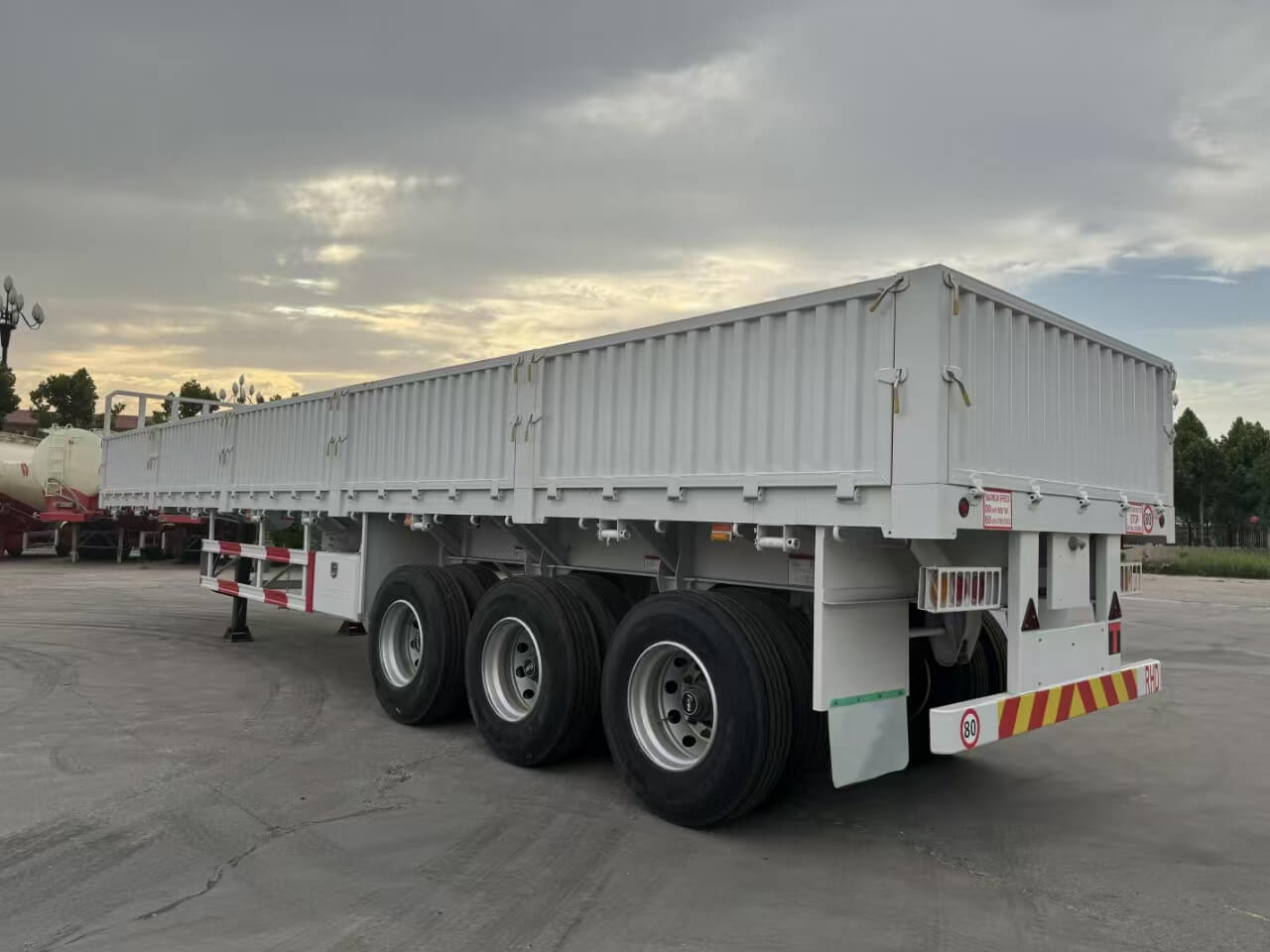
The materials used to manufacture a heavy duty side wall semi trailer dictate how well it withstands lateral pressure, impacts, and environmental degradation. Buyers must align the trailer's metallurgy with the specific demands of their cargo and the height of the walls.
High-tensile steel offers unmatched rigidity and impact resistance. When loading heavy building materials, aggregates, or scrap metal, steel withstands the punishing impacts of front-end loaders and dropped cargo. Steel side walls resist bowing under extreme lateral pressure, making them ideal for dense bulk loads. However, steel carries a higher tare weight, which directly reduces the maximum legal payload capacity and increases fuel consumption.
Aluminum alloys provide a significant weight advantage, lowering the trailer's tare weight and maximizing payload capacity. Aluminum also boasts natural corrosion resistance, making it the superior choice for hauling agricultural chemicals, fertilizers, or wet organic materials that would rapidly rust a steel frame. The primary trade-off with aluminum is its lower modulus of elasticity. Under heavy lateral loads, tall aluminum side walls are more prone to deflection and bowing than their steel counterparts, requiring closer vertical stake spacing and thicker extrusions to maintain structural integrity.
The method of side wall attachment fundamentally alters the engineering of the entire trailer chassis. Permanently welded side walls act as load-bearing trusses. In this design, the walls themselves distribute vertical stress across the length of the trailer, functioning similarly to the girders of a bridge. Because the walls carry a portion of the load, manufacturers can utilize a lighter main beam, reducing the overall tare weight.
Conversely, removable drop-side or stake-and-panel side walls are non-load-bearing. These modular systems provide no vertical structural support to the trailer deck. To compensate for the lack of truss support, the trailer requires a heavily reinforced, deep-dish main beam to prevent the chassis from sagging under heavy loads. While drop-sides offer versatility, the required chassis reinforcements add significant tare weight.
From a structural engineering perspective, a trailer side wall acts as a retaining wall against bulk loads. As bulk materials settle during transit, vibration increases the outward lateral pressure. To prevent wall bowing, manufacturers rely on specific engineering principles.
When evaluating a high capacity side wall cargo trailer, buyers must inspect specific stress points. The bottom third of the side wall endures the highest lateral pressure from bulk loads. Hinge points on drop-side models are notorious for fatigue and cracking. Rear corners face immense twisting forces when dumping or navigating uneven terrain.
Buyers should look for manufacturer specifications detailing heavy-duty gussets at the wall-to-floor transition, continuous rub rails to protect against loading equipment, and reinforced flooring transitions that distribute point loads away from the side wall joints.
Selecting the optimal wall height requires mapping the dimensions to specific use cases while acknowledging the inherent limitations of each configuration.
Low-profile side walls ranging from 24 to 36 inches are engineered for heavy, dense materials like palletized block, lumber, and heavy machinery. Because these loads reach the maximum weight limit quickly, tall walls are unnecessary. The primary advantage of low-profile walls is accessibility. Standard warehouse forklifts can easily reach over a 24-inch wall to side-load pallets, eliminating the need to load exclusively from the rear. This configuration keeps the center of gravity low, enhancing highway stability.
Mid-to-high walls exceeding 48 inches are designed to maximize volumetric capacity for low-density agricultural loads such as cotton, wood chips, and certain grains. These tall walls allow operators to haul massive volumes of light material in a single trip. However, tall permanent walls introduce significant aerodynamic drag penalties, reducing fuel efficiency when running empty. Additionally, the extra material required to build tall walls increases the trailer's tare weight, which must be factored into payload calculations.
Precision in measurement prevents catastrophic equipment mismatches at the loading site. "Clear Height" refers to the usable interior clearance from the trailer floor to the top rail or the bottom of the tarp bows. This measurement dictates the maximum height of the cargo that can be loaded. "Total Height" measures from the ground to the absolute highest point of the trailer, including ground clearance, chassis depth, and the side wall.
Operators must match the Total Height against the clearance limits of loading elevator chutes, overhead conveyors, and facility doors to prevent impact damage during loading.
Mixed-use fleets often gravitate toward drop-side or removable stake-and-panel systems. These trailers can haul bulk grain in the morning and, with the sides removed, haul wide palletized lumber in the afternoon. However, this flexibility comes with a high maintenance overhead. The locking mechanisms, hinges, and removable stakes require constant lubrication and inspection. Furthermore, modular walls sacrifice the structural rigidity provided by continuously welded fixed walls, necessitating a heavier base chassis.
The physical environment where the trailer operates dictates the viability of the chosen side wall height just as much as the cargo itself.
Side wall height directly impacts the reach requirements for loading equipment. A front-end loader moving gravel must have sufficient dump clearance to clear a 60-inch side wall without striking the top rail. Grain augers must be positioned high enough to flow material over the wall without bottlenecking. Warehouse forklifts require low walls to safely place heavy pallets without damaging the mast or the trailer.
Entering agricultural sheds, grain bins, and older warehouse loading docks with tall side wall profiles presents severe impact risks. Operators must maintain a strict clearance compatibility checklist, verifying the height of every door, overhead wire, and loading chute on their standard routes.
Hauling bulk loads in high-sided trailers dynamically shifts the center of gravity upward. As the trailer navigates curves or uneven job site terrain, the high center of gravity acts as a lever, increasing the risk of a rollover event. Bulk liquids or shifting agricultural loads exacerbate this risk by creating slosh or sudden weight transfers.
Mitigating rollover risk requires specific chassis and suspension configurations. Air ride suspensions equipped with manual dump valves allow the operator to exhaust the airbags before dumping or loading, lowering the deck and stabilizing the trailer. Wider track axles provide a broader footprint, resisting the tipping forces generated by tall, heavy loads.
Wall height dictates the complexity of load securement. Installing and operating roll tarps or sliding tarp systems becomes significantly more difficult on walls exceeding 60 inches. The tarp bows must be engineered to withstand wind loads without collapsing into the cargo area.
For securing non-bulk building materials, the side walls must feature integrated securement points. Recessed D-rings in the floor, continuous winch tracks along the lower rail, and chain tie-downs are mandatory for strapping down heavy pallets or machinery. The walls must not obstruct the routing of heavy-duty ratchet straps.
Finalizing specifications with a manufacturer requires moving beyond basic dimensions and demanding proof of structural capability.
Buyers must request certified engineering drawings that explicitly prove the side walls can withstand the specific lateral pressures of their intended bulk loads. A generic volume rating is insufficient. Manufacturers should provide lateral load ratings based on the bulk density of the heaviest anticipated cargo.
Review warranty documents carefully. Many standard warranties contain exclusions related to point-loading damage, structural side wall bowing caused by dense bulk materials, or moisture-induced overloading. Ensure the warranty covers the specific operational realities of the hauling environment.
Standard off-the-lot models offer lower upfront costs and immediate availability. However, if a standard model requires an operator to haul dead weight or limits payload capacity due to mismatched walls, the long-term operational costs will dwarf the initial savings. Custom-engineered solutions, while requiring longer lead times and higher initial capital, allow fleets to dial in the exact side wall height, material thickness, and axle configuration needed to maximize payload and efficiency for their specific contracts.
The optimal side wall height is a strict mathematical function of the cargo's bulk density, the trailer's structural material, and the limits of highway weight regulations. By prioritizing floor strength and axle capacity first, operators establish a safe baseline. From there, selecting the minimum side wall height necessary to achieve target payloads reduces unnecessary tare weight, lowers the center of gravity, and mitigates rollover risks.
A: There is no single standard, but agricultural side walls typically range from 48 to 60 inches or higher. This height maximizes the volumetric capacity needed for low-density bulk loads like grain, cotton, or wood chips, allowing operators to reach maximum legal weight limits efficiently.
A: Taller walls increase the available cubic volume but also add tare weight to the trailer. If hauling dense materials, the added tare weight of tall walls reduces the legal payload capacity before the volume is filled. For light materials, taller walls are necessary to maximize payload.
A: Yes, but it requires compromises. A trailer designed for both usually features mid-height removable drop-sides. The floor must be heavily reinforced to handle the point-loading of pallets, while the walls must be strong enough to resist the lateral pressure of bulk grain.
A: Divide the trailer's maximum legal payload capacity by the bulk density of the specific cargo. This yields the maximum usable volume. Divide that volume by the interior length and width of the trailer to find the maximum safe load height.
A: No. Removable or drop-side walls are non-load-bearing and do not provide vertical structural support to the trailer chassis. Fixed, continuously welded walls act as load-bearing trusses, offering superior rigidity and allowing for a lighter main chassis beam.
A: High-tensile steel is the best material for resisting lateral deflection and bowing under heavy pressure. While aluminum is lighter and resists corrosion, it has a lower modulus of elasticity and requires thicker extrusions and closer stake spacing to prevent bowing.
A: Load-bearing fixed walls distribute weight, allowing manufacturers to use a lighter main chassis beam, reducing overall tare weight. Non-load-bearing removable walls require a heavier, deeper main beam to support the cargo, which increases the trailer's total tare weight.


