
Views: 0 Author: Site Editor Publish Time: 2026-11-06 Origin: Site


Hauling rock, large boulders, and heavy aggregates remains one of the most brutal applications in the commercial transport industry. Many heavy-duty vehicles look exceptionally tough on the outside. However, the physical reality of hauling jagged stone will quickly destroy equipment lacking highly specific engineering standards. The sudden kinetic impact of loading and the severe sliding friction of unloading require structural integrity far beyond standard dirt-hauling requirements.
For operators facing these extreme conditions, the side dump trailer offers unparalleled stability and efficiency. Choosing the right physical specifications is the ultimate challenge for fleet buyers. Wall thickness, when properly combined with premium steel quality, dictates whether a trailer operates reliably for a decade or suffers catastrophic structural fractures within a single month.
This technical guide examines precise thickness specifications, optimal steel grades, structural design advantages, and payload dynamics. These insights will help you make an informed, data-driven procurement decision.
Recent market analyses in the heavy transport sector reveal a distinct shift toward optimizing tare weight without compromising structural integrity. Commercial transport is strictly governed by tightening Department of Transportation weight regulations and fluctuating fuel costs. Fleet managers can no longer afford to pull dead weight.
Consequently, the industry is rapidly moving away from archaic, over-thickened mild steel tubs that often exceed 3/8 inch. Modern metallurgical advancements favor thinner profiles forged from advanced compounds. This strategic pivot maximizes legal payload limits while maintaining the sheer strength required for severe-duty aggregate hauling.
Understanding why rock is the ultimate test for heavy transport equipment requires examining the mechanical forces at play. Moving jagged boulders subjects the chassis and tub to two highly destructive stresses: high-velocity impact and sliding friction.
The loading phase introduces massive kinetic energy into the trailer tub. Imagine a heavy-duty excavator releasing a two-ton jagged granite boulder from a height of six feet. The localized force on the steel bed at the exact point of impact is staggering. This sudden stress tests the yield strength of the material to its absolute limits. If the steel walls are too thin or manufactured from standard mild carbon steel, the material simply yields. It undergoes plastic deformation, resulting in deep dents, structural warping, and eventual punctures.
While loading causes blunt impact, the unloading process introduces severe sliding abrasion. The deafening grind of stone against steel during the tilt cycle is the sound of microscopic metal layers being shaved away. Jagged rocks act like heavy-grit sandpaper under immense pressure. As the steel wears down over thousands of dumping cycles, the walls become progressively thinner. Having an adequate initial wall thickness serves as a vital sacrificial buffer.
When evaluating equipment specifications, buyers require exact numbers. The ideal thickness depends entirely on the specific aggregate being transported. Over-specifying thickness wastes payload capacity. Under-specifying leads to rapid equipment destruction.
For operators primarily hauling lighter materials such as sand, standard gravel, or loose dirt, a wall thickness of 1/8 inch to 3/16 inch is usually sufficient. These materials do not generate the concentrated impact forces required to dent standard steel.
Conversely, hauling riprap, large limestone boulders, or heavy demolition debris demands a significantly heavier specification. For these extreme applications, engineers strongly recommend a thickness of 1/4 inch to 5/16 inch for both the walls and the floor. This exact thickness provides the necessary resistance to absorb the initial loading shock and endure the subsequent abrasive wear.
In traditional end dump configurations, the floor takes the vast majority of the impact. This allows manufacturers to use thinner steel on the side walls. Side dump mechanisms change this dynamic entirely. During the lateral tilt of the unloading phase, the side wall effectively becomes the floor. It takes on a massive percentage of the material weight and abrasive friction. Consequently, the side walls must be engineered just as robustly as the tub floor.
A persistent misconception assumes that thicker steel automatically equates to a stronger trailer. In modern metallurgy, the grade of the steel is actually more important than its physical thickness. A thinner wall constructed from premium metallurgical compounds will consistently outperform a heavily thickened wall made from cheap, low-carbon steel.
Abrasion-Resistant steel, featuring industry designations like AR400 or AR450, is engineered specifically for extreme wear environments. The numbers in these designations refer to the Brinell hardness scale. High-tensile AR steel possesses an exceptionally high yield strength. It can absorb massive kinetic energy, flex under the strain, and return to its original shape without permanently denting. Furthermore, its surface hardness actively resists the scraping caused by sliding rocks.
To illustrate the stark differences in material performance, consider the following engineering benchmarks when selecting tub materials:
| Material Type | Typical Thickness | Yield Strength | Tare Weight Impact | Best Application |
|---|---|---|---|---|
| Standard Mild Steel A36 | 3/8 inch | Low to Medium | Very Heavy | Agricultural, Light Dirt |
| High-Tensile AR450 | 1/4 inch | Extremely High | Lightweight | Heavy Rock, Boulders, Demolition |
By utilizing thinner AR450 plate instead of a thick mild steel plate, manufacturers provide the ultimate combination of structural durability and lower tare weight. This strategic weight reduction translates directly into higher payload capacities and increased profitability per trip.
The geometric design of the tub plays a critical role in how impact energy is dispersed. Structural shape dictates the lifespan of the equipment just as much as the steel thickness.
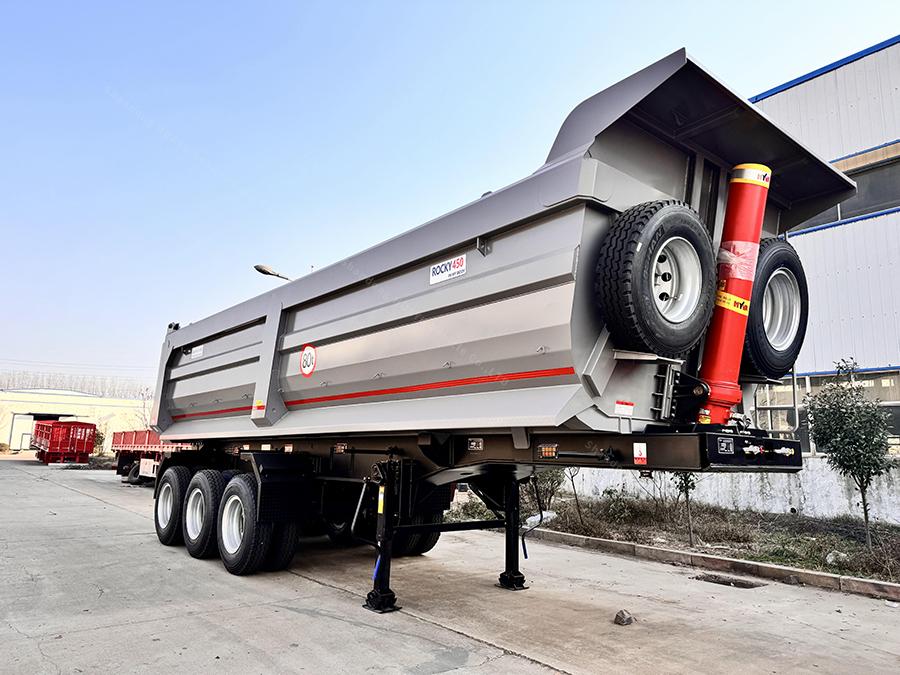
Traditional square-box trailers feature rigid 90-degree corners that absorb impact energy bluntly. When a heavy boulder strikes a flat floor, the energy has nowhere to go. This results in immediate stress on the welds and steel plates. Specifically designed to combat this mechanical flaw, a u shape dump trailer lacks harsh angles. The curved, semi-elliptical walls encourage dropped rocks to strike at an angle, slide, and settle into the belly of the tub. For instance, a 60-ton U-shape configuration actively dissipates kinetic energy over a larger surface area, drastically reducing localized denting.
Another significant advantage of the curved interior is operational efficiency. Wet dirt, jagged rocks, and sticky clay have a tendency to pack tightly into the 90-degree corners of traditional trailers. This often requires operators to aggressively jerk the vehicle to dislodge stuck material. The smooth, continuous curve of a U-shaped tub prevents material hang-ups, ensuring a fast and entirely predictable release of materials.
Understanding the relationship between cubic volume and physical weight is essential for safe rock hauling. Miscalculating this dynamic frequently causes severe equipment damage and costly regulatory fines.
In the aggregate transport industry, visual volume is highly deceptive. Three cubic yards of dry topsoil is relatively light and easy to transport. However, three cubic yards of solid granite or wet limestone carries a vastly different weight profile. Solid rock is incredibly dense. It occupies very little physical space while exerting maximum downward force on the trailer chassis.
Buyers must accurately calculate their specific hauling requirements based on material density rather than pure volume. A high-volume tub might look impressive on a specification sheet. Yet, when hauling dense rock, the axle weight ratings will reach their legal limits long before the tub is actually full. Operators are advised to choose equipment built specifically for high-weight payload dynamics.
While wall thickness and steel grade are paramount, the tub relies entirely on the supporting infrastructure beneath it. Even the thickest steel will fail if the chassis flexes or the hydraulics give out. A holistic approach to equipment evaluation is necessary when browsing industrial dump trailers for severe-duty applications.
The physical act of side dumping fundamentally shifts the vehicle center of gravity laterally. As massive weight slides to one side, immense torsional stress hits the trailer frame. To safely manage this weight transfer, the underlying frame must be exceptionally strong. Look for heavy-duty chassis beams constructed from high-yield steel and closely spaced cross-members. For massive payload demands, opting for a dump trailer for sale featuring a 3-axle, 80-ton capacity ensures the structural framework can handle extreme lateral transfer without twisting.
Hauling rock means consistently lifting the maximum legal weight limit under harsh conditions. The hydraulic system bears the entire burden of this load. Ensure the hydraulic cylinders are rated for heavy industrial use. Large-diameter, multi-stage cylinders featuring robust trunnion mounts handle lateral stress far better during the dump cycle than standard eyelet mounts.
Even the most robustly engineered steel trailers require proactive operational habits to achieve their intended lifespan. Implementing smart practices on the job site protects the walls and prevents premature failure.
Machine operators play a crucial role in equipment preservation. Whenever possible, operators should load a base layer of finer material like sand or crushed gravel into the empty tub first. This initial layer acts as a natural shock-absorbing cushion. When heavier boulders are subsequently dropped into the trailer, the cushion layer absorbs the kinetic energy, preventing the rocks from striking the bare steel directly.
Consistent preventative maintenance catches minor issues before they escalate. Operators should conduct routine visual inspections of the tub interior, looking for micro-fractures near the weld seams. The quality of the welding is the literal glue holding the steel together. Continuous, deep-penetration welds are absolutely mandatory along all critical joints. Stitch welding will quickly split under the extreme stress of dropping boulders.
Hauling rock remains one of the most demanding transport tasks in the commercial sector. The violent impact of loading boulders and the relentless sliding abrasion require equipment built to exacting standards. As outlined, the ideal wall thickness of 1/4 to 5/16 inches, paired strictly with high-tensile AR steel, is non-negotiable for true longevity.
Investing in a high-quality side dump or U-shape trailer engineered with the correct metallurgy and structural geometry will save thousands of dollars in premature repairs. By understanding payload dynamics and prioritizing a robust chassis, operators can ensure their fleet operates safely and profitably. If you are ready to upgrade your fleet with severe-duty equipment, explore the premium manufacturing solutions at Huayu Vehicle to find the exact specifications tailored for your rock hauling demands.
The best material is high-tensile Abrasion-Resistant steel, commonly designated as AR400, AR450, or Hardox. These specialized steel grades offer exceptionally high yield strength to resist denting from heavy boulder impacts, alongside a hardened surface that combats the severe sliding friction of jagged aggregates.
When engineered with 1/4-inch to 5/16-inch AR steel and maintained properly, a severe-duty side dump trailer can reliably operate for 7 to 10 years. Conversely, trailers built with standard mild steel or inadequate wall thickness may suffer catastrophic structural failures within the first few months of heavy rock hauling.
Total capacity depends heavily on the specific axle configuration and local transportation laws regarding gross vehicle weight. Typical heavy-duty side dumps handle legal payloads ranging from 20 to over 40 tons. When hauling high-density materials like solid rock, the equipment hits this maximum legal weight limit very quickly, often when the tub is only half full visually.
Yes, side dumps are generally considered safer and more efficient for heavy rock applications. Because they deposit material laterally, they maintain a much lower center of gravity throughout the entire dump cycle. This mechanical advantage virtually eliminates the risk of the trailer tipping over on uneven job sites.
Capacity visualization requires a firm understanding of material density. A standard heavy-duty trailer might easily accommodate 20 cubic yards of lightweight topsoil without straining the suspension. However, that same physical volume of mixed gravel or heavy riprap would drastically exceed legal weight limits. Operators generally load significantly fewer cubic yards of rock to ensure the axle weight remains within safe operating parameters.


